Port destinations of Belaruskali, supplies from Grodno Azot and Gomel Chemical Plant, trading and forwarding companies. The Community of Railway Workers of Belarus analyzes the volumes, product range, and organization of fertilizer export: from loading stations to port terminals, Russian and Latvian recipients, and overland routes to China.
Introduction
The Community of Railway Workers of Belarus continues its research into export transportation. Following petroleum products, liquefied petroleum gases, and petrochemical products, we are now examining fertilizers and related chemical cargo. The material is based on supplies to Russian and Latvian stations for 2025 and January–April 2026. Potash transport via Zabaikalsk, Grodekovo, and Naushki is analyzed separately.
In 2025, 214,869 railcars with 11.119 million tonnes of products were dispatched in these directions, and in January–April 2026, 73,524 railcars with 3.877 million tonnes. The average monthly tonnage increased from 926.6 thousand to 969.3 thousand tonnes. However, the overall increase conceals varying results from enterprises: without Belaruskali, the average monthly shipment was 32.1% lower than the 2025 level.
For potash, major port destinations and the organization of container transport are crucial. For nitrogen and complex fertilizers, differences are more noticeable between direct supplies from industrial enterprises, regional distribution, and shipments by intermediaries. The same railway hub often receives products from several shippers, while trading participants and delivery methods change.
The material presents 19 shippers for 2025 and eight for January–April 2026. Along with fertilizers, halite and other salts, ammonia, sulfuric acid, sulfites, cryolite, and related products from chemical enterprises are considered. Cargo mass is estimated in physical tonnes of product. Comparisons of early 2026 with 2025 refer to the average monthly intensity of transportation, not to identical months year-on-year.
The geography of railway destinations does not coincide with the geography of final consumption. Port stations provide further sea export, while non-port recipients include industrial consumers, freight forwarders, warehouses, and distribution companies. In the Chinese traffic, the eastern exits considered supplement the main corridor through Russia and Kazakhstan. Kazakh transit and further sea transportation are not included in the volumes above.
Key Points
- In 2025, 214,869 railcars and 11,118,642 estimated tonnes were dispatched in the directions under review; in January–April 2026, 73,524 railcars and 3,877,132 tonnes.
- The share of Russian port destinations increased from 81.7% to 85.7% of the mass. The main overland potash corridor to China passes through Russia and Kazakhstan; Zabaikalsk, Grodekovo, and Naushki serve other delivery branches.
- In 2025, Bronka was Belaruskali's largest destination. In January–April 2026, Luzhskaya surpassed it in mass, while Bronka retained first place in terms of railcars. In February–March, Murmansk also received potash.
- The average monthly mass increased by 4.6% relative to the average month of 2025. Without Belaruskali, it decreased by 32.1%. Grodno Azot saw a 67.0% decrease, while Gomel Chemical Plant saw a 15.2% increase.
- In Latvian supplies, ammophos replaced urea as the main cargo. The composition of shippers changed, but individual station destinations and recipients remained.
Section I. Railway Export of Belarusian Fertilizers and Related Products in 2025
1.1. Total volume, commodity structure, and geography of transport
The three largest shippers accounted for 99.2% of the tonnage. Belaruskali dispatched 193,865 railcars with 10.086 million tonnes of products, Grodno Azot – 13,155 railcars with 563.7 thousand tonnes, and Gomel Chemical Plant – 6,303 railcars with 380.9 thousand tonnes. Other participants account for less than one percent of the mass. Nevertheless, their shipments reveal specific sales and forwarding channels not limited to direct factory shipments.
| Shipper | 2025, railcars | 2025, tonnes | Jan.–Apr. 2026, railcars | Jan.–Apr. 2026, tonnes |
|---|---|---|---|---|
| Belaruskali | 193,865 | 10,086,059 | 69,957 | 3,643,500 |
| Grodno Azot | 13,155 | 563,672 | 1,055 | 62,000 |
| Gomel Chemical Plant | 6,303 | 380,944 | 2,138 | 146,290 |
| Other shippers | 1,546 | 87,967 | 374 | 25,342 |
| Total | 214,869 | 11,118,642 | 73,524 | 3,877,132 |
To Russian port stations, 177,870 railcars with 9.082 million tonnes were dispatched – 81.7% of the total mass. Non-port Russian destinations received 31,416 railcars with 1.857 million tonnes. Through Zabaikalsk, Grodekovo, and Naushki, 4,802 railcars with 134.5 thousand tonnes of potash products proceeded to China. Latvia accounted for 781 railcars with 45.6 thousand tonnes, including 470 railcars to port destinations.
The Russian direction combines two different types of cargo flow. Port export is concentrated at several stations receiving large volumes of potash. Non-port supplies are distributed across industrial and agricultural regions; here, the diversity of cargo and recipients is higher. The Latvian flow is significantly smaller but also concentrates in specific hubs – primarily Riga, Liepaja, and Daugavpils.
Potassium chloride, including container shipments, amounted to 9.063 million tonnes. The next largest single item by mass is halite, 984.9 thousand tonnes. These cargoes differ not only in intended use but also in transportation geography: potassium chloride forms the main export flow to sea terminals, while halite predominates in Belaruskali's non-port supplies to Russia.
1.2. JSC Belaruskali
The main loading stations for Belaruskali were Kaliy III – 85,991 railcars, Kaliy I – 59,541, Kaliy IV – 37,145, and Mulyarovka – 11,080. Another 108 railcars were dispatched from Mogilev II. Thus, almost the entire railcar flow of the enterprise was formed at four specialized stations, from where products were distributed among ports, industrial destinations, and the Chinese direction.

Export to third countries via Russian ports
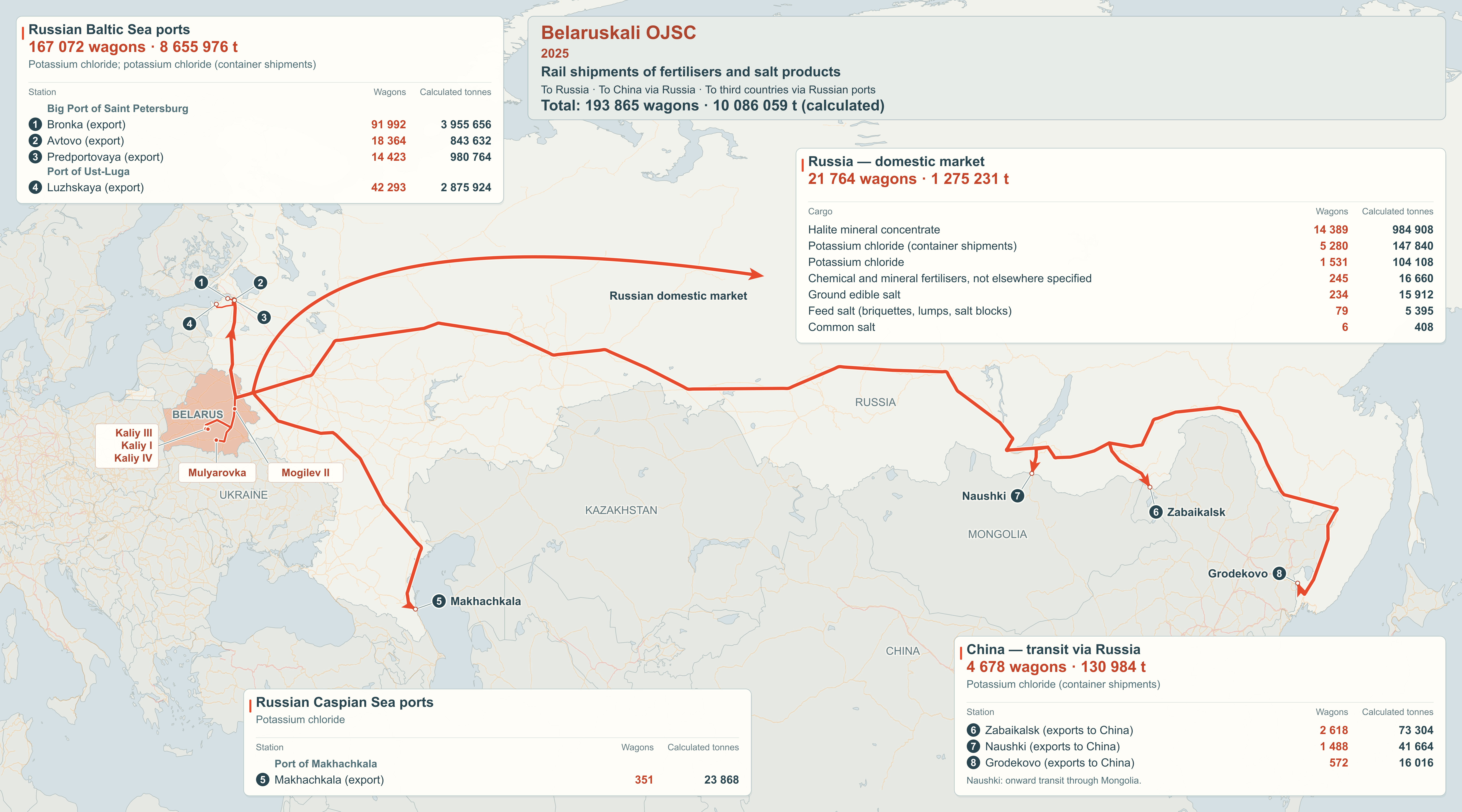
To Russian port stations, 167,423 railcars with 8.680 million tonnes were sent, or 86.1% of the enterprise's total shipments. The flow was concentrated at Bronka, Luzhskaya, Predportovaya, and Avtovo. Makhachkala supplemented this scheme, but its volume – 351 railcars with 23.9 thousand tonnes – accounted for less than three-tenths of a percent of the port tonnage.
Bronka. LLC Phoenix received 91,992 railcars with 3.956 million tonnes of potassium chloride in bulk containers. This is the enterprise's largest destination for 2025, both by railcars and by mass. Phoenix is a terminal operator: the container train completes its railway leg of export delivery here, after which the cargo undergoes port handling.
Each railcar heading to Bronka carries two bulk containers with a total estimated mass of 43 tonnes. For comparison, potash arrived at Luzhskaya with a estimated load of 68 tonnes per railcar. Such a difference in transportation method directly affects the railcar flow: the same tonnage corresponds to different rolling stock needs and volumes of station work.
Luzhskaya. The station received 42,293 railcars with 2.876 million tonnes. The recipient is LLC Kontuber, a company for customs support for imports, exports, and transit. Here, the recipient performs a different function than the operator Phoenix at Bronka: along with railway delivery, specialized customs service is present in the chain.
Bronka accounted for 54.9% of Belaruskali's port destination railcars, but 45.6% of its mass. For Luzhskaya, the ratio is reversed: 25.3% of railcars and 33.1% of tonnage. Together, the two stations received 6.832 million tonnes – 78.7% of the enterprise's total port shipments.
Predportovaya. 14,423 railcars with 980.8 thousand tonnes were shipped to the station addressed to JSC Port Cargo Service. The company has its own sidings, handles bulk cargo from hoppers, and organizes delivery to St. Petersburg sea terminals. In this case, railway unloading and vessel loading may be performed at different sites.
Predportovaya represents an intermediate link in port delivery: railcars are supplied to the cargo complex, products undergo transshipment, then are transported to the sea terminal. This organization allows the use of station and warehouse infrastructure beyond the berth front. Through one recipient at Predportovaya in 2025, almost 981 thousand tonnes of potash passed – 11.3% of the enterprise's port mass.
Avtovo. 18,364 railcars with 843.6 thousand tonnes were dispatched. The main receiving site operated under the name BasisPort; on December 19, 2024, Terminal Morskoy Rybny Port announced its transition to this brand.
The Avtovo flow combined two technologies: 8,236 railcars with 560.0 thousand tonnes of potassium chloride and 10,128 railcars with 283.6 thousand tonnes of containerized cargo. Container transport accounted for 55.2% of railcars but 33.6% of the mass. By this ratio, Avtovo differs both from Bronka with its bulk container export and from Luzhskaya, where the entire potash flow is represented by non-containerized shipments.
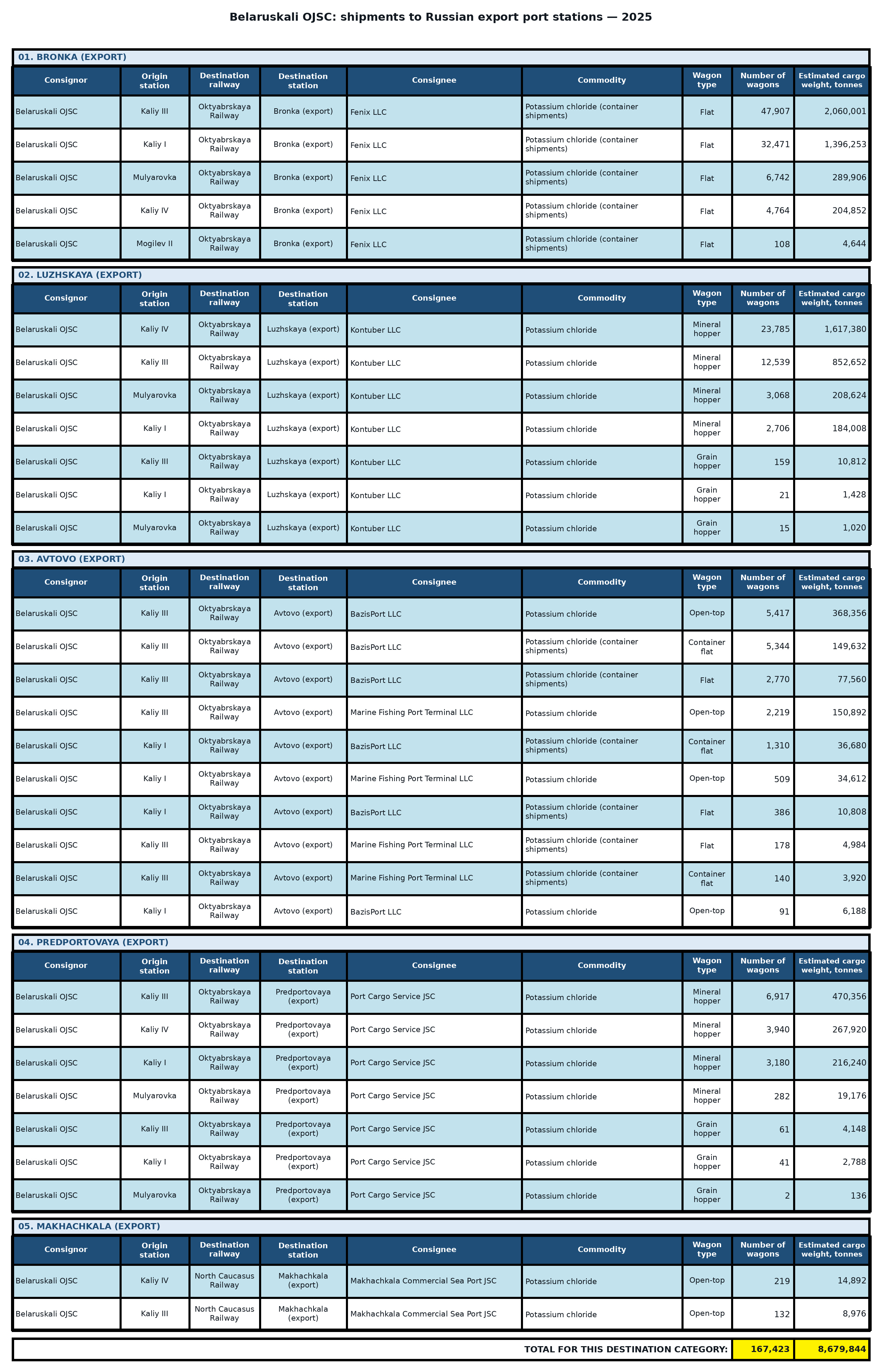
Bronka and Luzhskaya not only topped the list of destinations: they accounted for the main part of port operations with potash. Predportovaya and Avtovo supplemented the export with other transshipment schemes, while Makhachkala received a significantly smaller flow. To redistribute products among these exits, it is necessary to coordinate not only railway delivery but also the unloading method, container provision, warehousing, and berth operations.
Supplies to the Russian Federation
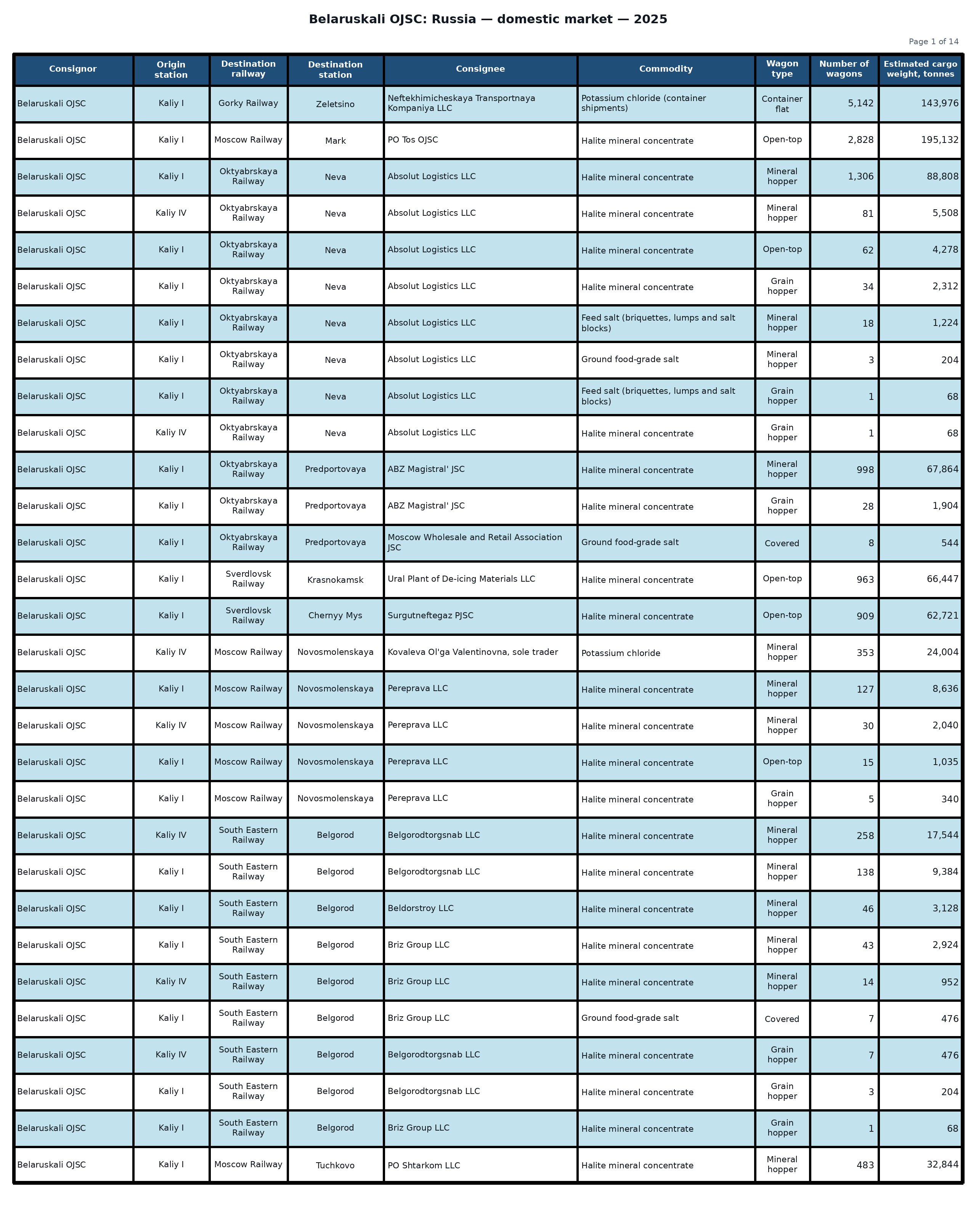
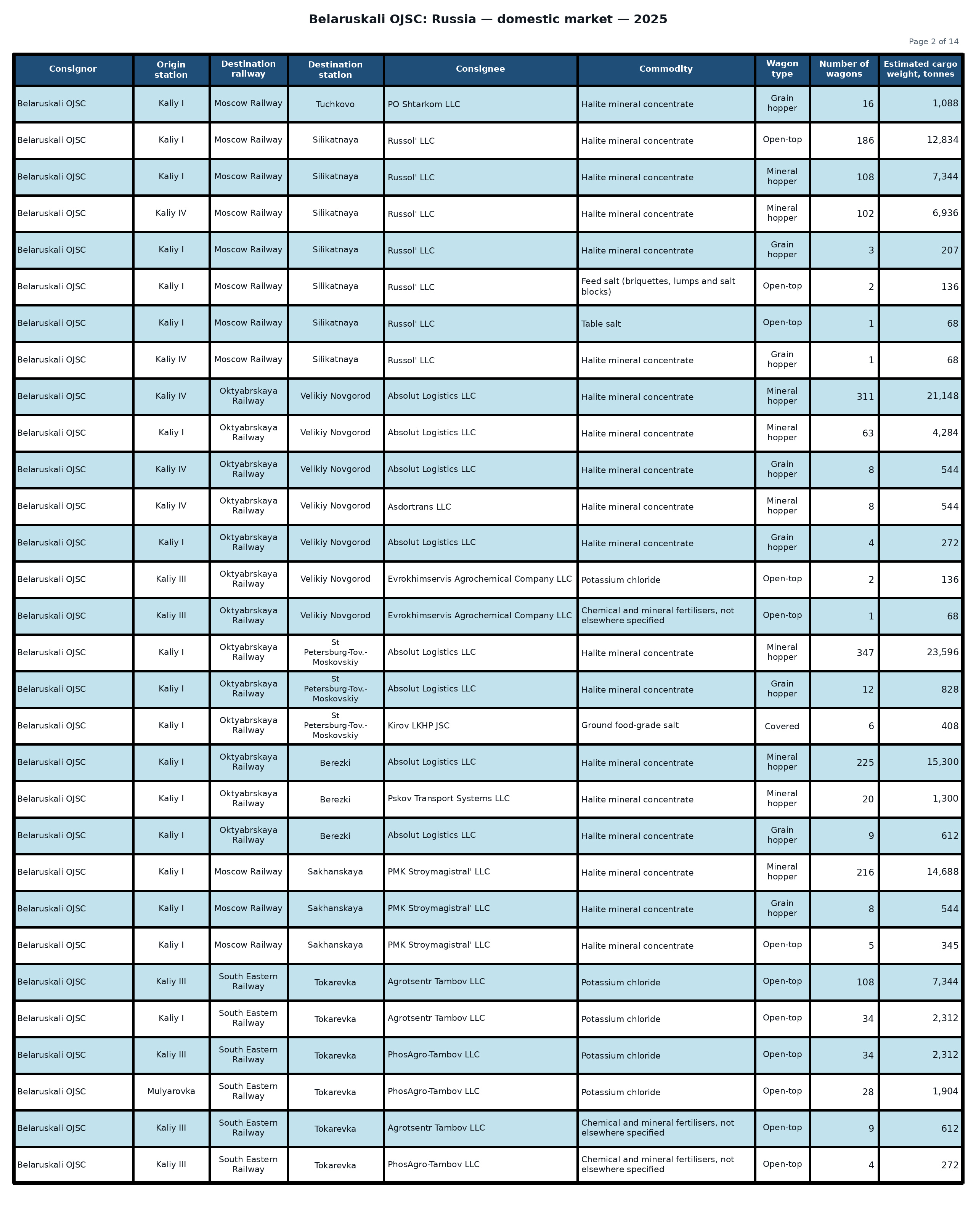
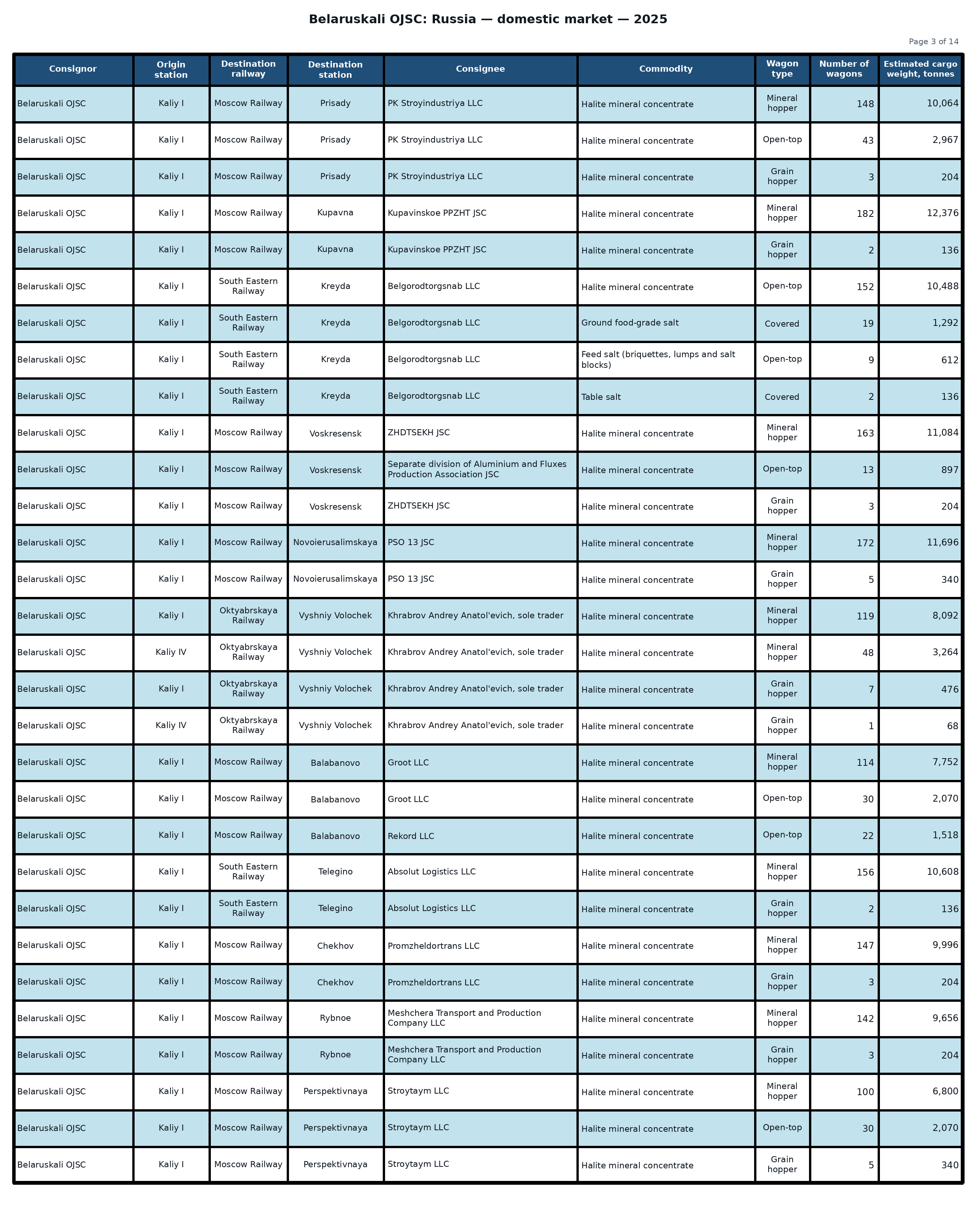
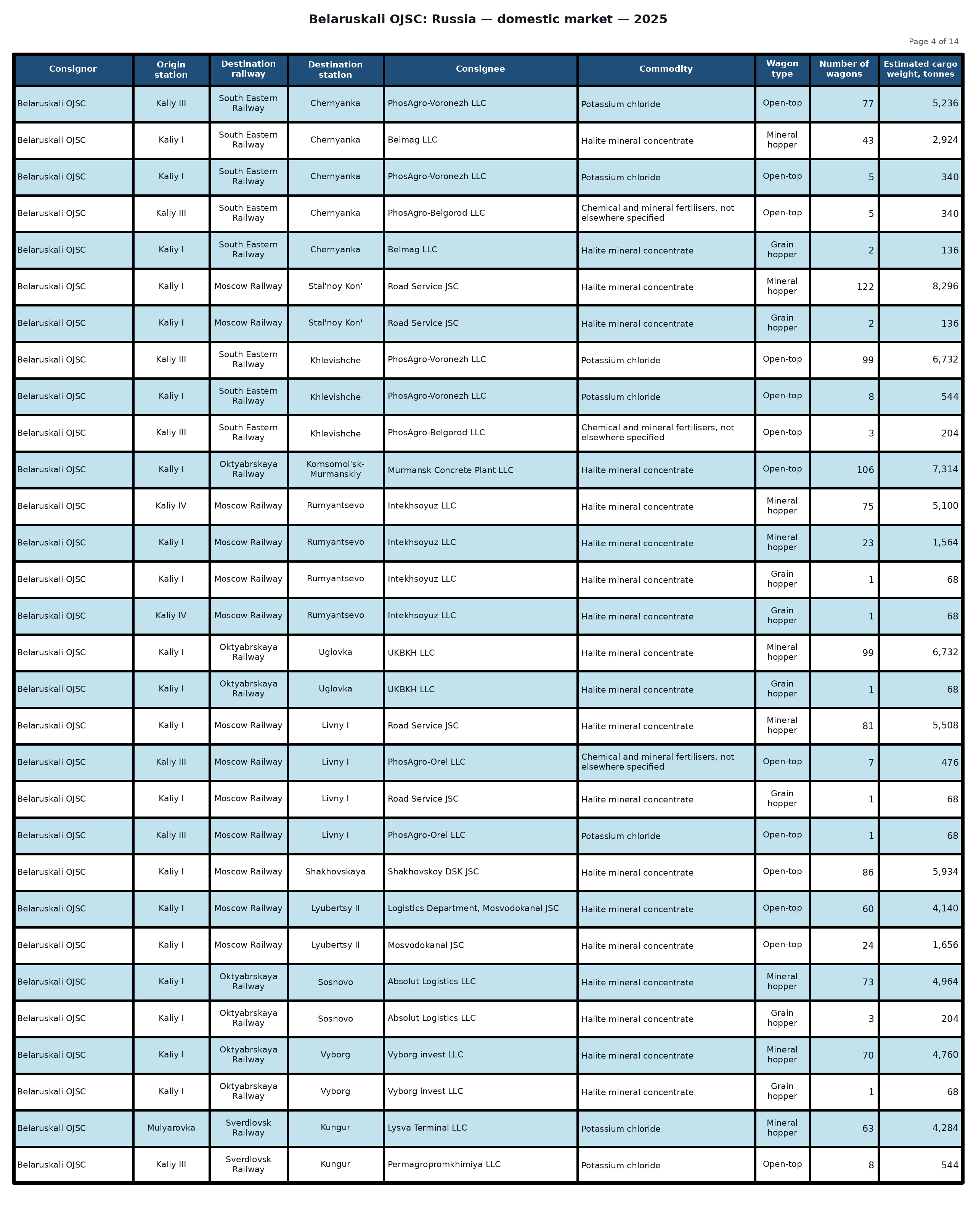
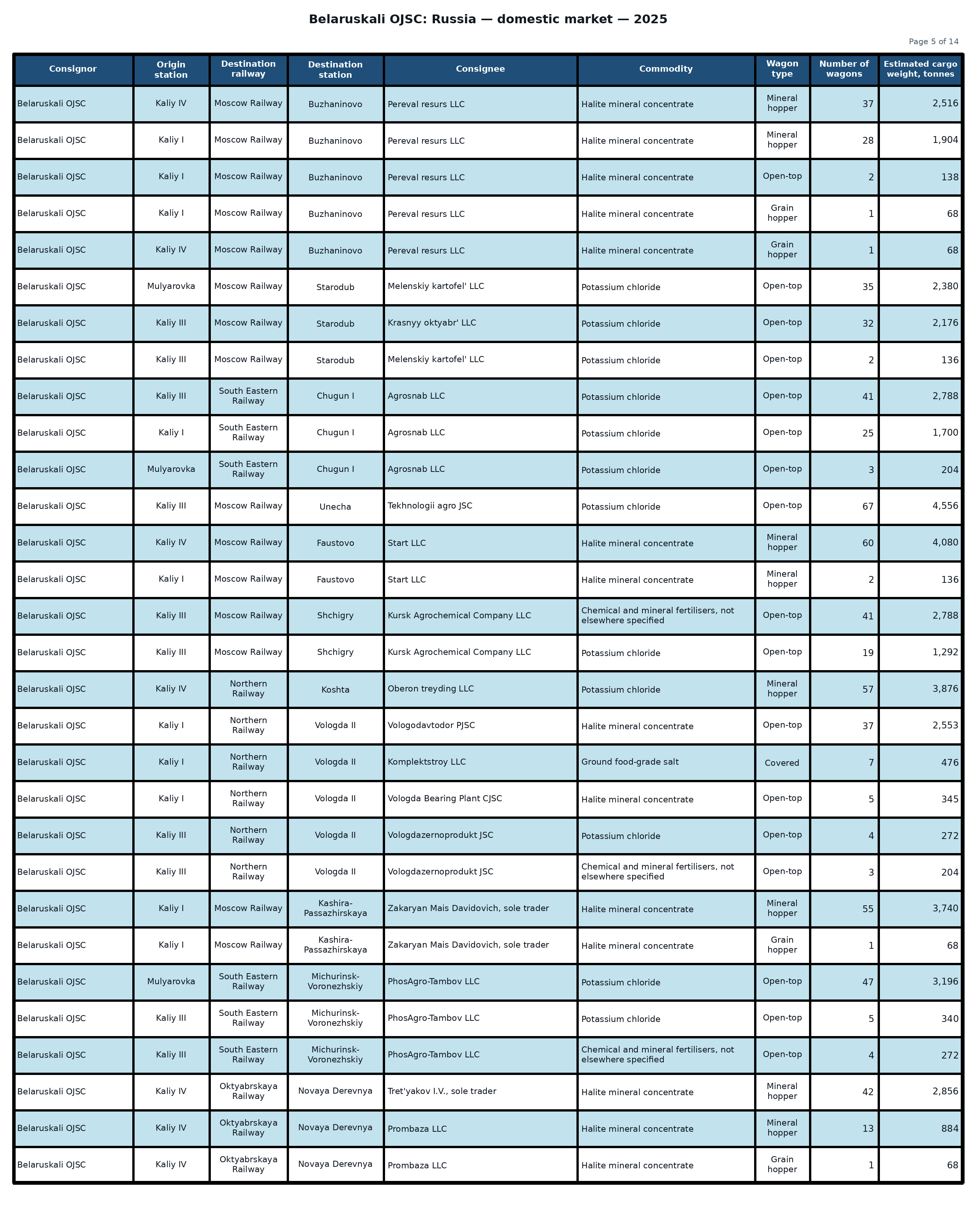
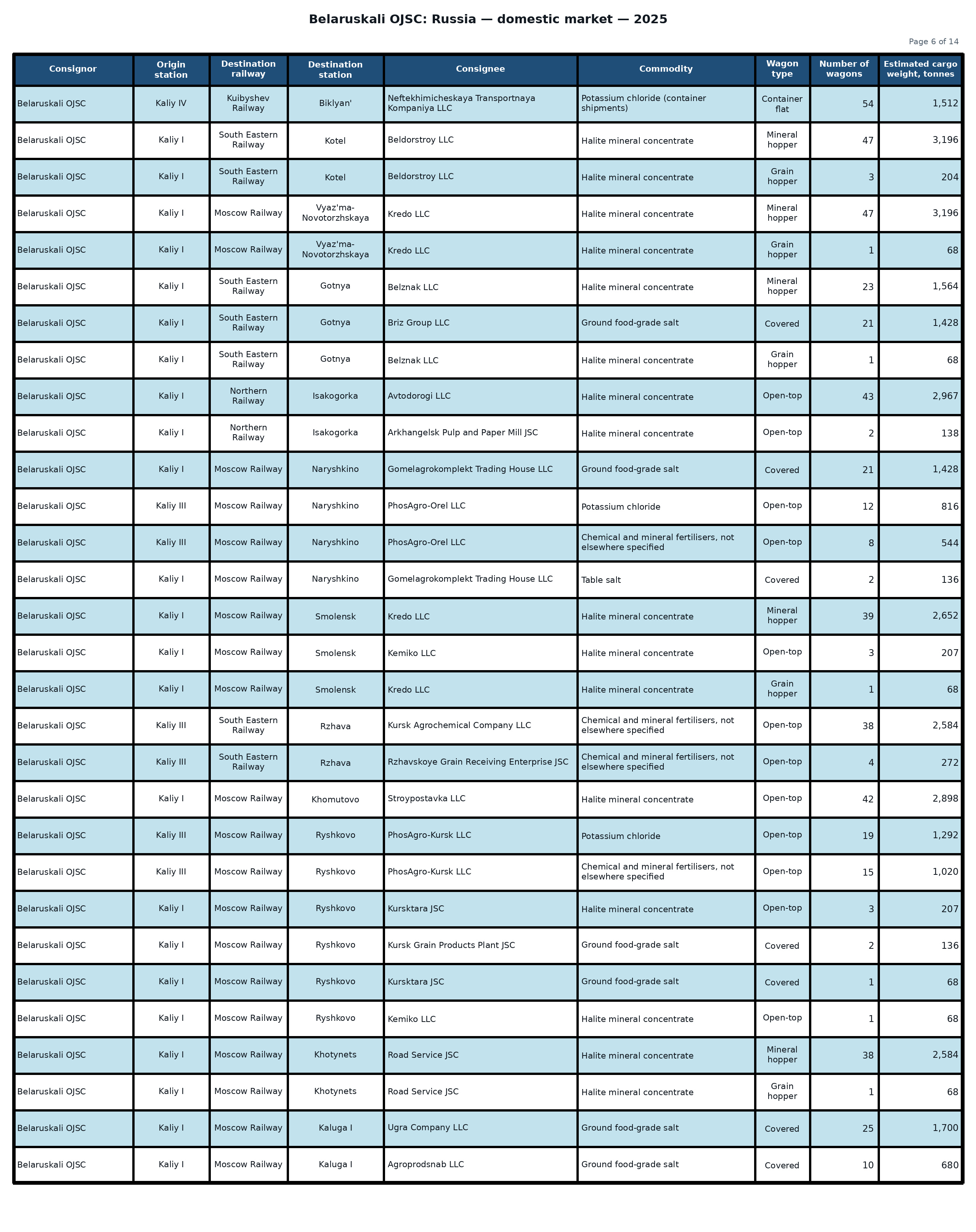
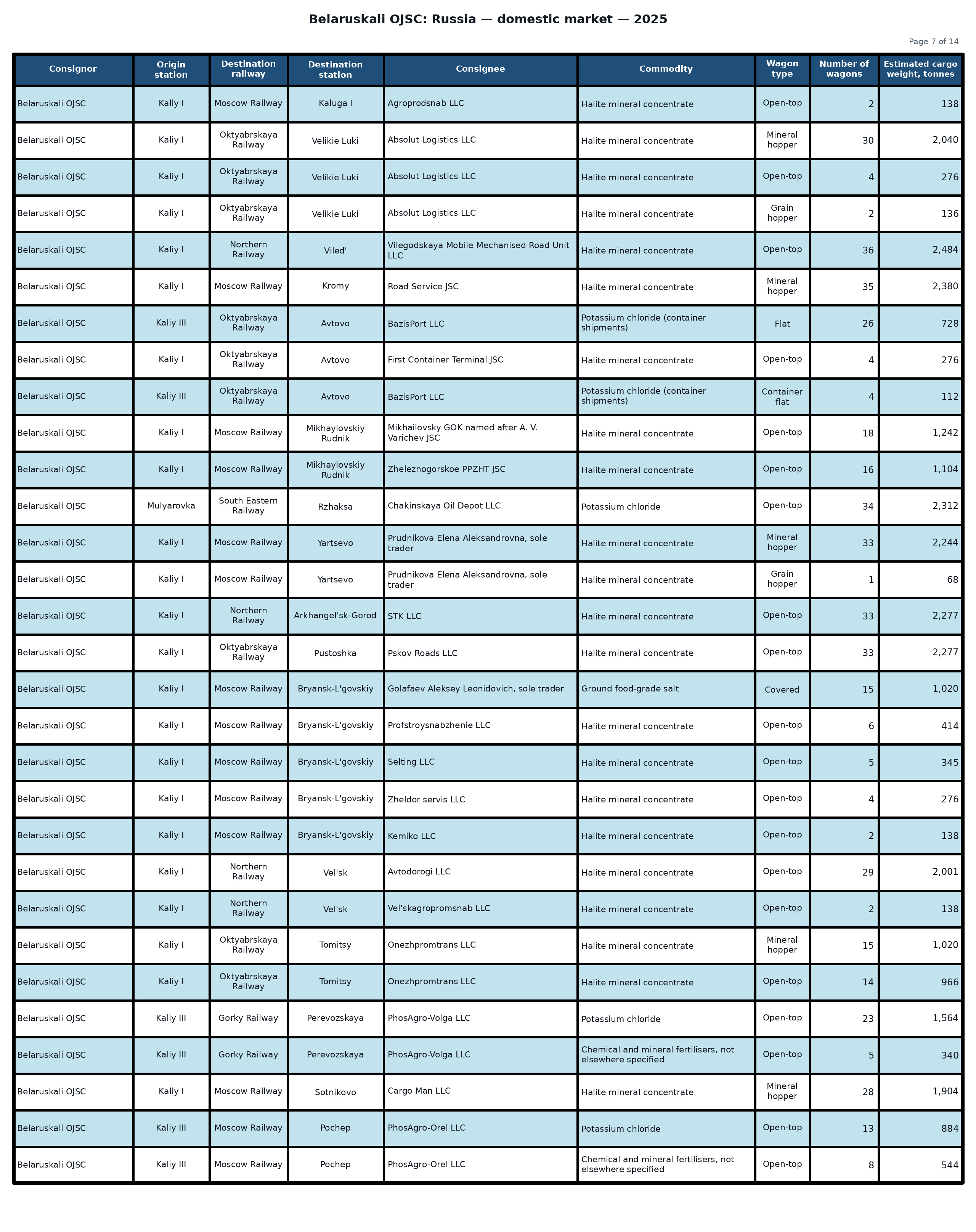
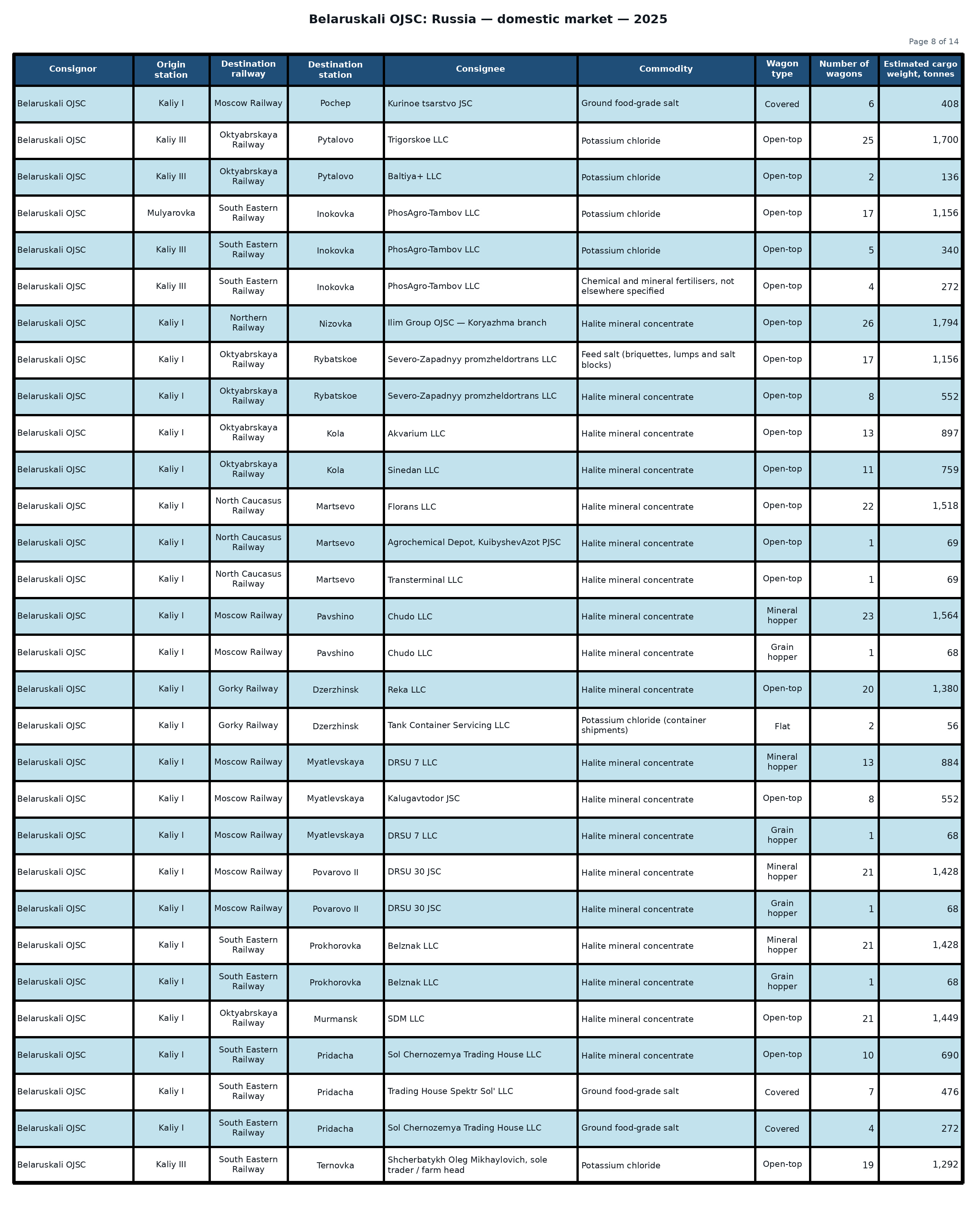
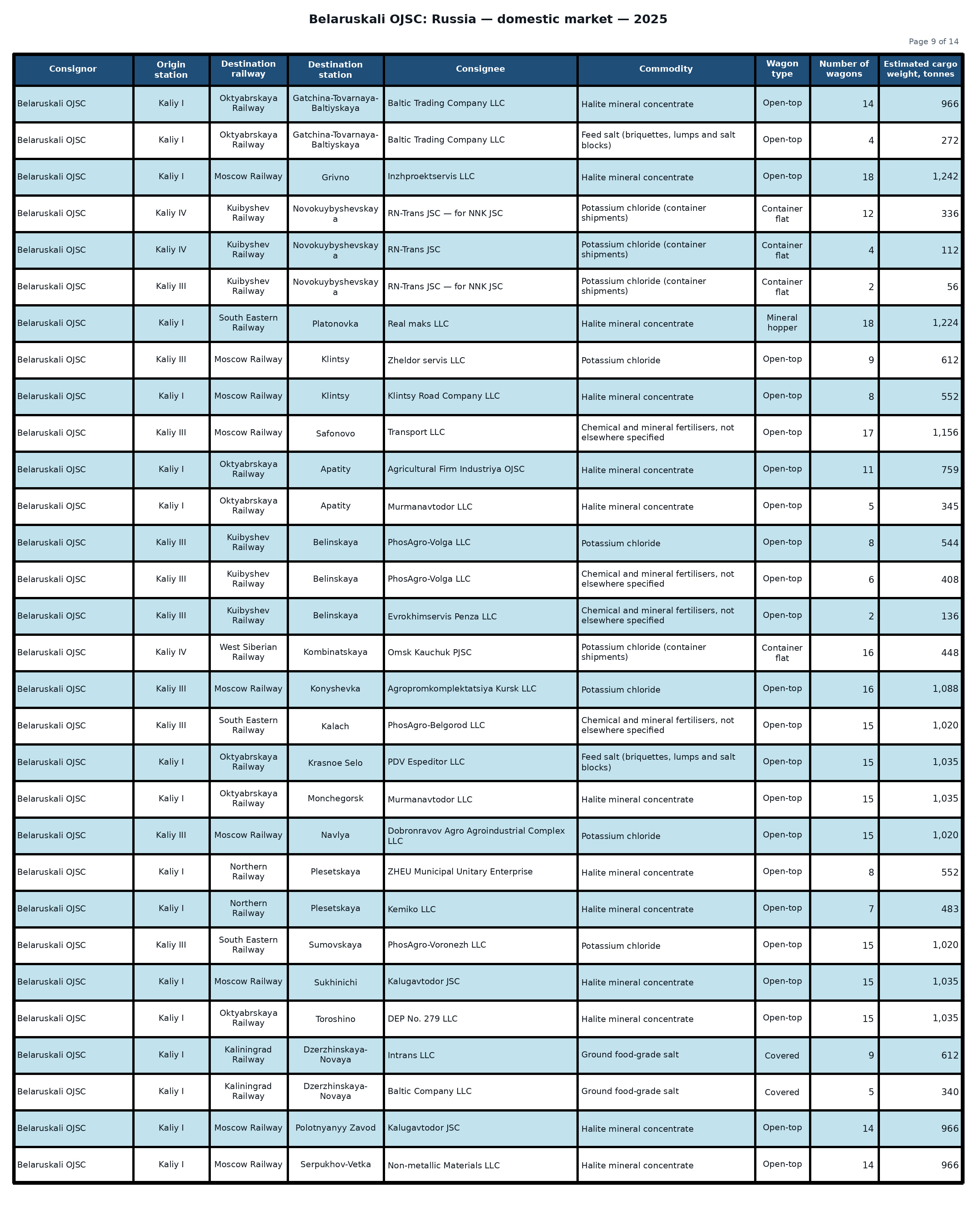
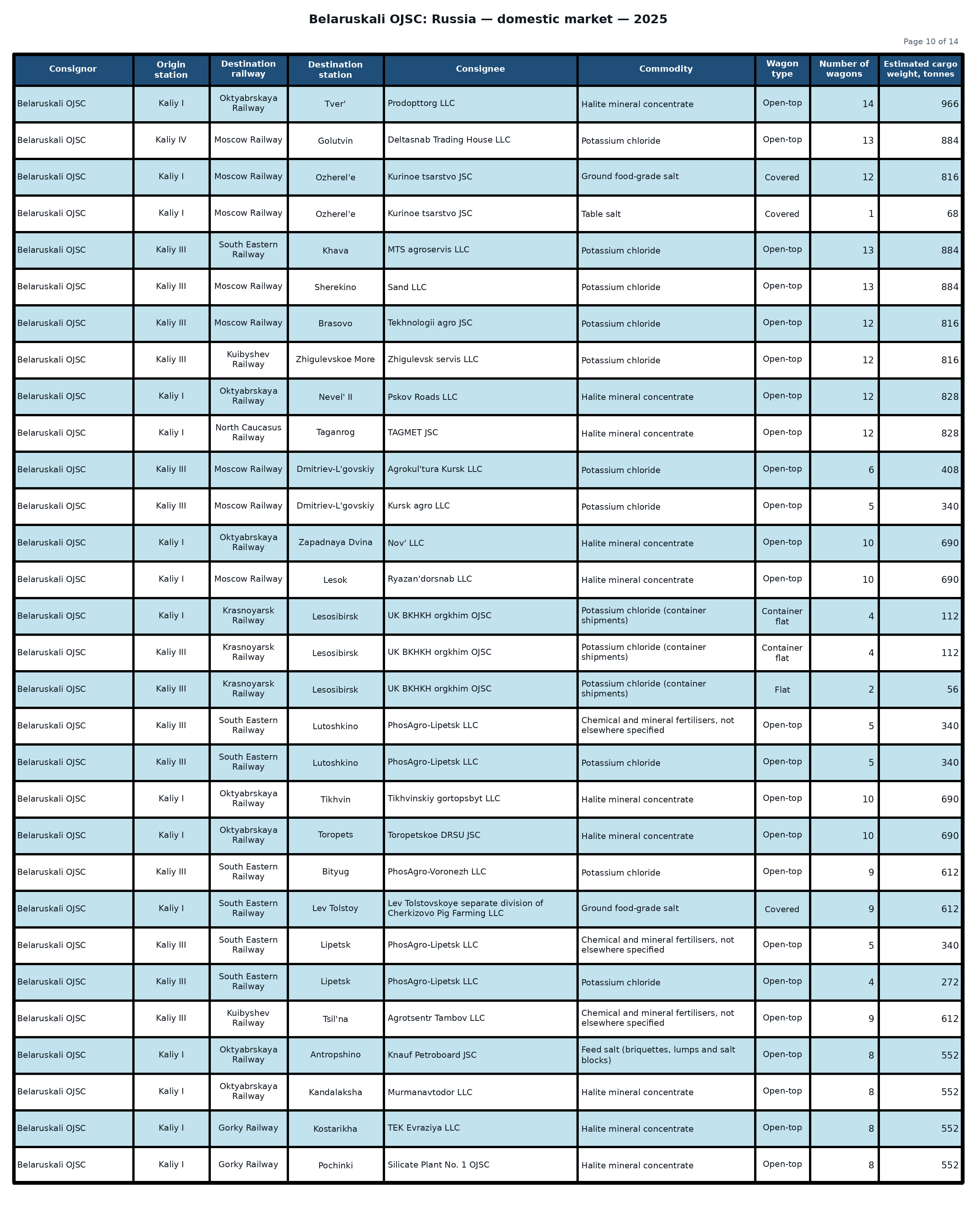
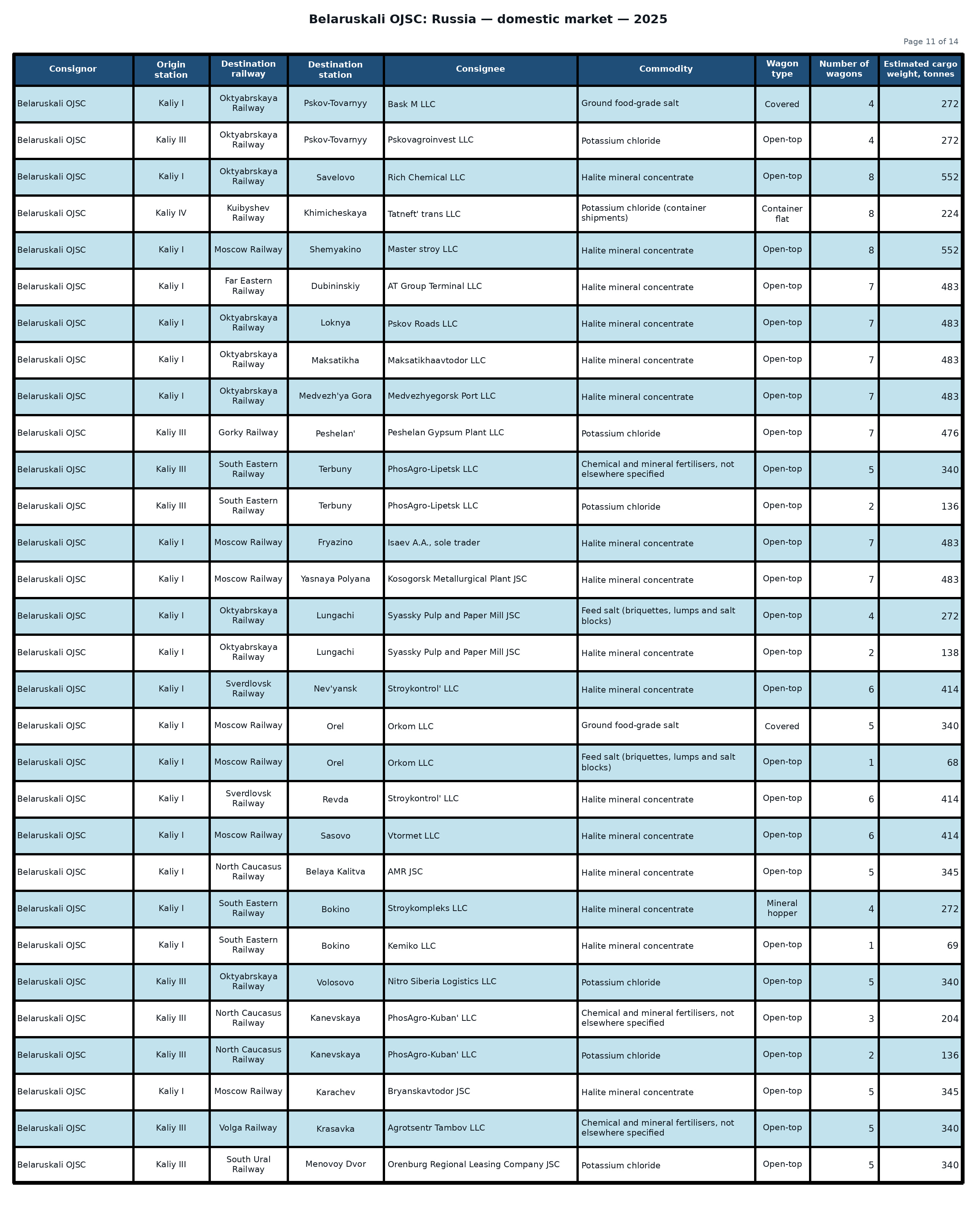
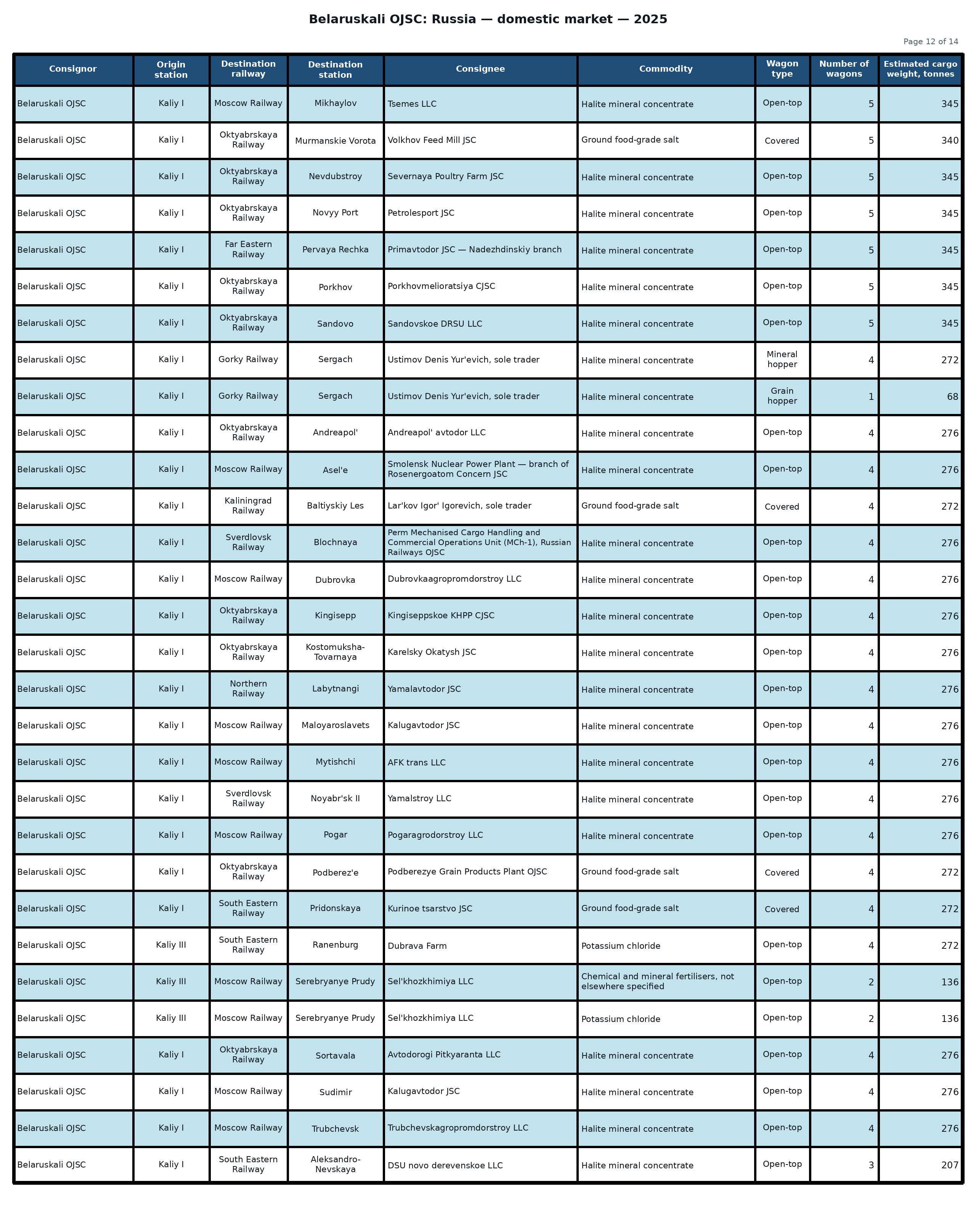
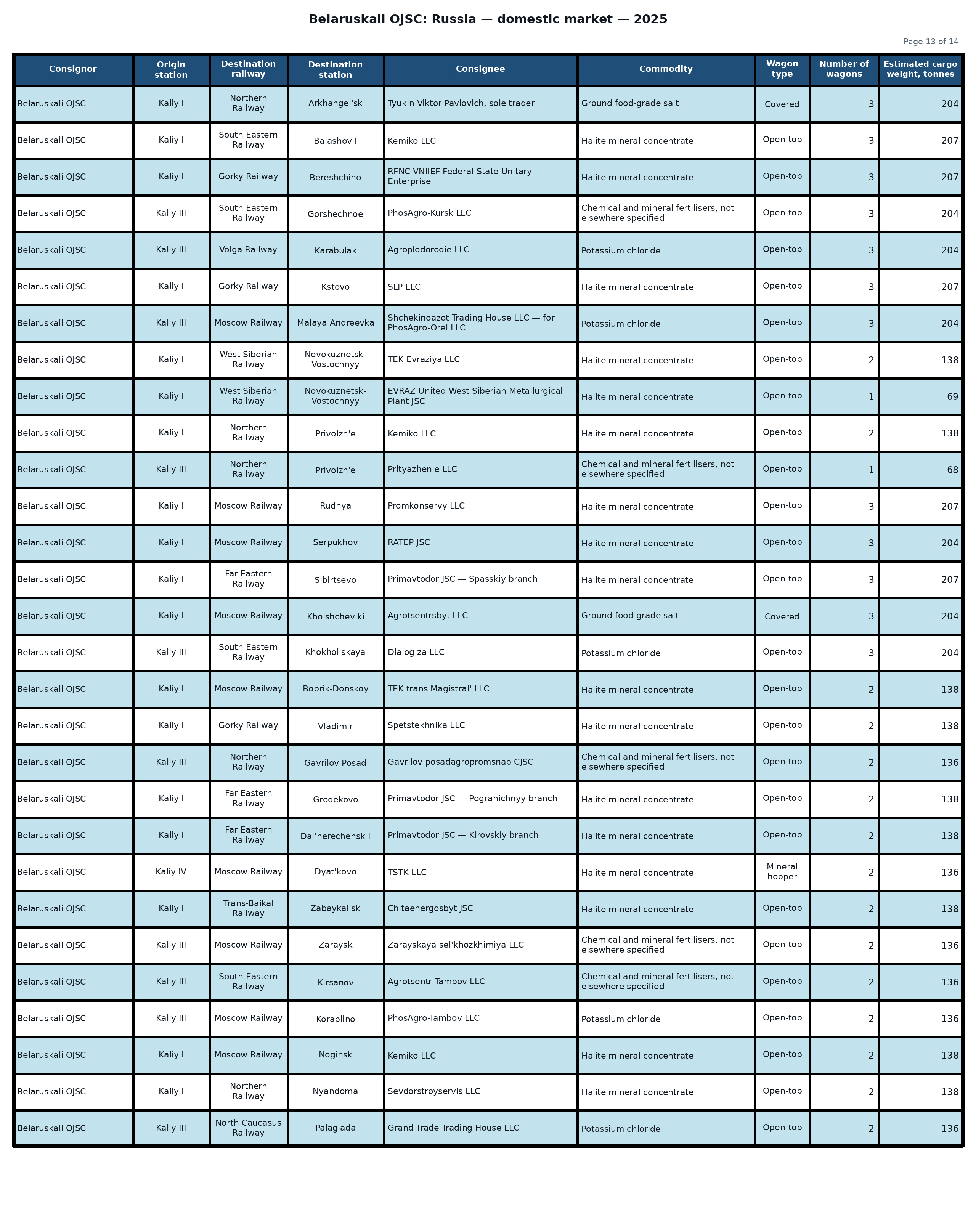
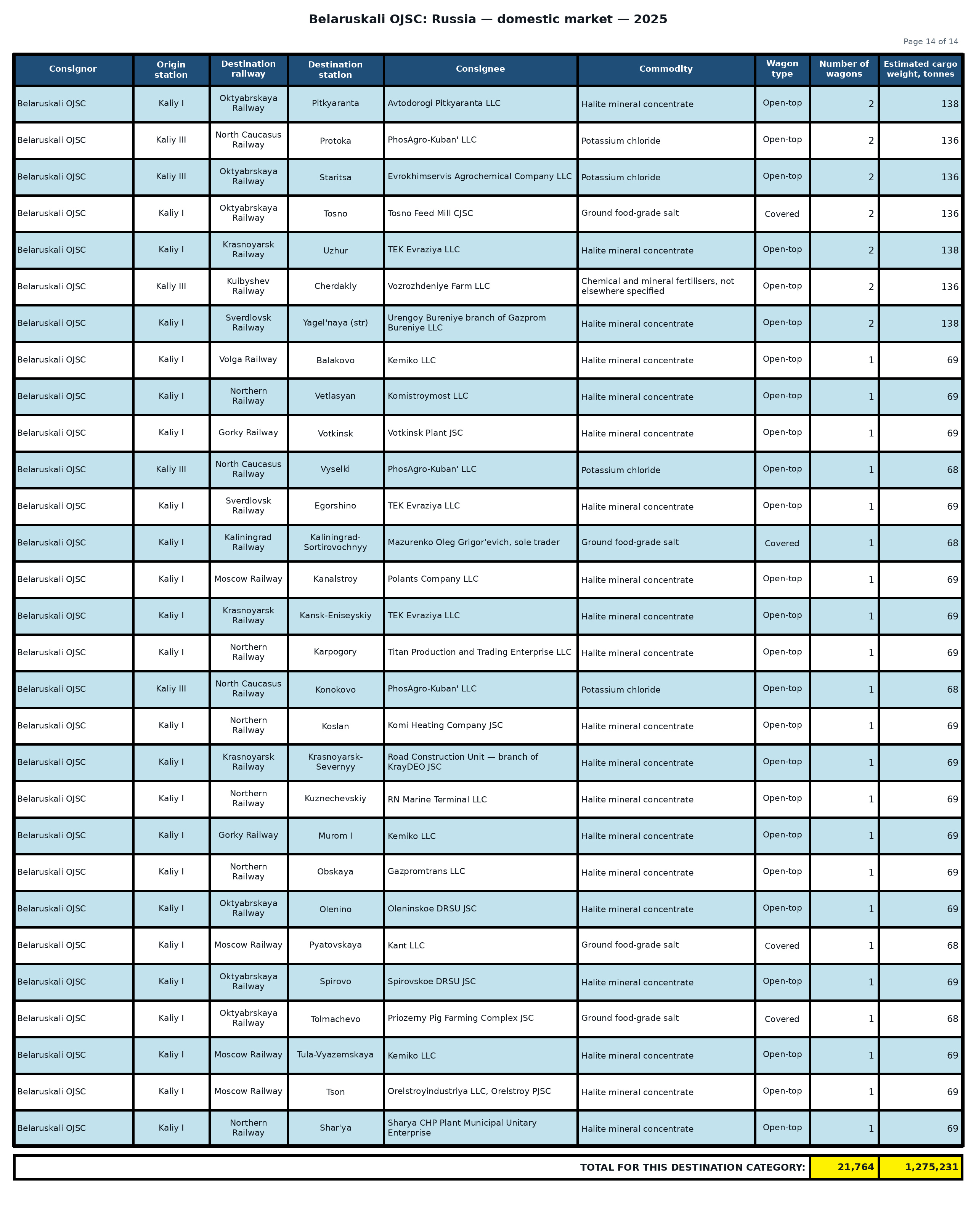
To Russian non-port destinations, Belaruskali dispatched 21,764 railcars with 1.275 million tonnes of products. Halite accounted for 984.9 thousand tonnes – 77.2% of the mass in this direction. Potassium chloride accounted for 251.9 thousand tonnes, other mineral fertilizers for 16.7 thousand tonnes, and food, feed, and table salts for another 21.7 thousand tonnes.
Unlike port export, these supplies were distributed among numerous industrial, transport, and trading recipients. Large volumes of halite were received by Absolut Logistika and PO TOS. In the potash segment, on the contrary, one transport recipient stands out with a high concentration at a specific station destination.
LLC Neftekhimicheskaya Transportnaya Kompaniya received 5,142 railcars with 144.0 thousand tonnes of containerized potassium chloride at Zeletsino. Another 54 railcars with 1.5 thousand tonnes were sent to the same company at Biklyan. NHTK is engaged in transport and forwarding services and rolling stock operations.
Zeletsino accounted for almost 99% of containerized potash addressed to NHTK. Consequently, behind the broad geography of Russian non-port supplies, large concentrated flows are also hidden: the distribution of halite across the network coexists with potash shipments to a single forwarding recipient, predominantly to one station.
Export of potash products to China
The main overland corridor for delivering Belarusian potash to China passes through Russia and Kazakhstan. The Community of Railway Workers of Belarus noted the leading role of Kazakh transit back in its review of transportation for January–September 2024. Zabaikalsk, Grodekovo, and Naushki serve other branches of the Chinese direction; their volumes do not characterize the entire railway export of potash to the PRC.
The technology of the Kazakh route can be traced in a specific example described by the Community of Railway Workers of Belarus in April 2024: potassium chloride from Kaliy III station in 20-foot containers was included in an export train at Kolyadichi. At Dostyk, transshipment of containers from 1520 mm gauge flatcars to 1435 mm gauge rolling stock was envisaged for further delivery to Xi'an. Here, not only the length of the railway leg is important, but also the formation of the container train, transfer between carriers, and the operation of the transshipment complex at the border with China.
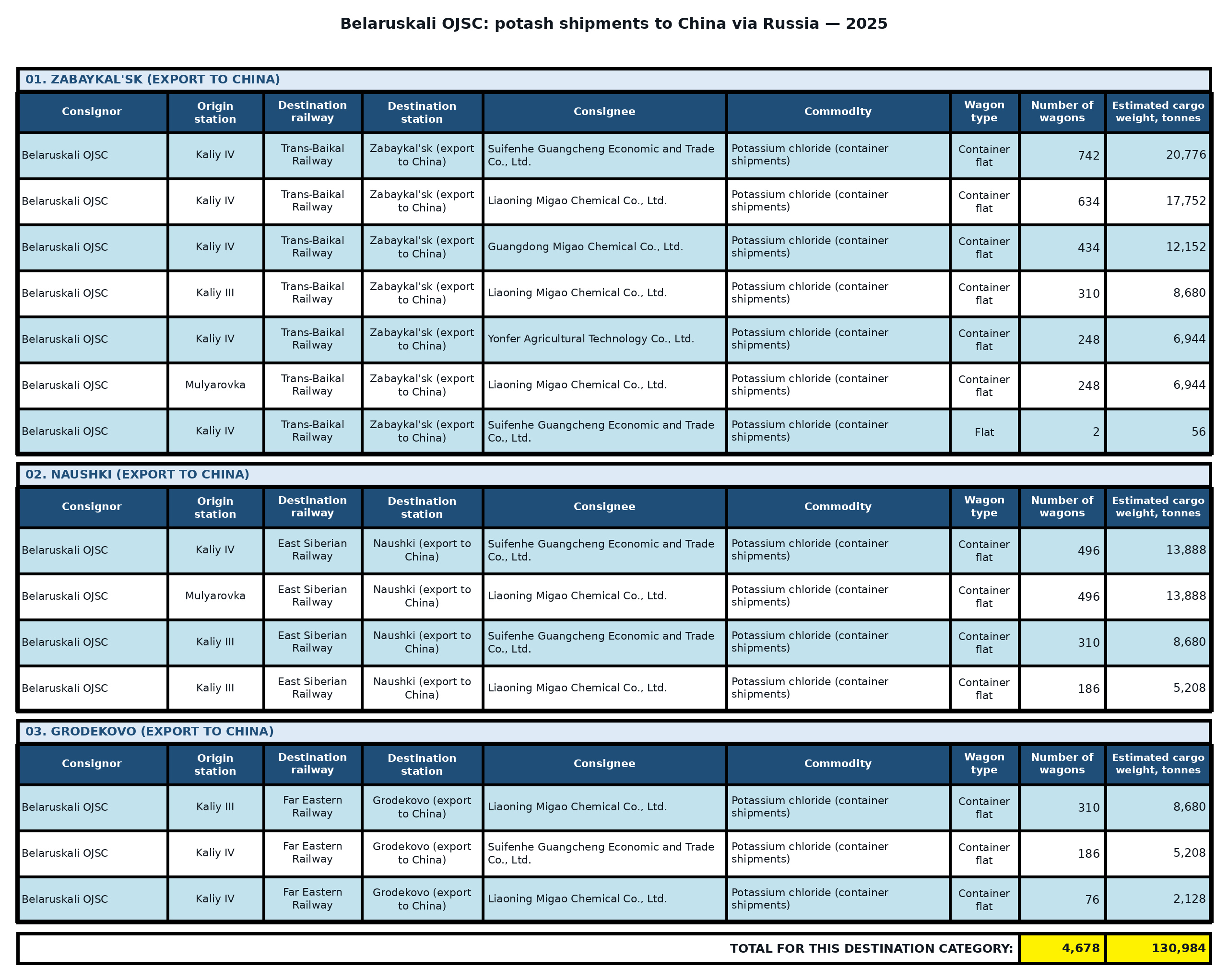
Through the three eastern exits of the Russian network, Belaruskali dispatched 4,678 railcars with 131.0 thousand tonnes in 2025: via Zabaikalsk – 2,618 railcars, via Naushki – 1,488, via Grodekovo – 572. Recipients include Liaoning Migao Chemical Co., Ltd., Suifenhe Guangcheng Economic and Trade Co., Ltd., Guangdong Migao Chemical Co., Ltd., and Yonfer. Zabaikalsk and Grodekovo provide exits to the Chinese network; Naushki – to the Mongolian network. In the latter case, the cargo travels along the Ulaanbaatar Railway to the Chinese border station Erlian.
1.3. JSC Belarusian Potash Company
The Belarusian Potash Company dispatched 124 railcars with 3,472 tonnes of containerized potash products from Kolyadichi. The entire volume was sent via Naushki to Liaoning Migao Chemical Co., Ltd. These supplies supplemented Belaruskali's shipments along the Mongolian corridor.
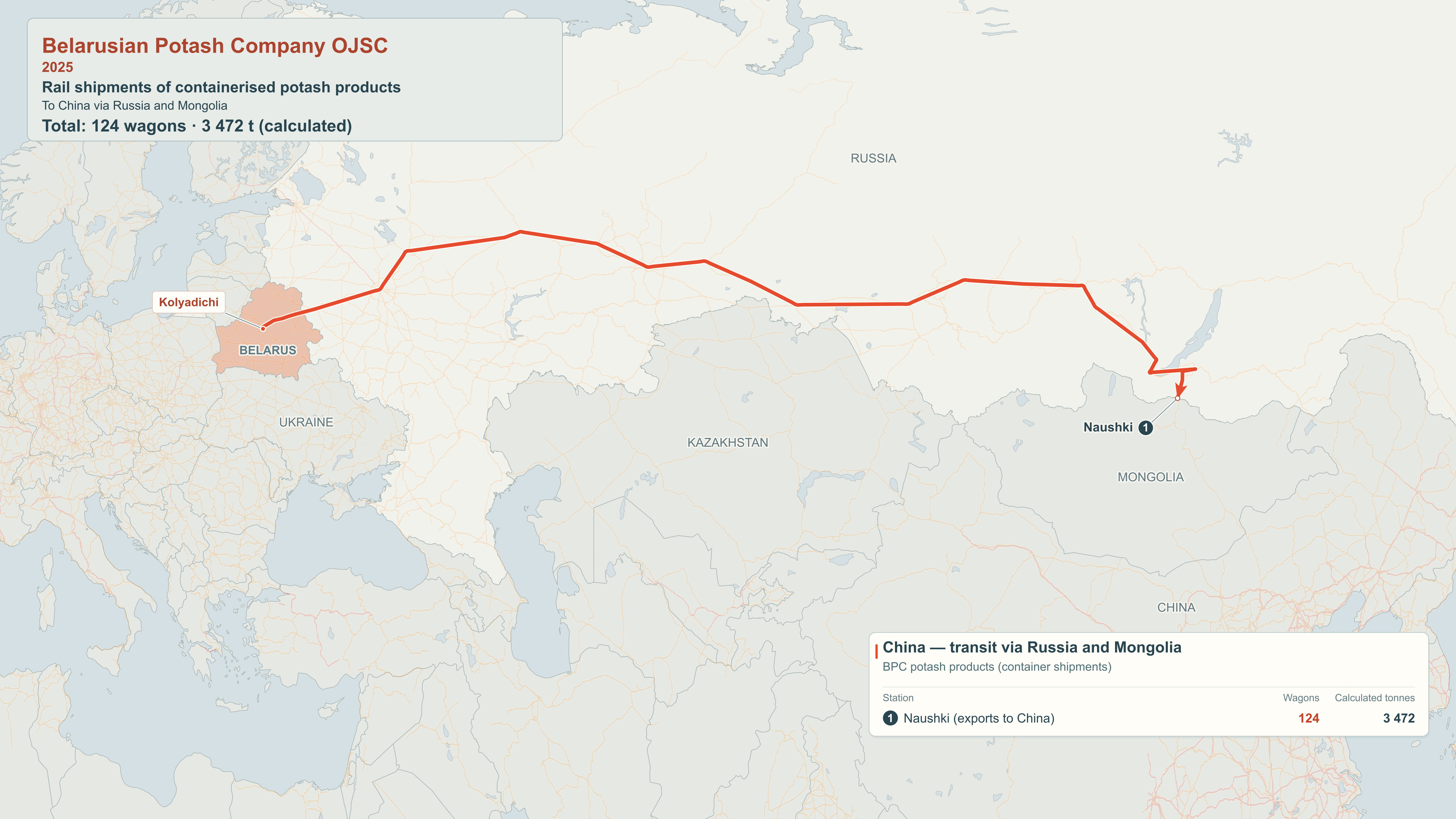
Kolyadichi serves as a container train formation hub: cargo loaded at the production site can arrive here for further dispatch as part of an export route. In BPC's 2025 shipments, Kolyadichi was the departure station, and the Russian-Mongolian crossing Naushki was the only border exit.

Together, Belaruskali and BPC sent 4,802 railcars with 134,456 tonnes through the three eastern border stations. Naushki, considering both shippers, received 1,612 railcars; the remaining volume passed through Zabaikalsk and Grodekovo. The Kazakh corridor represents a separate branch of Chinese logistics and is not included in these 134.5 thousand tonnes.
1.4. JSC Grodno Azot
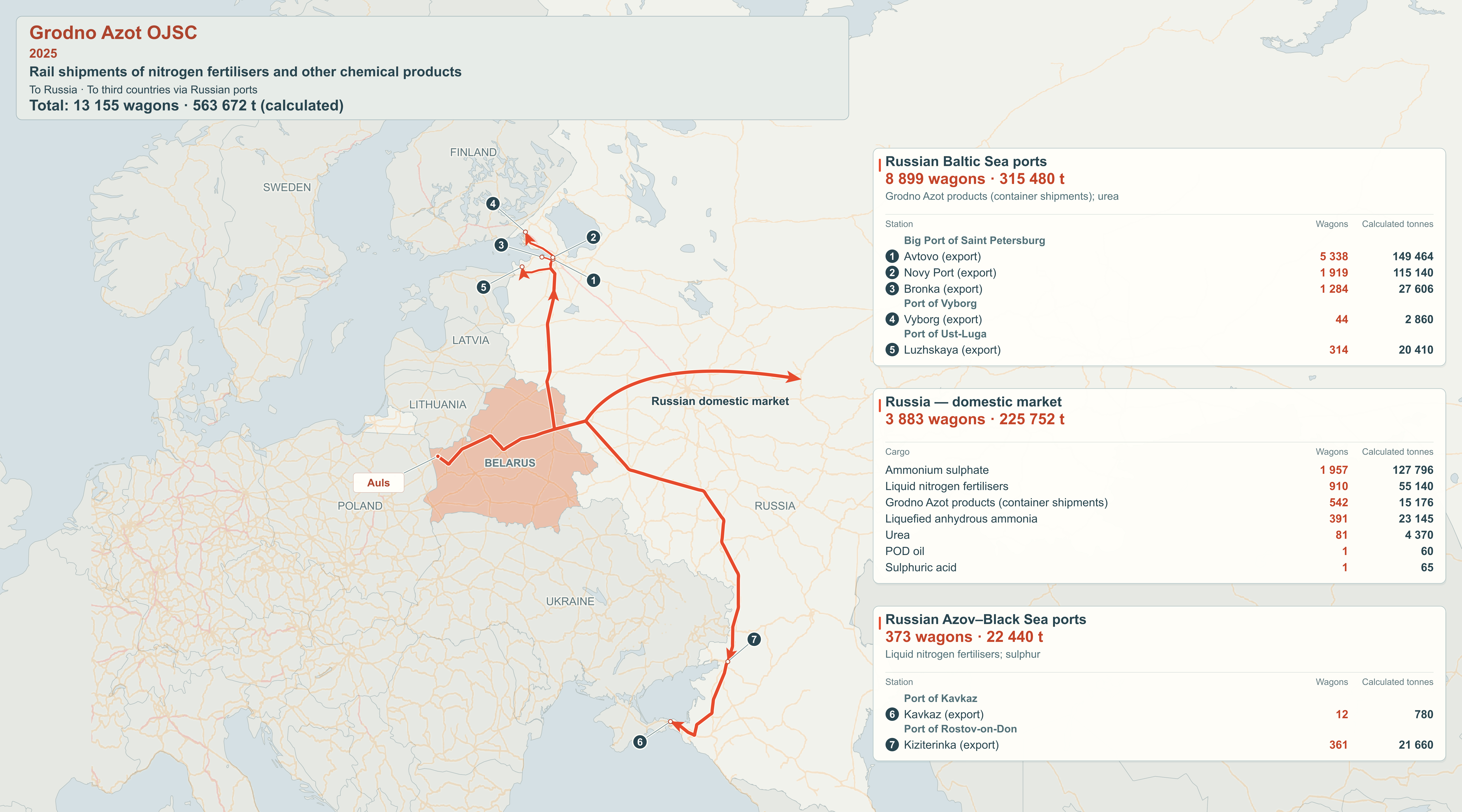
From Auls station, Grodno Azot dispatched 13,155 railcars with 563,672 tonnes of products. The cargo flow is significantly more diverse than potash: container transport accounted for 192.2 thousand tonnes, urea – 142.8 thousand, ammonium sulfate – 127.8 thousand, liquid nitrogen fertilizers – 76.8 thousand, anhydrous liquefied ammonia – 23.1 thousand tonnes. Small batches of sulfur, sulfuric acid, and POD oil accounted for another 905 tonnes.
Export to third countries via Russian ports
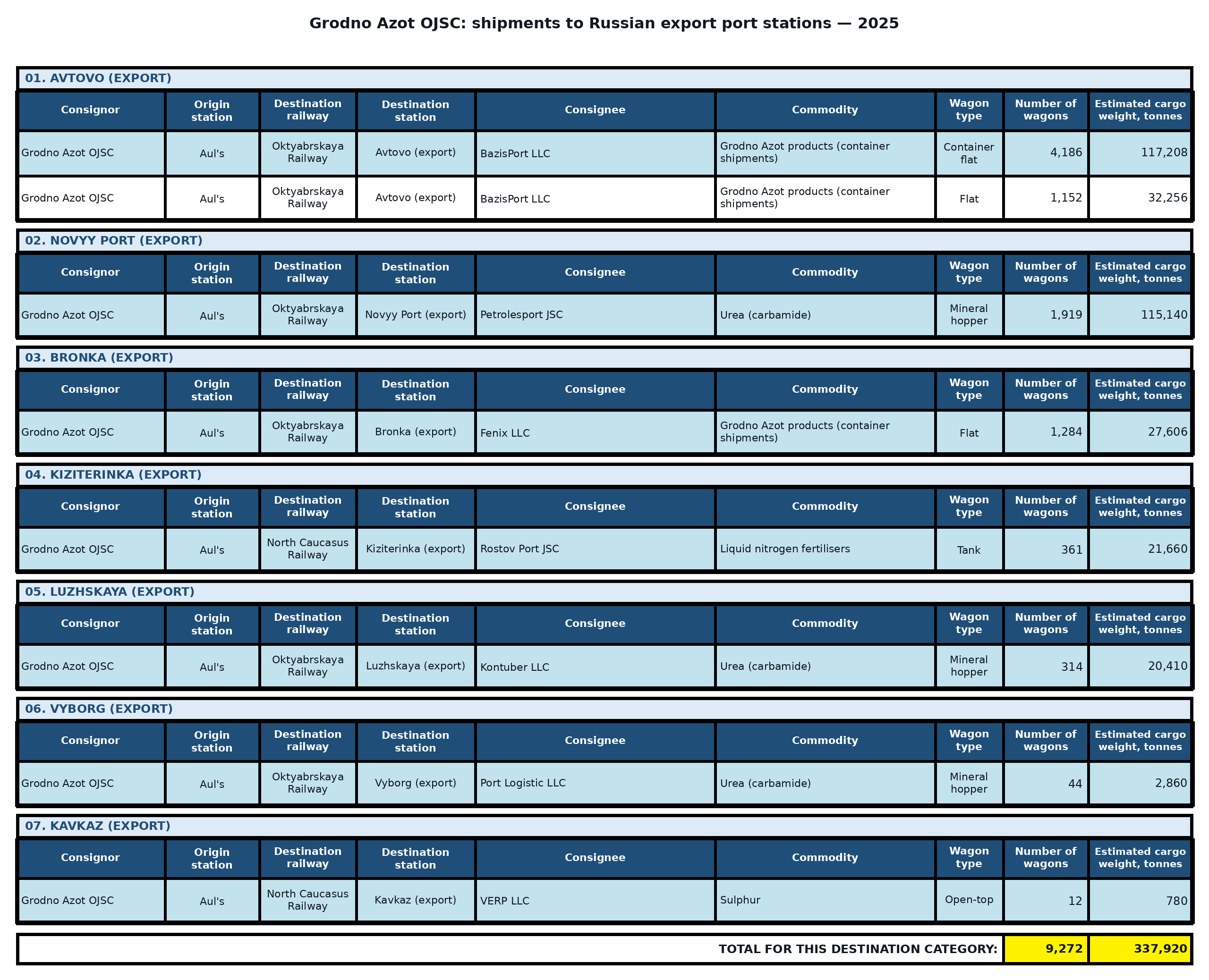
To port stations, 9,272 railcars with 337.9 thousand tonnes were sent – about 60% of the enterprise's mass. The largest destination is Avtovo, recipient BasisPort: 5,338 railcars with 149.5 thousand tonnes of containerized products. To Novy Port, addressed to JSC Petrolesport, 1,919 railcars of urea with 115.1 thousand tonnes were sent. Bronka received another 1,284 railcars with 27.6 thousand tonnes of containerized products.
Destinations differed in product specialization. Avtovo received a large container flow, Novy Port – urea. To Kiziterinka, addressed to Rostov Port, 361 railcars of liquid nitrogen fertilizers with 21.7 thousand tonnes were sent. Luzhskaya received 314 railcars of urea with 20.4 thousand tonnes. Smaller volumes arrived at Vyborg and Kavkaz.
Compared to the geography of January–September 2024, the combination of cargo and port changed. Then, Avtovo and Vyborg stood out in urea shipments, while containerized products went to Bronka. In 2025, large container shipments concentrated at Avtovo, and urea – at Novy Port.
Supplies to the Russian Federation
To non-port Russian stations, 3,883 railcars with 225.8 thousand tonnes arrived. All 1,957 railcars of ammonium sulfate – 127.8 thousand tonnes – were sent here. Liquid nitrogen fertilizers accounted for another 55.1 thousand tonnes, ammonia – 23.1 thousand tonnes. Urea occupied a significantly smaller place: 81 railcars with 4.4 thousand tonnes. Thus, the main urea shipments went to sea terminals, and ammonium sulfate – to non-port recipients.
Among the largest recipients are LLC CTK with 68.3 thousand tonnes and LLC Oberon Trading with 61.8 thousand tonnes. Ammonia was supplied, in particular, to EuroChem Belorechenskie Minudobreniya and Novomoskovskaya Aktsionernaya Kompaniya Azot. In liquid nitrogen products, regional companies of PhosAgro are noticeable. Container shipments to Chepetskaya are associated with HaloPolymer Kirovo-Chepetsk. This is a combination of industrial and distribution addresses, not just supplies directly to agricultural consumers.
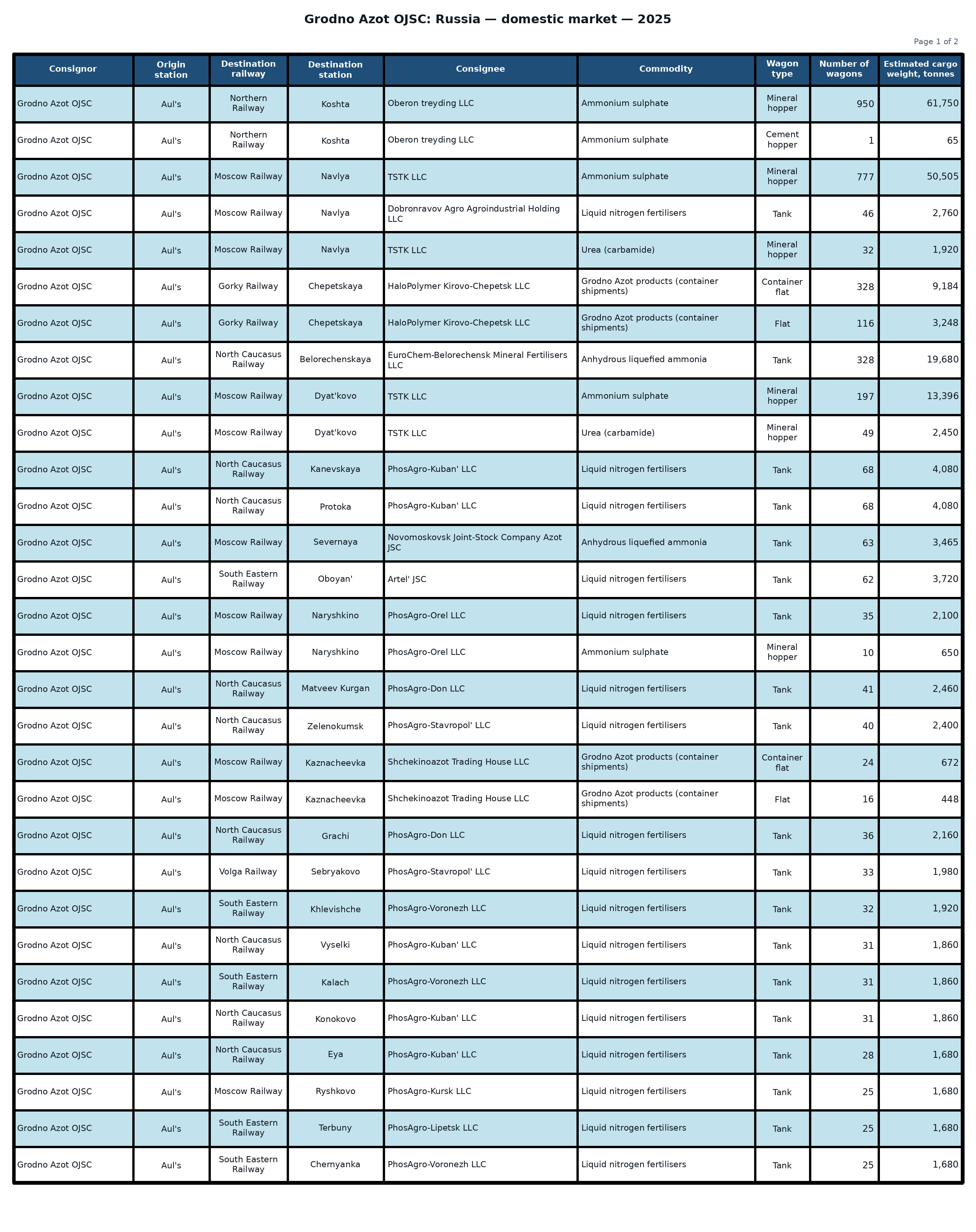
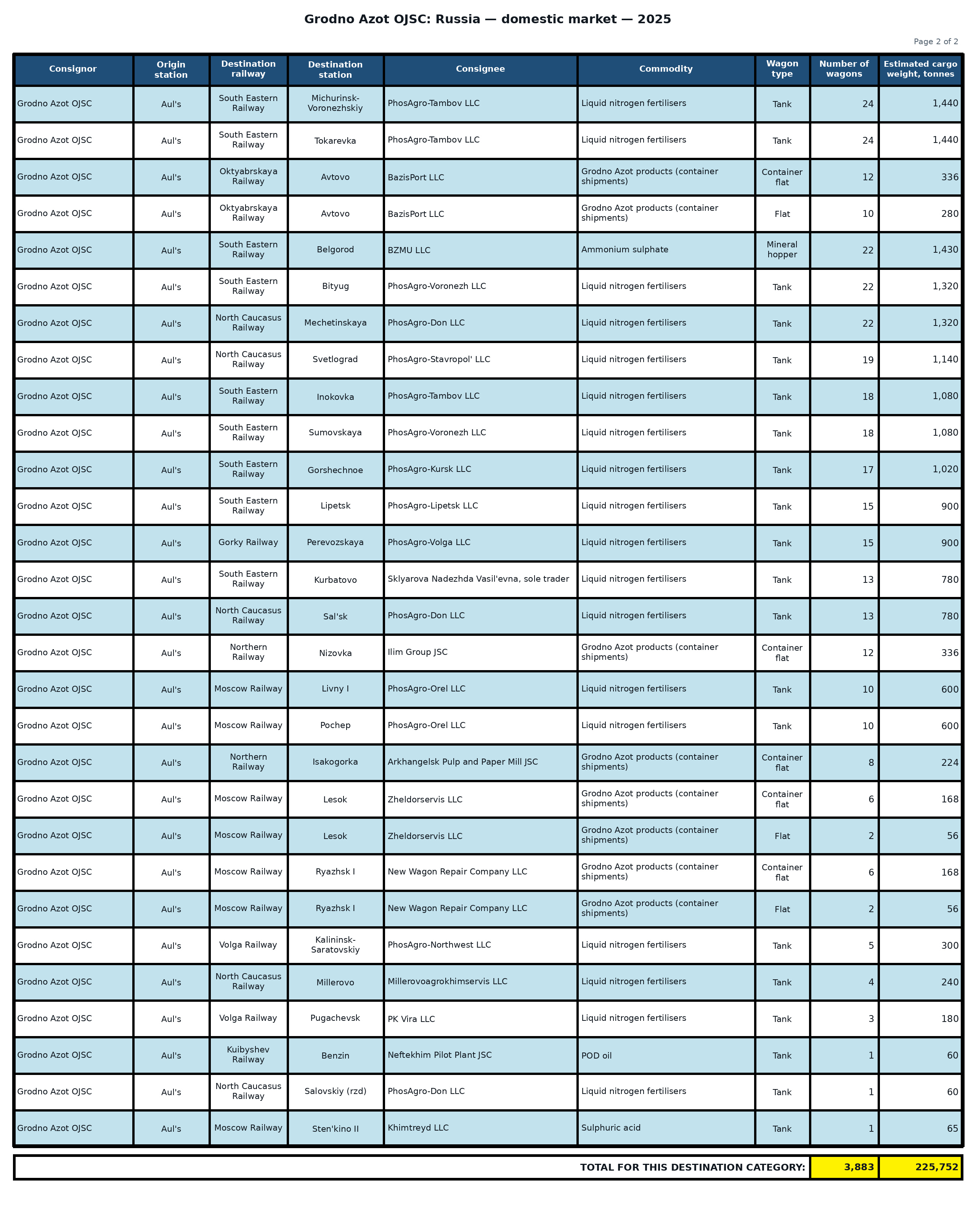
In total, the main enterprise's products arrived at 56 station destinations. However, CTK and Oberon Trading together received about 58% of the mass of non-port shipments. A wide list of addresses was combined with a high concentration on two large recipients.
1.5. Khimvolokno Plant Branch of JSC Grodno Azot
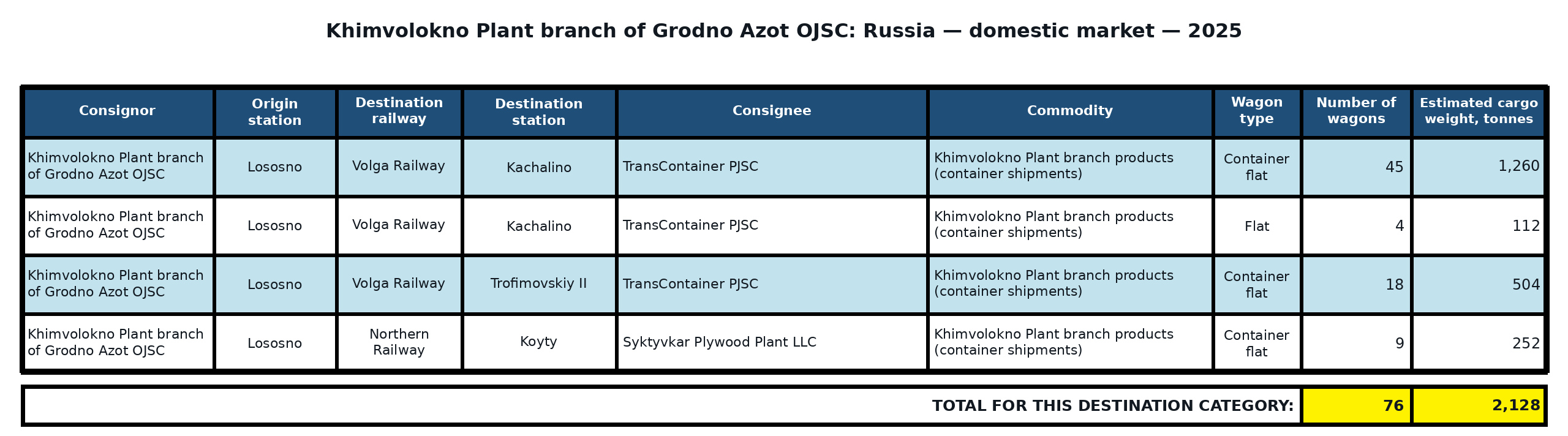
The Khimvolokno Plant branch dispatched 76 railcars with 2,128 tonnes of containerized products from Lososno station. The branch has its own network of shipments, differing from the main enterprise's flow from Auls station.
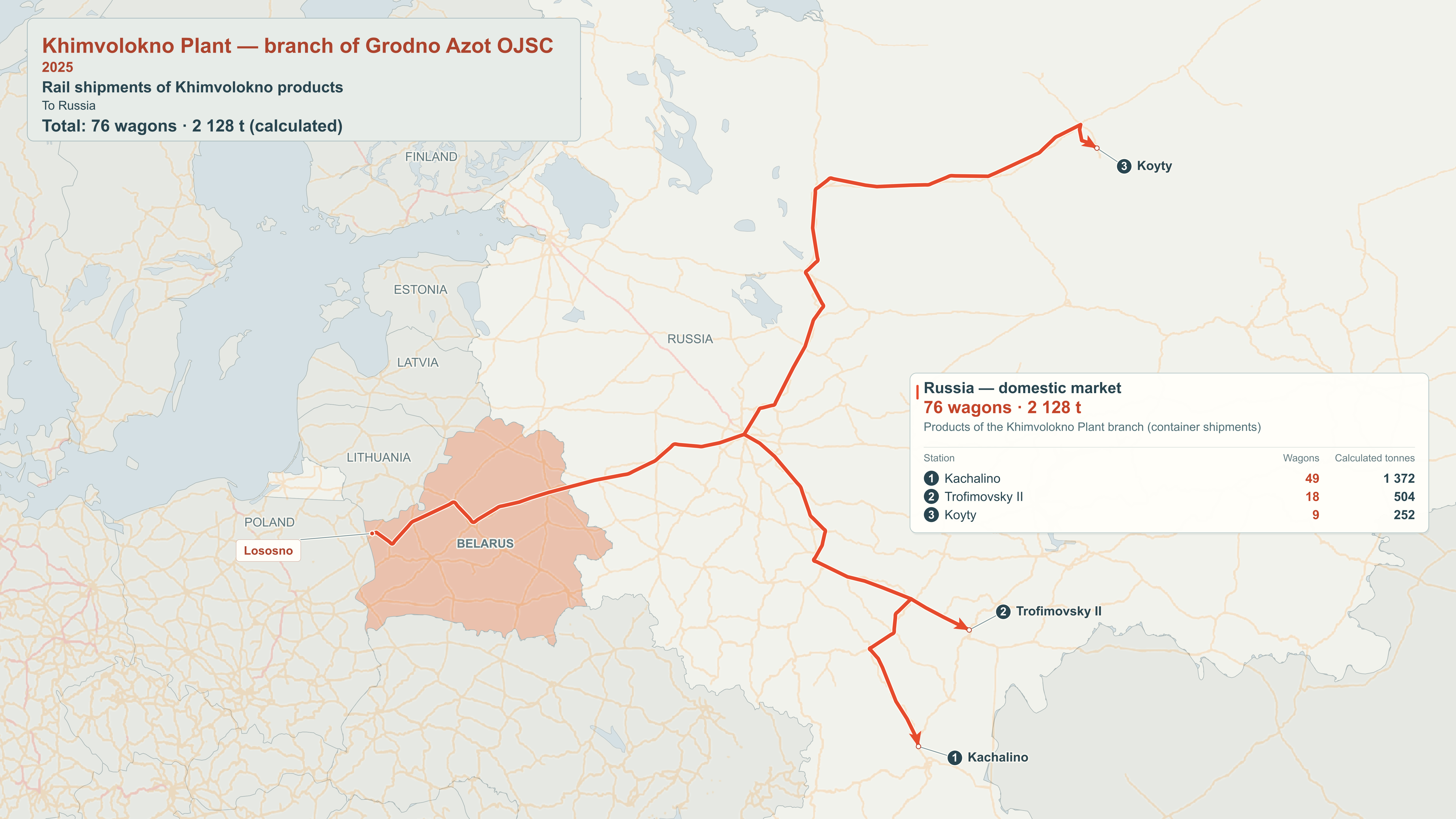
To Kachalino, addressed to TransContainer, 49 railcars arrived; to Trofimovsky II, to the same recipient – 18. Another nine railcars were sent to Koyty for Syktyvkar Plywood Mill. Thus, 67 out of 76 railcars – 88.2% – were addressed to a container operator, the remaining nine – to an industrial enterprise.
1.6. JSC Gomel Chemical Plant
Gomel Chemical Plant dispatched 6,303 railcars with 380,944 tonnes from Centrolit. Mineral fertilizers accounted for 5,041 railcars with 342.7 thousand tonnes, containerized products – 1,186 railcars with 33.2 thousand tonnes. Related shipments included 44 railcars of sulfites, 24 railcars of sulfuric acid, and eight railcars of cryolite.
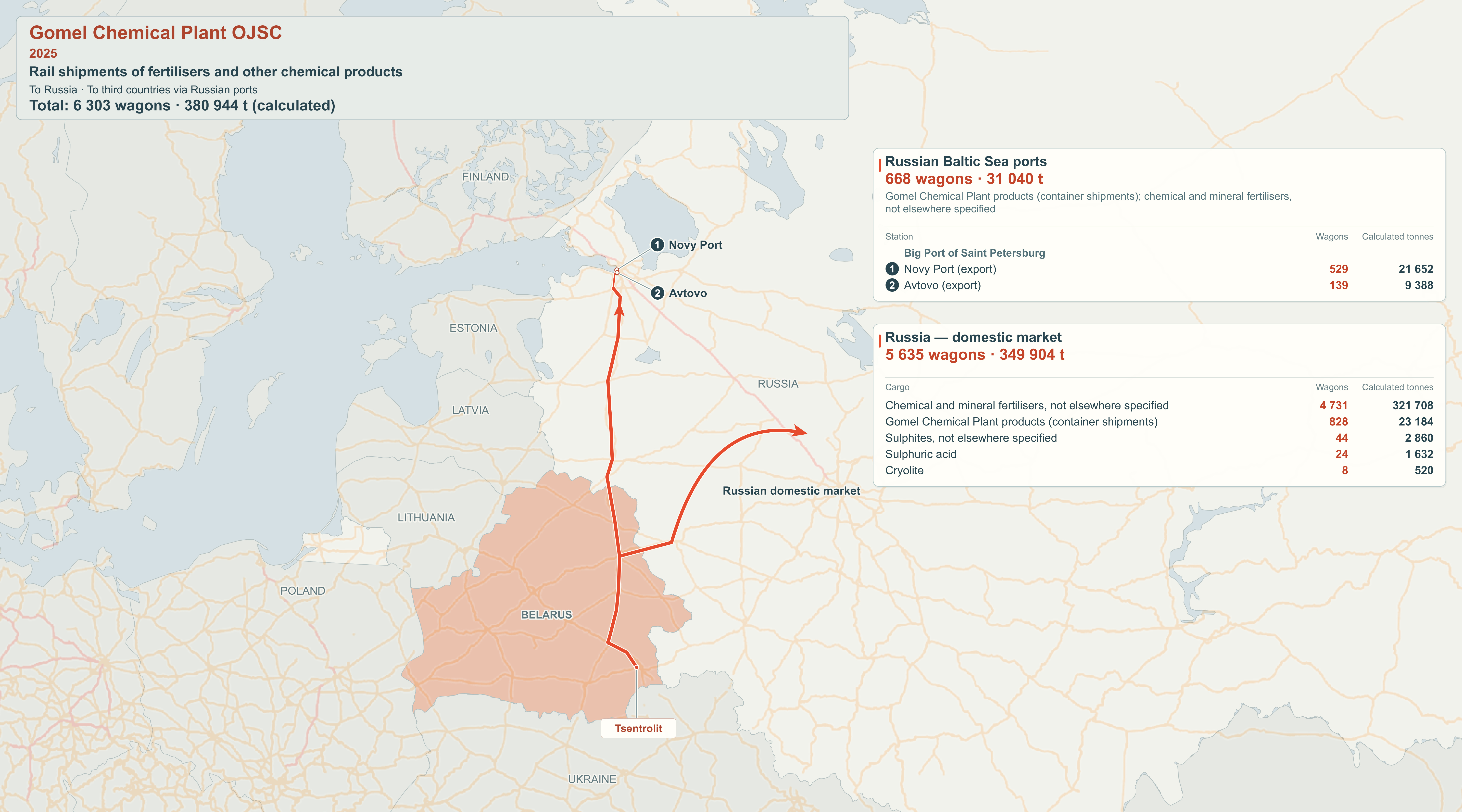
The product range reflects two directions of the plant's work – fertilizer production and related chemical products. Sulfuric acid, sulfite products, and cryolite are part of its assortment. At the same time, the cargo flow is not limited to agricultural recipients: part of the products is sent to industrial enterprises.
Supplies to the Russian Federation
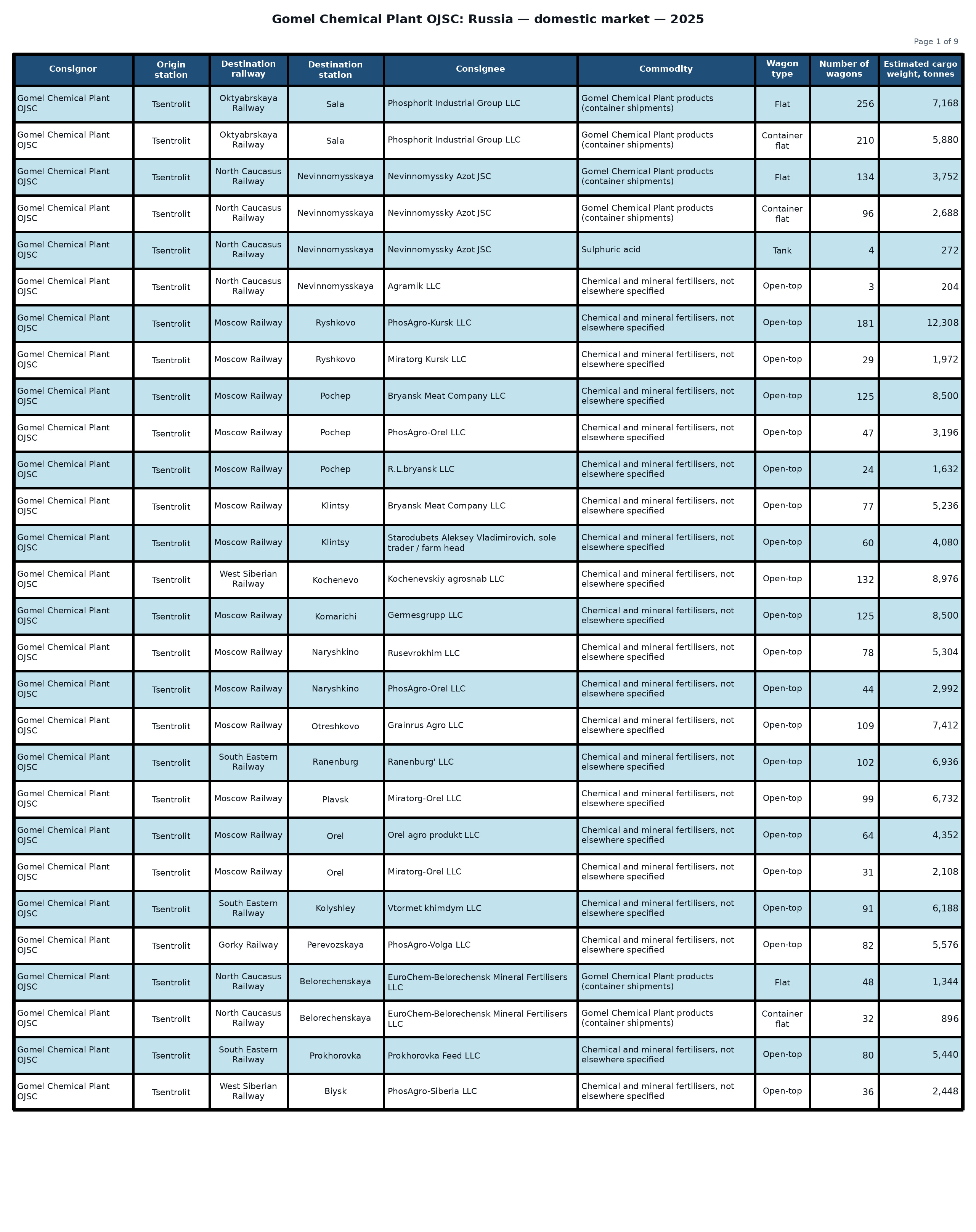
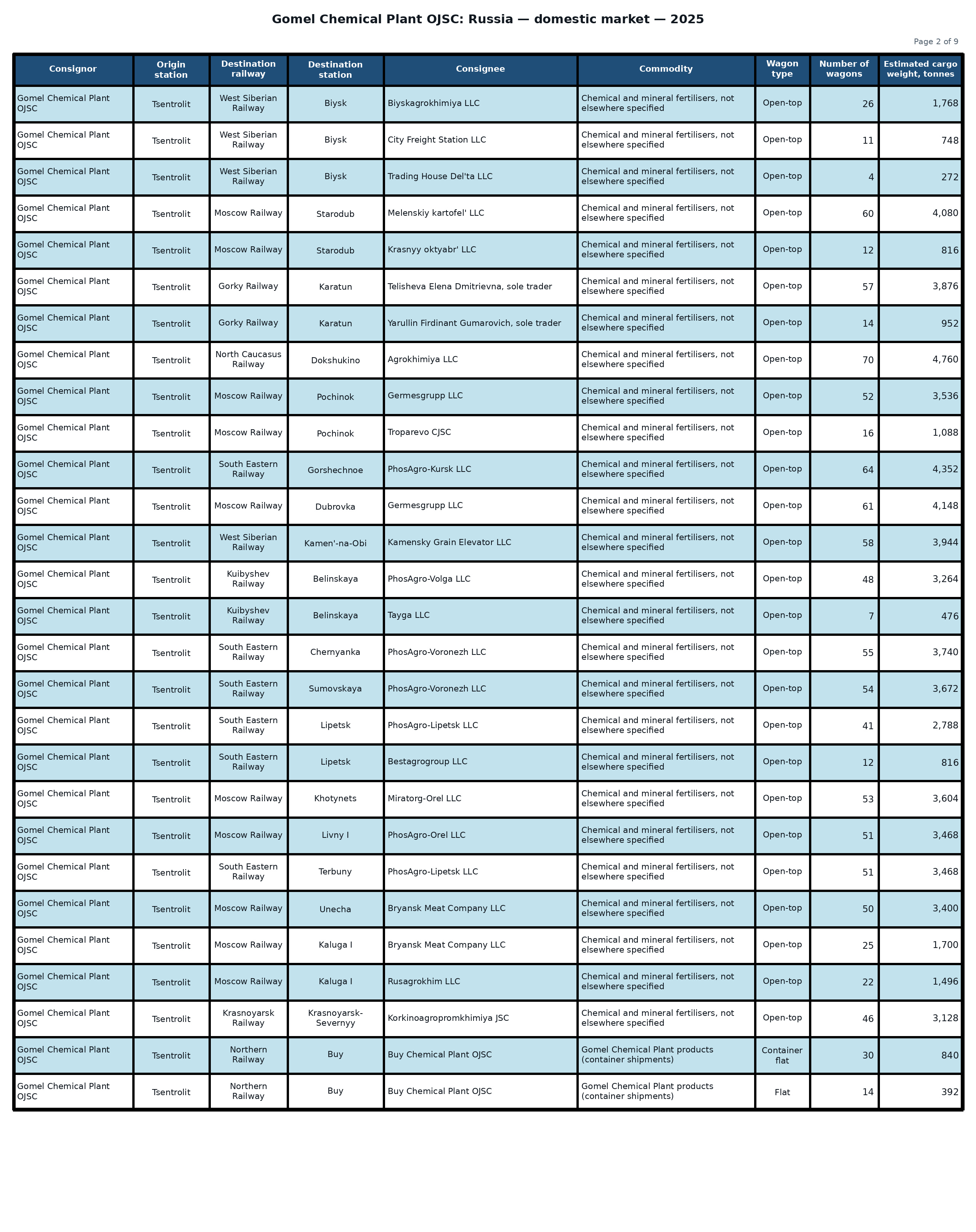
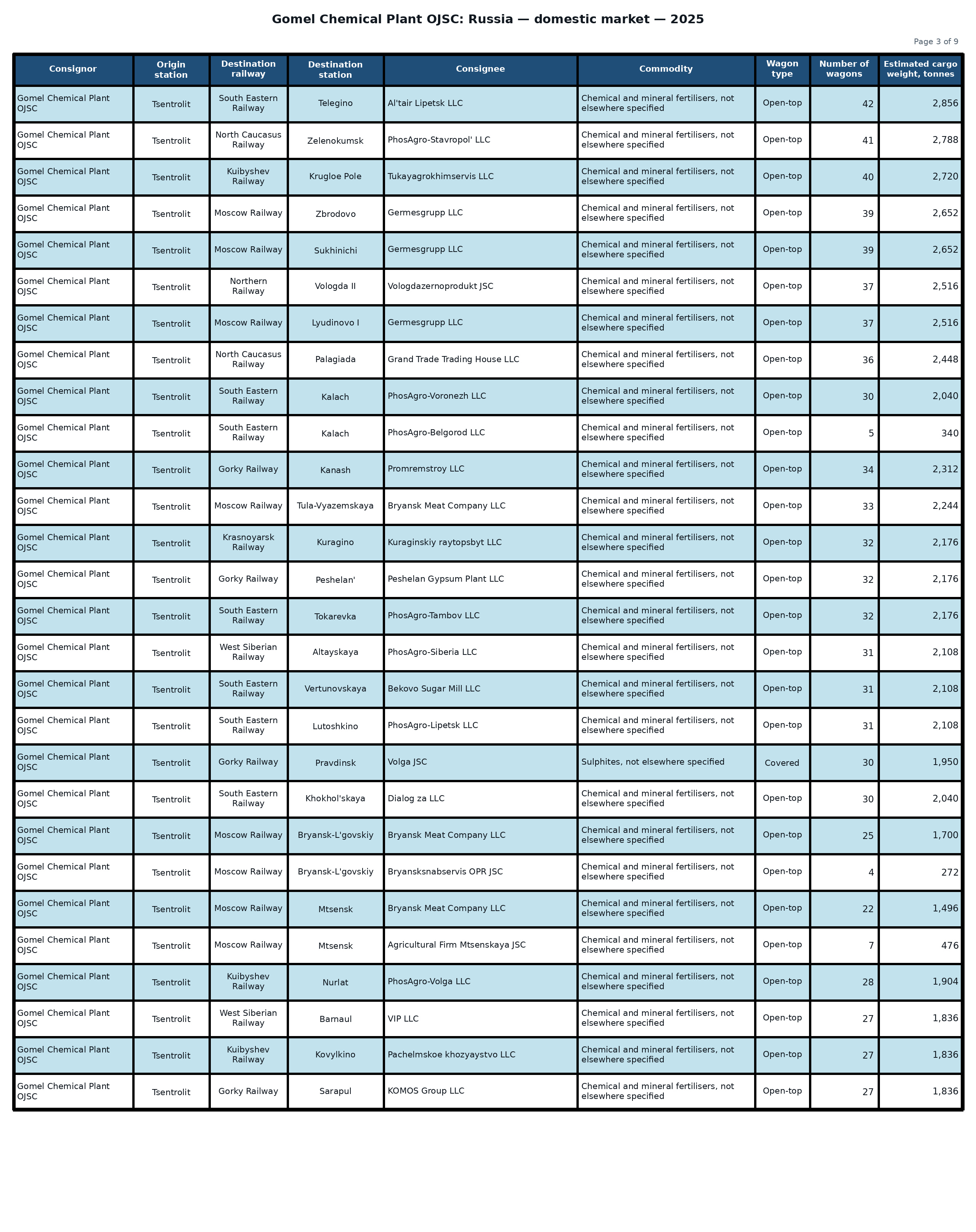
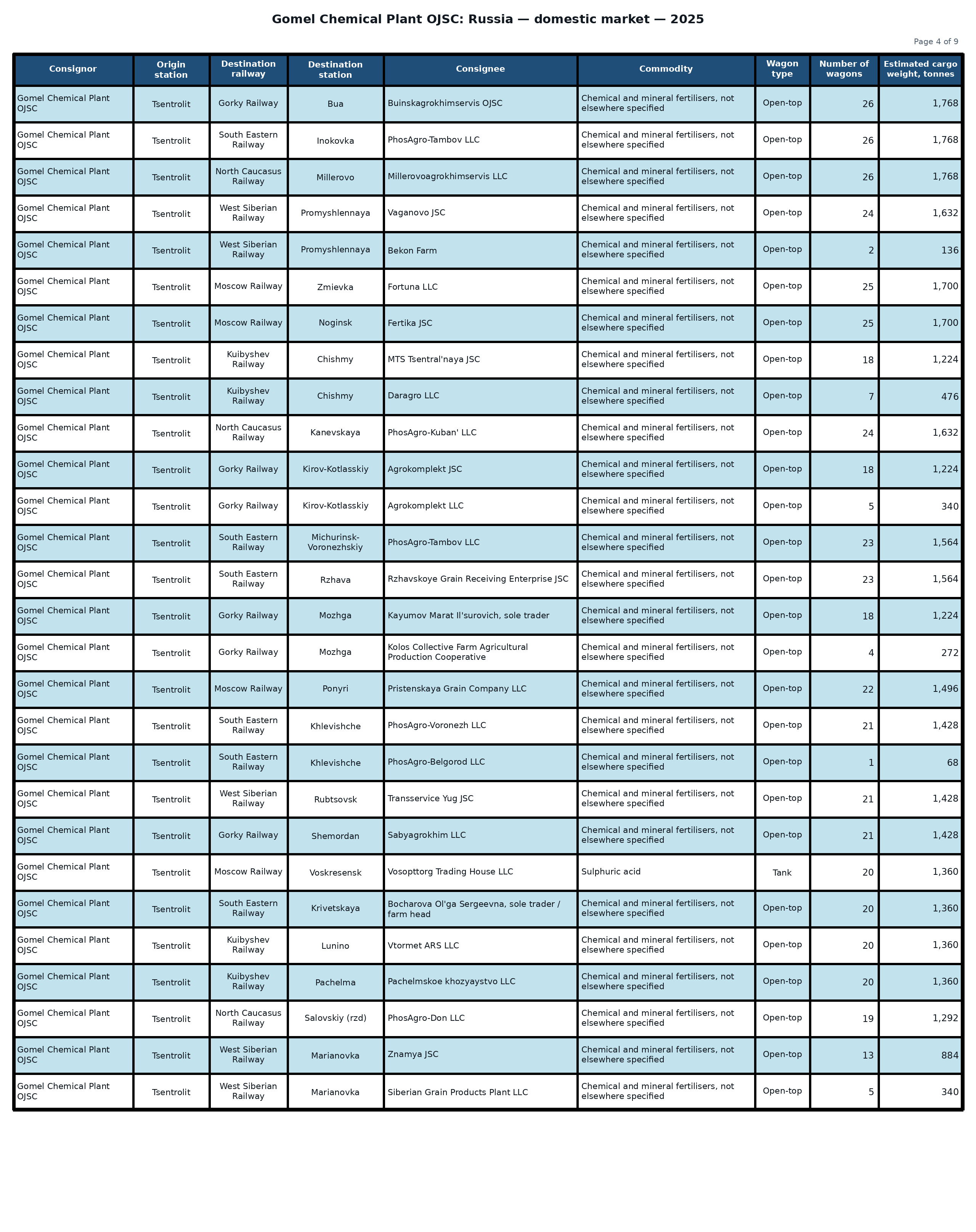
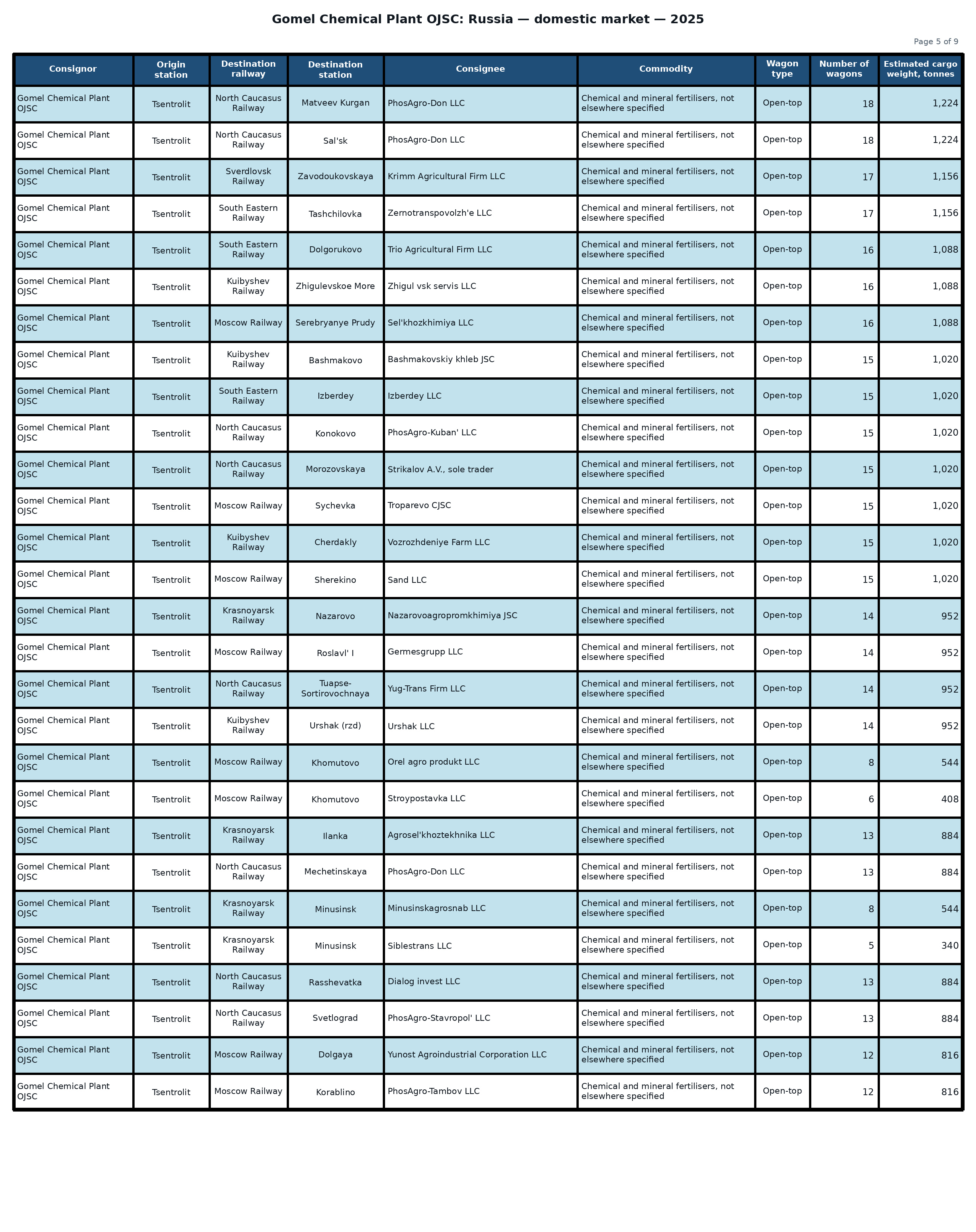
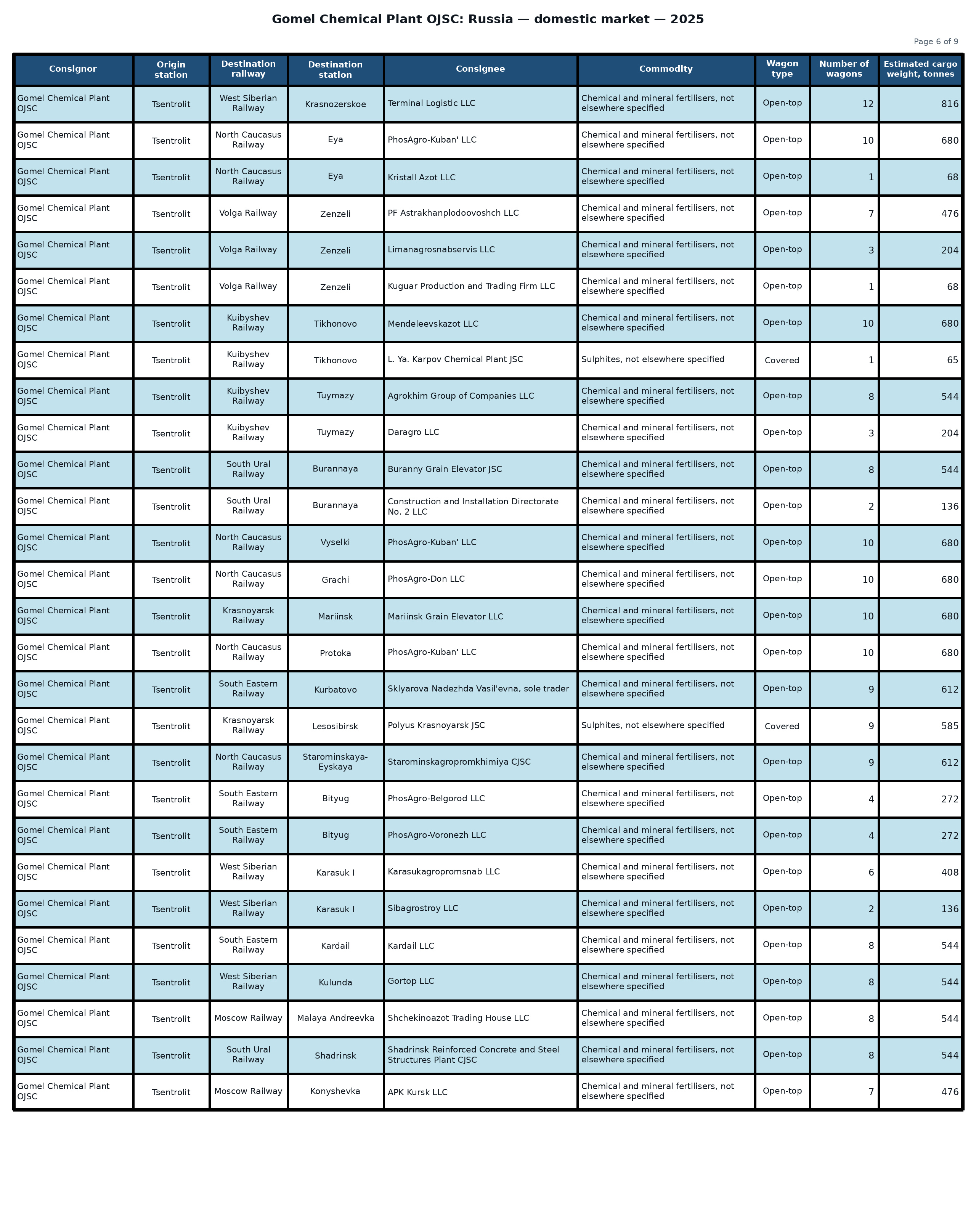
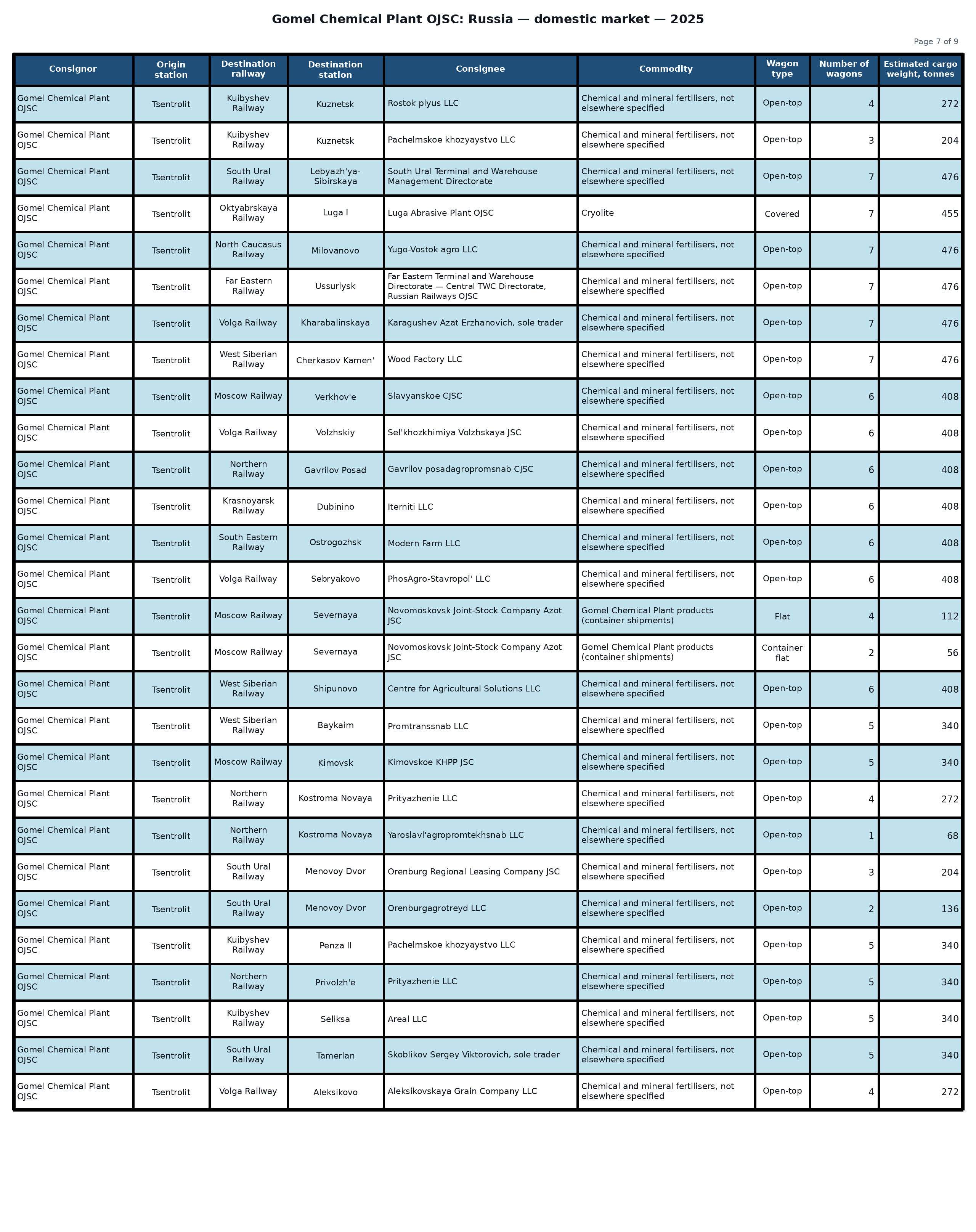
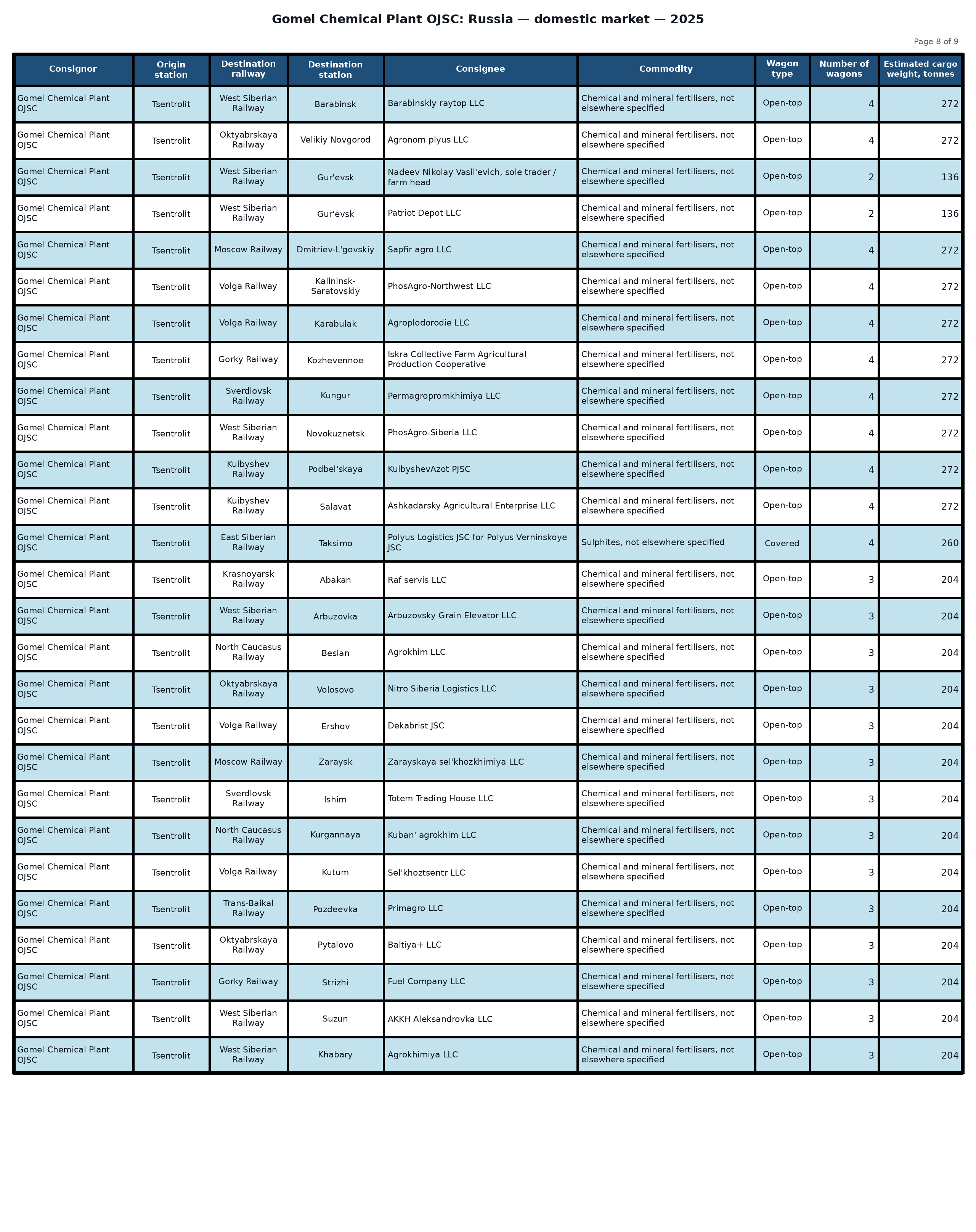
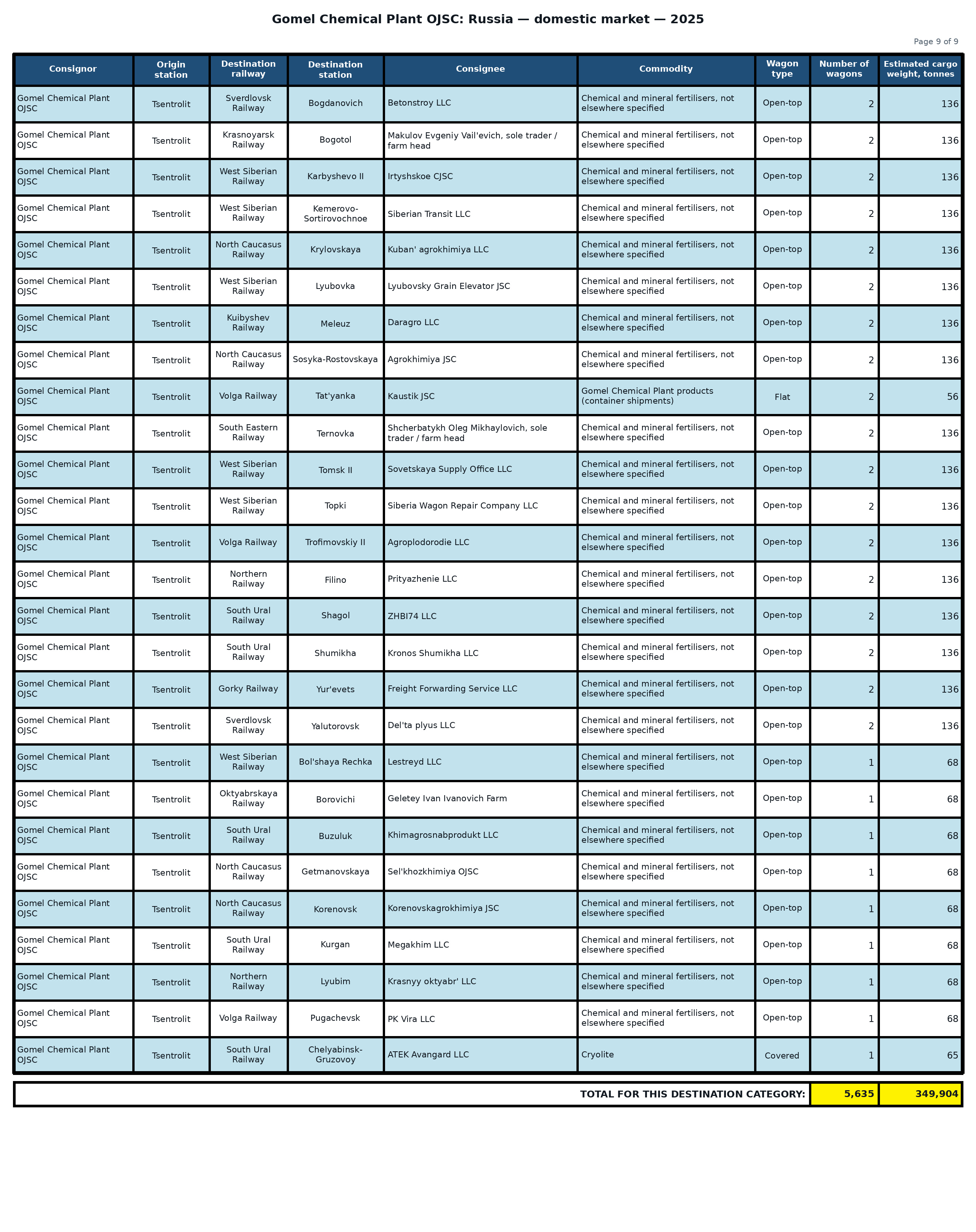
Gomel's main difference is a distributed network of destinations. Russian non-port stations accounted for 5,635 railcars with 349.9 thousand tonnes, or 91.9% of the mass. In total, the plant shipped products to 207 station destinations. Recipients include regional fertilizer suppliers, agricultural holdings, industrial enterprises, and grain elevators.
The largest non-port recipients are Hermesgroup with 367 railcars and 25.0 thousand tonnes, Bryansk Meat Company with 357 railcars and 24.3 thousand tonnes, PhosAgro-Kursk with 245 railcars and 16.7 thousand tonnes. Further follow Industrial Group Phosphorit, Miratorg-Orel, other regional PhosAgro companies, Kochenevsky Agrosnab, and a wide range of other recipients.
Industrial Group Phosphorit has a higher railcar volume than the listed recipients: 466 railcars. However, this is containerized product – 13.0 thousand tonnes. Therefore, by mass, this flow is inferior to supplies to Hermesgroup, Bryansk Meat Company, and PhosAgro-Kursk.
For Centrolit, such a structure means working with a large number of destinations, and for the receiving network – distributing railcars among regional cargo stations. On the recipients' side, warehouse processing and further delivery to consumption areas are significant. This is a different nature of transportation than potash export to two or three large port hubs.
Export to third countries via Russian ports
The port share amounted to 668 railcars with 31,040 tonnes. Novy Port accounted for 529 railcars: 171 – addressed to Baltic Port, 358 – to Sea Port of St. Petersburg. Avtovo received 139 railcars, recipients – BasisPort and CFS Terminal. This part is significantly smaller than the non-port part and is itself heterogeneous in terms of transportation method.
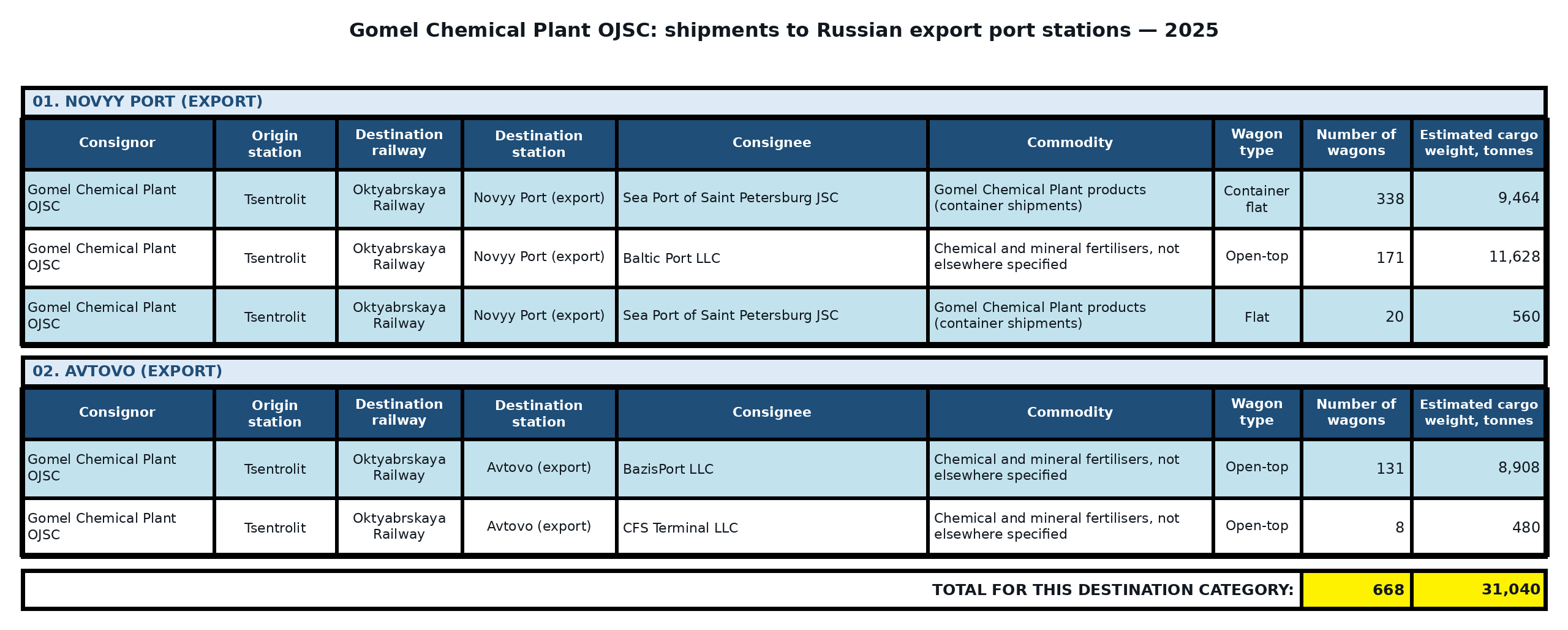
The predominance of non-port supplies remains compared to January–September 2024. Then, among the port destinations of Gomel Chemical Plant were Novy Port and Novorossiysk; in 2025, port shipments were distributed between Novy Port and Avtovo.
1.7. Transportation of fertilizers by other shippers in the Russian direction
LLC Company BKM
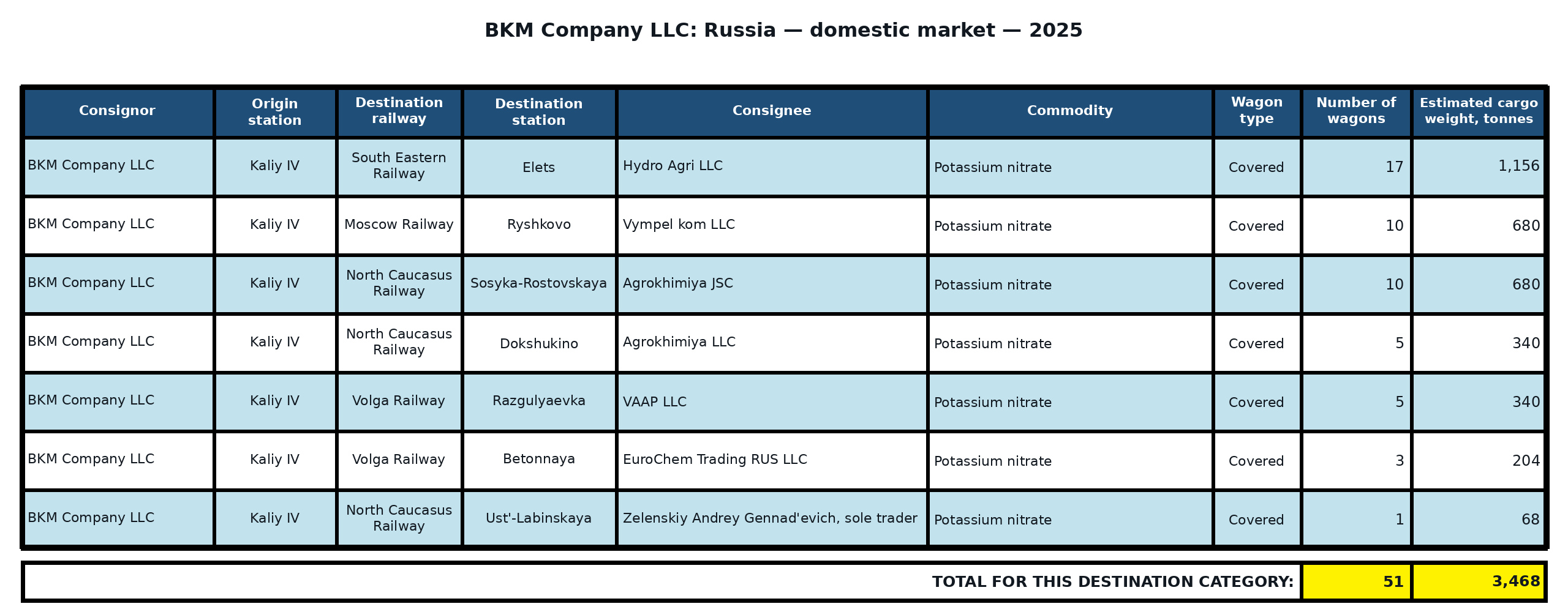
LLC Company BKM dispatched 342 railcars of potassium nitrate with 23,256 tonnes from Kaliy IV station. Despite the similarity of abbreviations, this is an organization separate from the Belarusian Potash Company. Unlike Belaruskali's potassium chloride, its entire flow is represented by potassium nitrate.
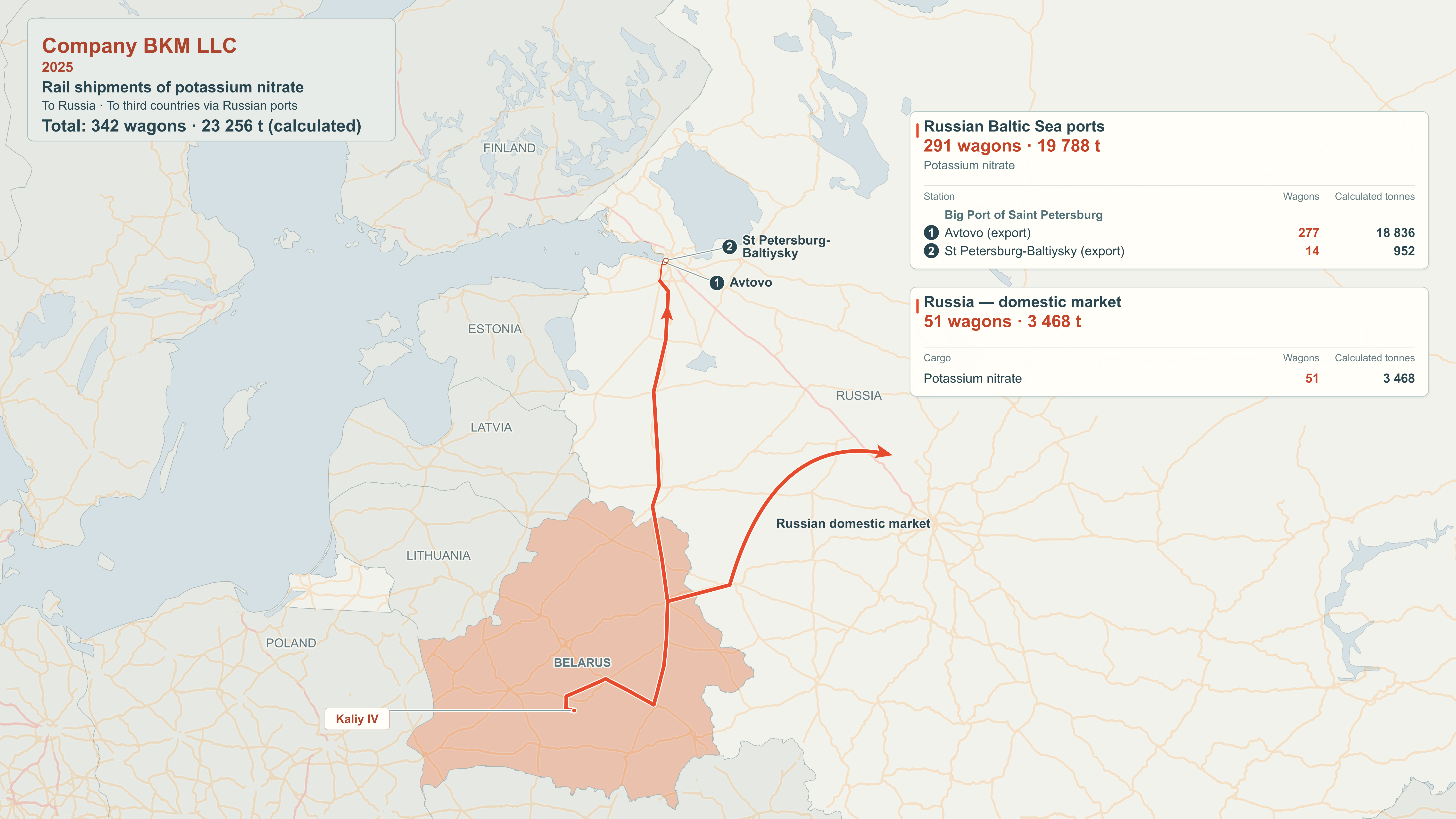
The port flow of Company BKM was concentrated primarily at Avtovo: 212 railcars of potassium nitrate were sent to Neva Metall, 65 – to BasisPort. Another 14 railcars were processed for St. Petersburg-Baltiysky with an export mark, also for Neva Metall.
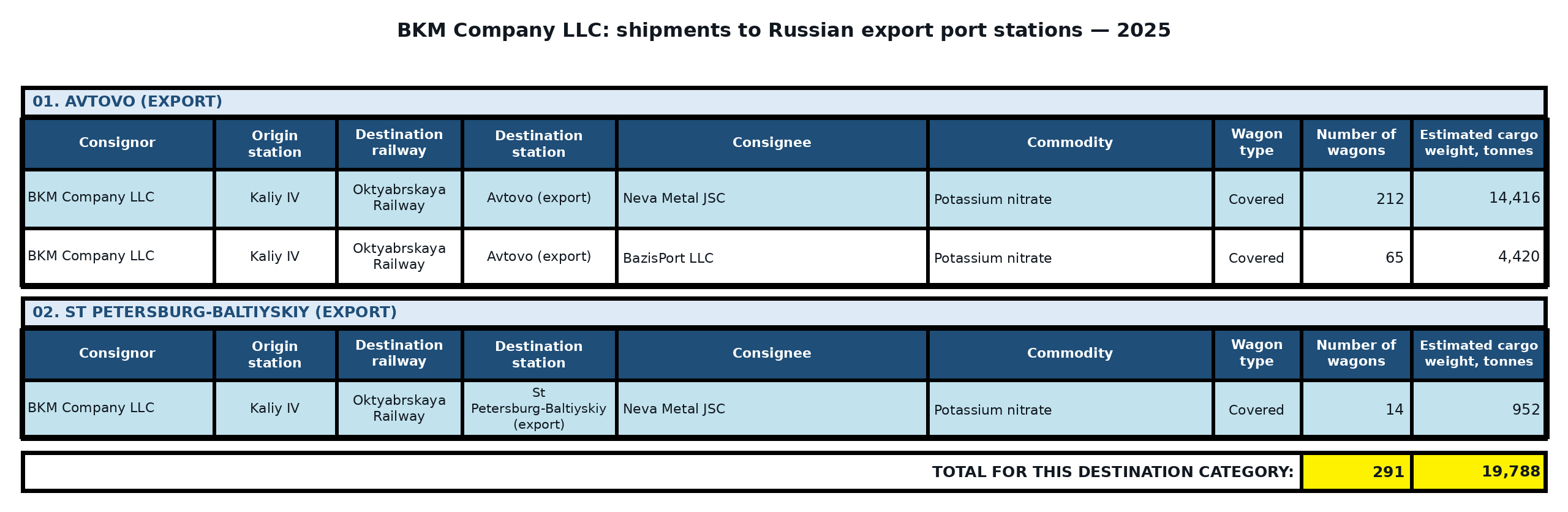
51 railcars of potassium nitrate went to non-port Russian stations. The largest batch – 17 railcars to Yelets for Hydro Agri. Ten railcars each were received by Vympel Kom at Ryshkovo and Agrokhimiya at Sosyka-Rostovskaya. The remaining volume was distributed among Dokshukino, Razgulyaevka, Betonnaya, and Ust-Labinskaya.
Urea transportation
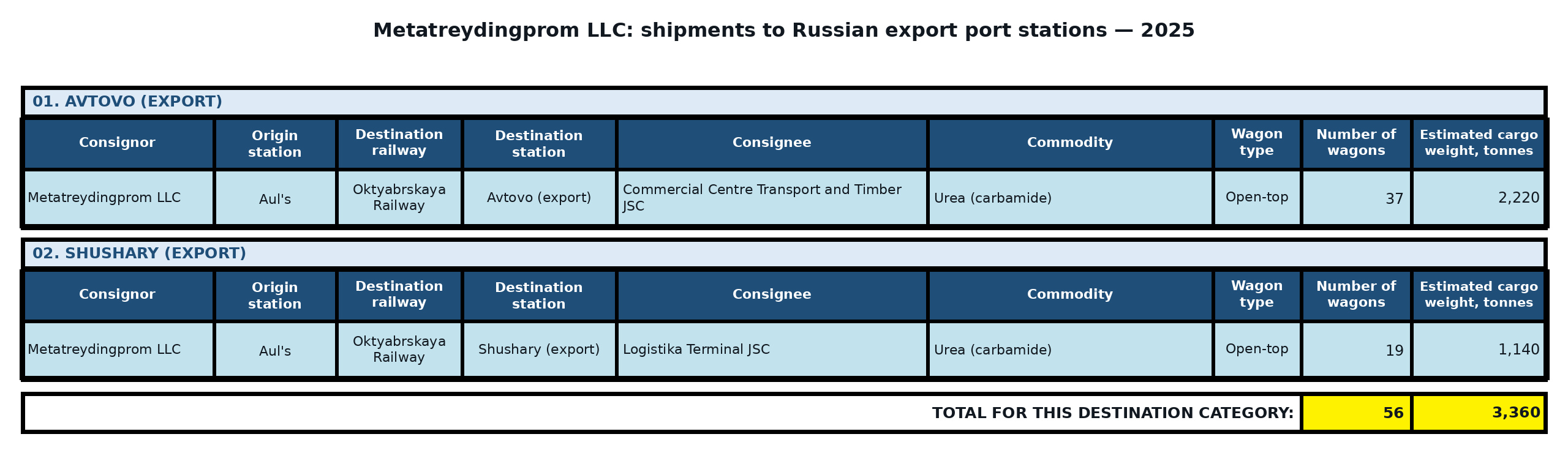
In addition to direct factory supplies, Auls formed a urea flow for trading companies. LLC Metatradingprom dispatched 56 railcars with 3,360 tonnes. They were distributed between two Russian port destinations.
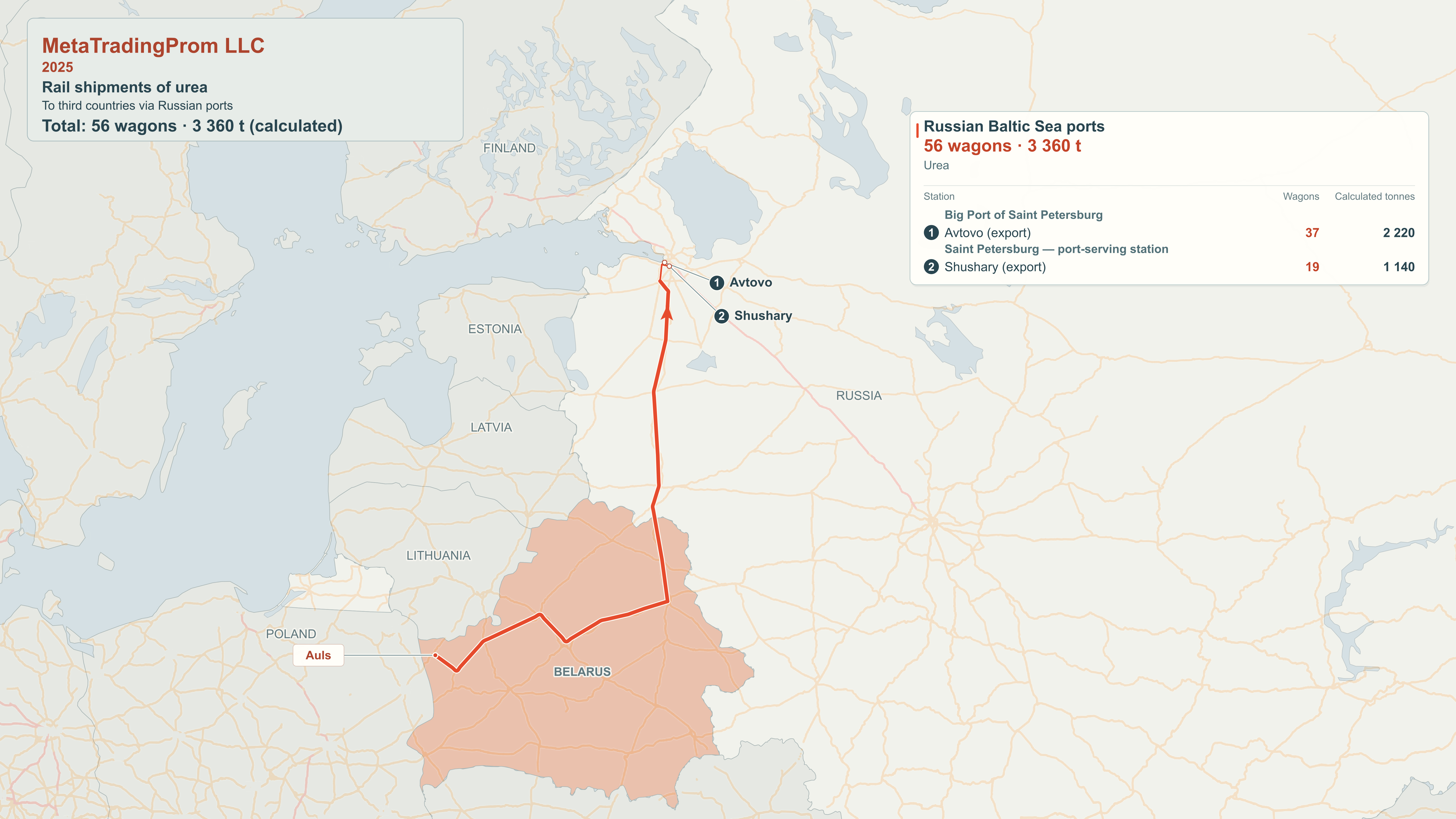
Of Metatradingprom's 56 railcars, 37 arrived at Avtovo – addressed to Commercial Center Transport and Wood. The remaining 19 were sent to Shushary for Logistics Terminal. Thus, one cargo from Auls station was distributed between two station-terminal destinations.
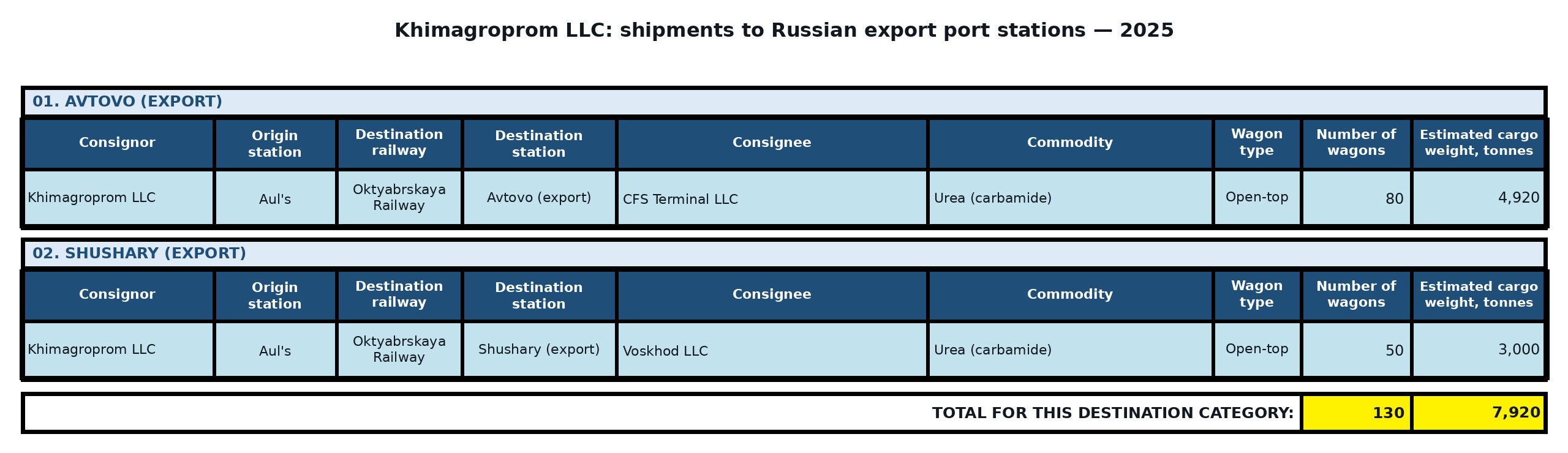
LLC Khimagroprom dispatched 130 railcars of urea with 7,920 tonnes from Auls station. As with Metatradingprom, Russian destinations are Avtovo and Shushary, but the recipients for these companies are different.
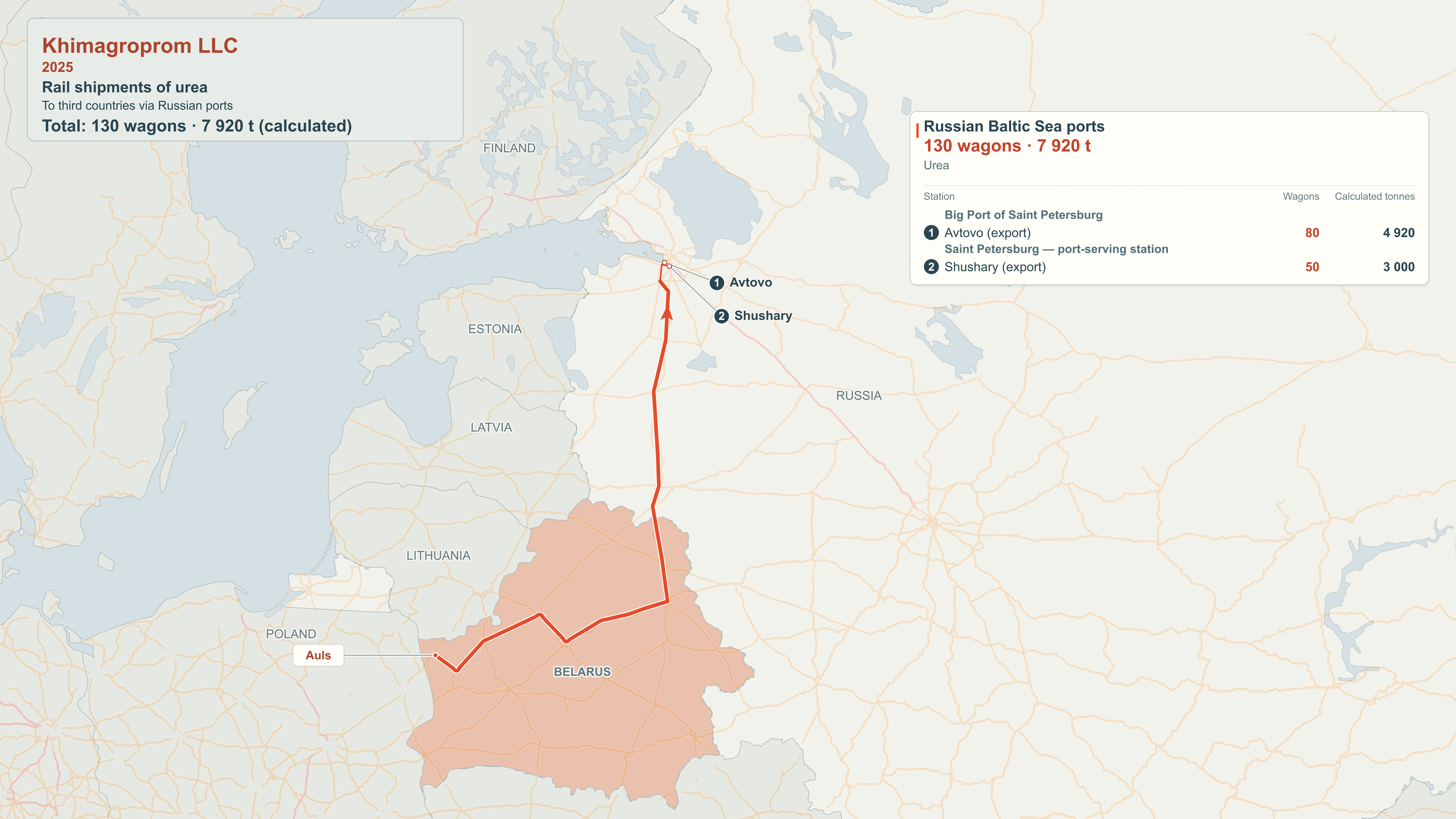
The main part of Khimagroprom's urea – 80 railcars – arrived at Avtovo for CFS Terminal. Another 50 railcars were sent to Shushary addressed to Voskhod. Thus, some stations of the St. Petersburg hub received urea from several trading shippers, but different recipients handled the service.
LLC Fert Corporation dispatched 20 railcars of urea with 1,200 tonnes. The company operated in one Russian port direction.
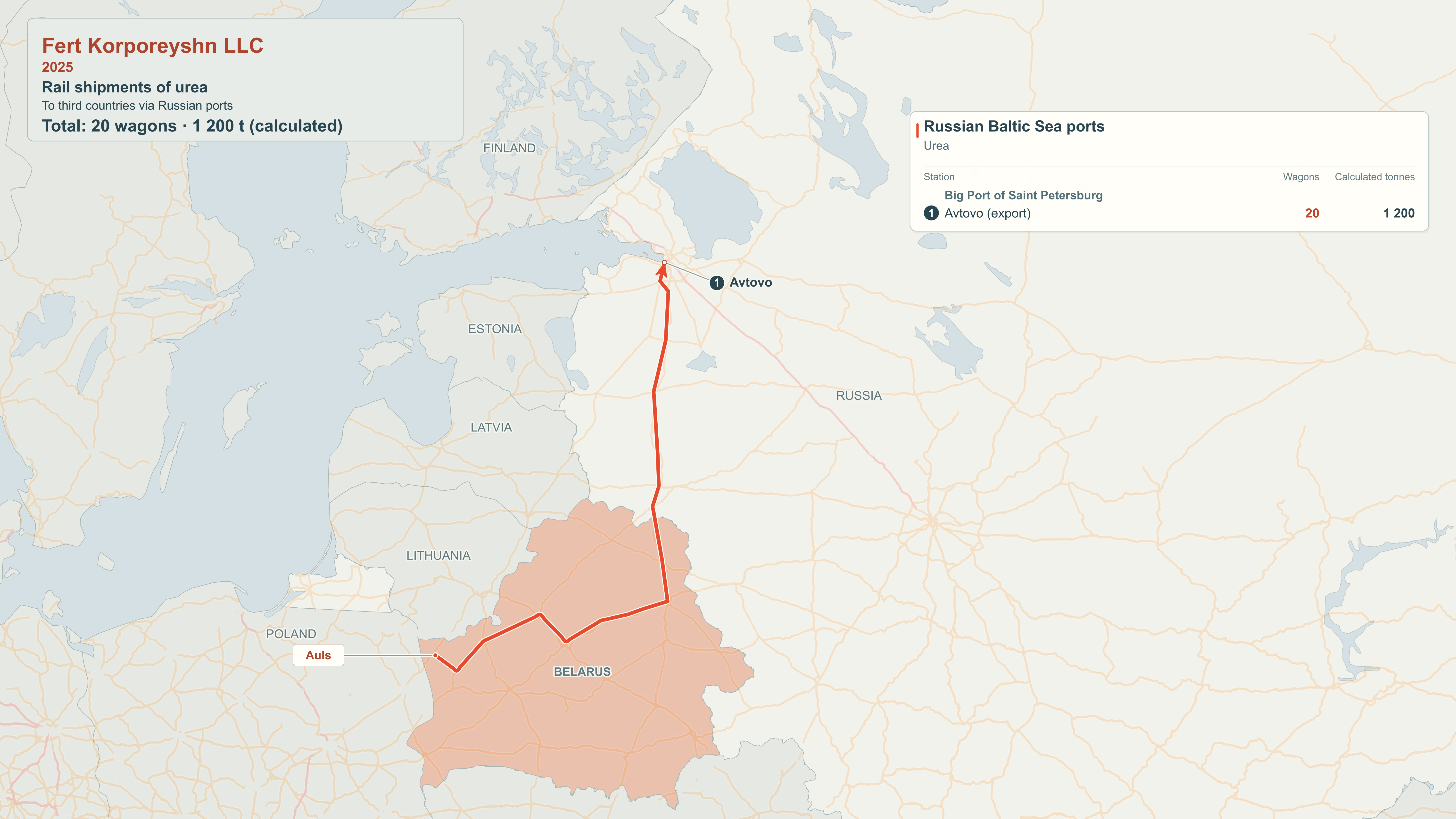
All 20 railcars proceeded from Auls to Avtovo addressed to CFS Terminal. Together with Khimagroprom's 80 railcars, this amounted to 100 railcars of urea for one recipient from one loading station. Another flow from Auls – Metatradingprom's 37 railcars – arrived at Avtovo for another recipient.

The activities of some intermediaries were the subject of a joint investigation by the Belarusian Investigative Center (BIC), Rabochy Rukh, and LSM, published in June 2025. Based on Belneftekhim documents and the tracking of specific consignments, the authors described the transfer of Grodno Azot equipment for lease to exporters and the registration of production on their behalf. According to the investigators, such a mechanism allowed changing the declared manufacturer when selling the plant's products.
According to OCCRP, Technospetstrading was added to Poland's national sanctions list in December 2024, and Metatradingprom in March 2025. These decisions applied to specific companies; they are not identical to a blanket ban on transporting any urea in all directions.
In the July continuation of the BIC investigation, it was reported that Yury Minich, owner and director of Fert Corporation, simultaneously worked as a driver for Technospetstrading, and in 2023 received a salary from TechnospetstradingExport. This refers to a documented personnel connection between trading participants, not a conclusion from coinciding stations. BIC also indicated that it sent inquiries to the companies but did not receive responses by the time of publication.
Transportation of liquid nitrogen and other mineral fertilizers
Separate small batches went directly to Russian non-port stations. CJSC Vilaris dispatched five tank cars of liquid nitrogen fertilizers with 300 tonnes from Bruzgi.
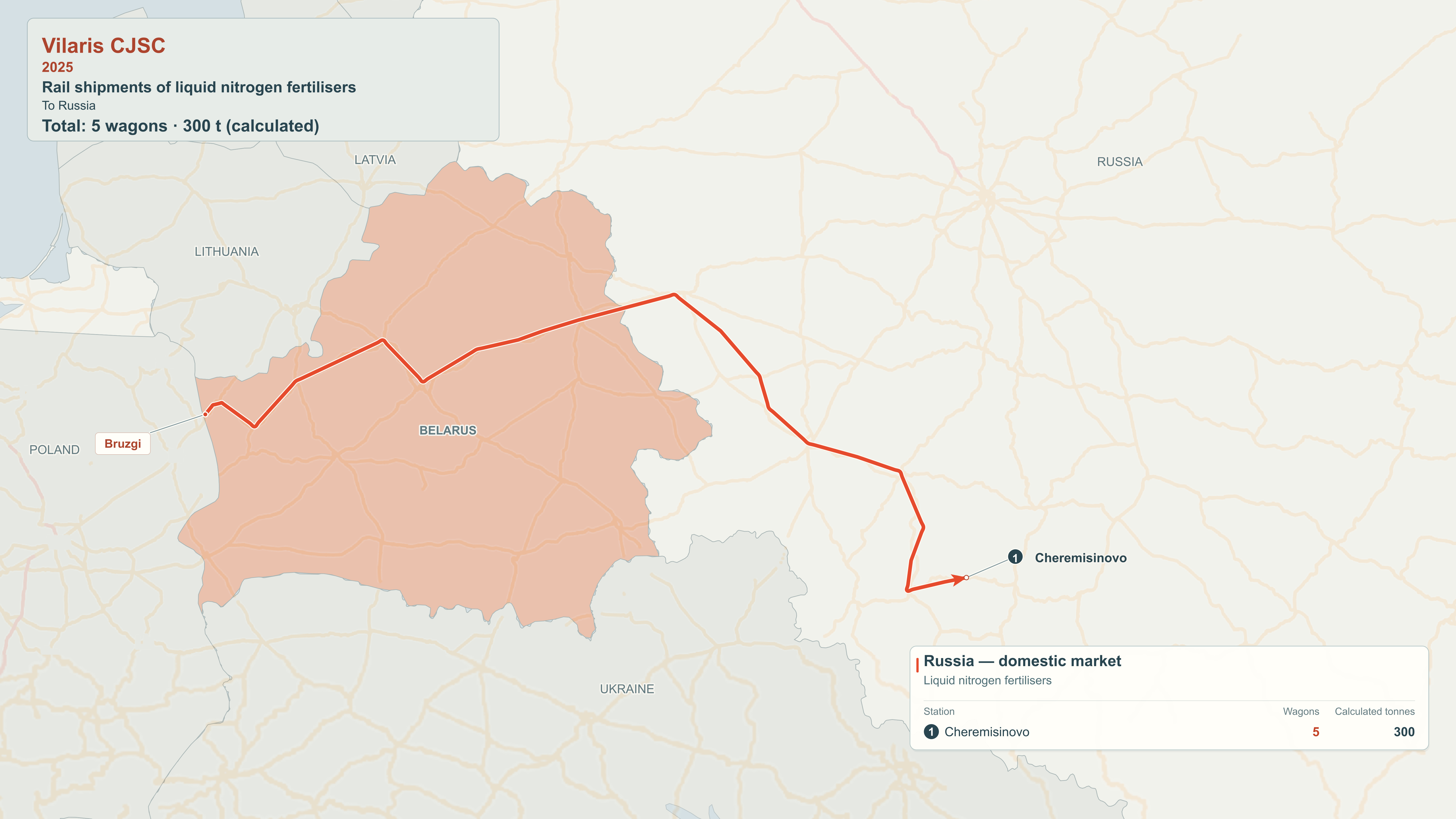
The entire Vilaris batch arrived at JSC Russkiy Dom at Cheremisinovo. Tank cars are used here, whereas in the urea shipments discussed above, rolling stock for solid products was used. Liquid and dry cargoes are served by different unloading fronts, even when they belong to the same nitrogen group.

LLC Minorstroy dispatched two boxcars of mineral fertilizers weighing 136 tonnes.
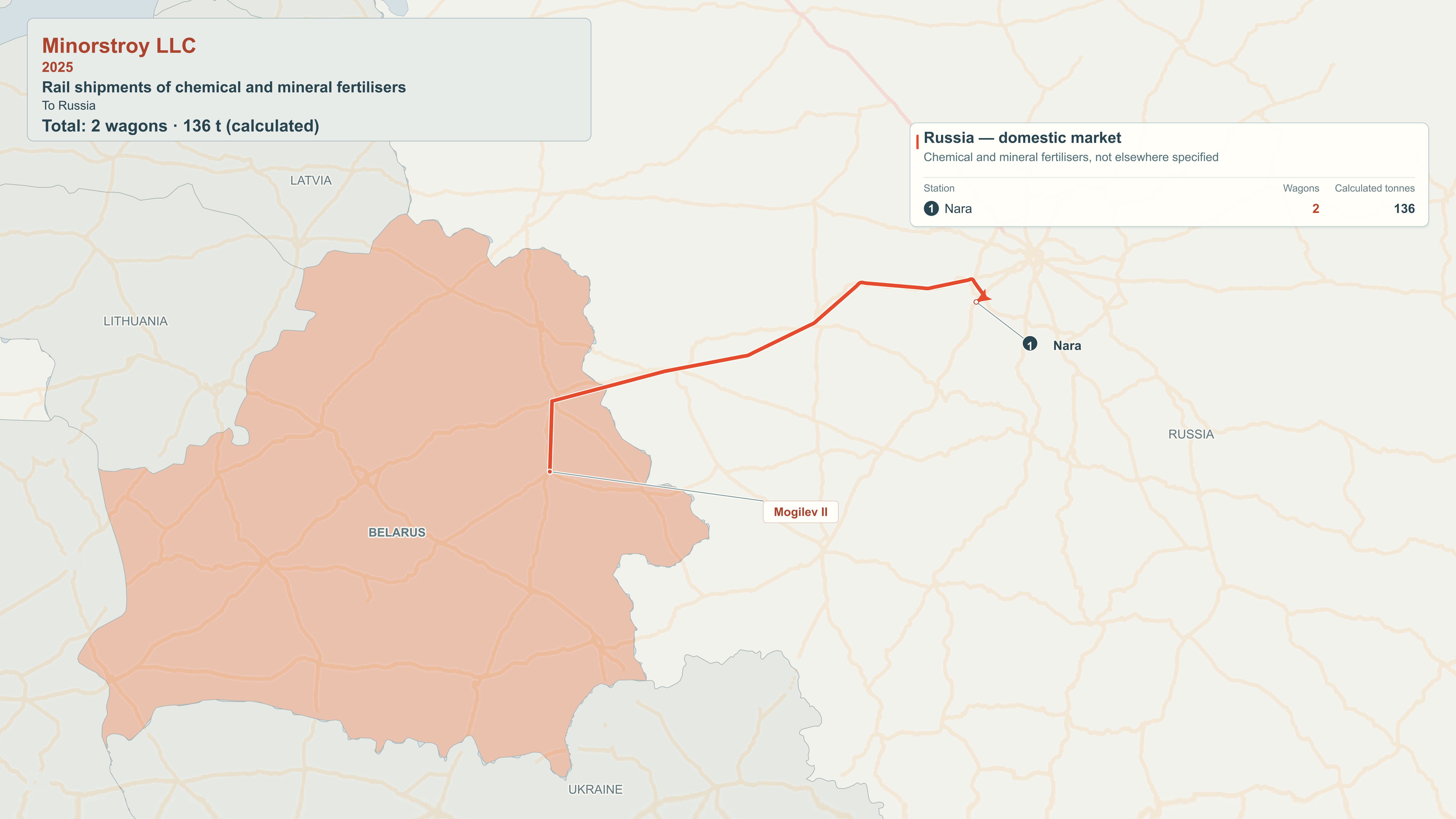
The cargo proceeded from Mogilev II to Nara addressed to LLC Spetsavtomatikaservis. Compared to the concentrated port export from Auls, this is a small, targeted supply from a different formation station.

1.8. Direct supplies to Latvia
To Latvian stations in 2025, 781 railcars with 45,645 tonnes were sent. Urea accounted for 520 railcars and 29,060 tonnes, ammophos – 197 railcars and 12,805 tonnes, liquid nitrogen fertilizers – 54 railcars and 3,180 tonnes, ammonia – ten railcars and 600 tonnes. Almost two-thirds of the mass was urea.
| Cargo | 2025, railcars | 2025, tonnes | Jan.–Apr. 2026, railcars | Jan.–Apr. 2026, tonnes |
|---|---|---|---|---|
| Urea | 520 | 29,060 | 46 | 3,128 |
| Ammophos | 197 | 12,805 | 160 | 10,880 |
| Liquid nitrogen fertilizers | 54 | 3,180 | 2 | 110 |
| Anhydrous ammonia | 10 | 600 | — | — |
| Total | 781 | 45,645 | 208 | 14,118 |
Zemitani, including the Riga-Krasta cargo area, became the main urea reception hub: 386 railcars with 21,414 tonnes arrived for export. Liepaja received 84 railcars with 4,788 tonnes. Non-port supplies were distributed among Ilguciems, Daugavpils, Olaine, and Zemitani. The Riga hub thus combined port services with direct delivery, and Daugavpils also received liquid nitrogen products and ammonia.
Urea transportation
LLC Anlodrail is the largest urea shipper in the Latvian direction: 294 railcars from Motykaly to Zemitani. The company sent another ten railcars to Russia. A total of 304 railcars with 16,720 tonnes were shipped.
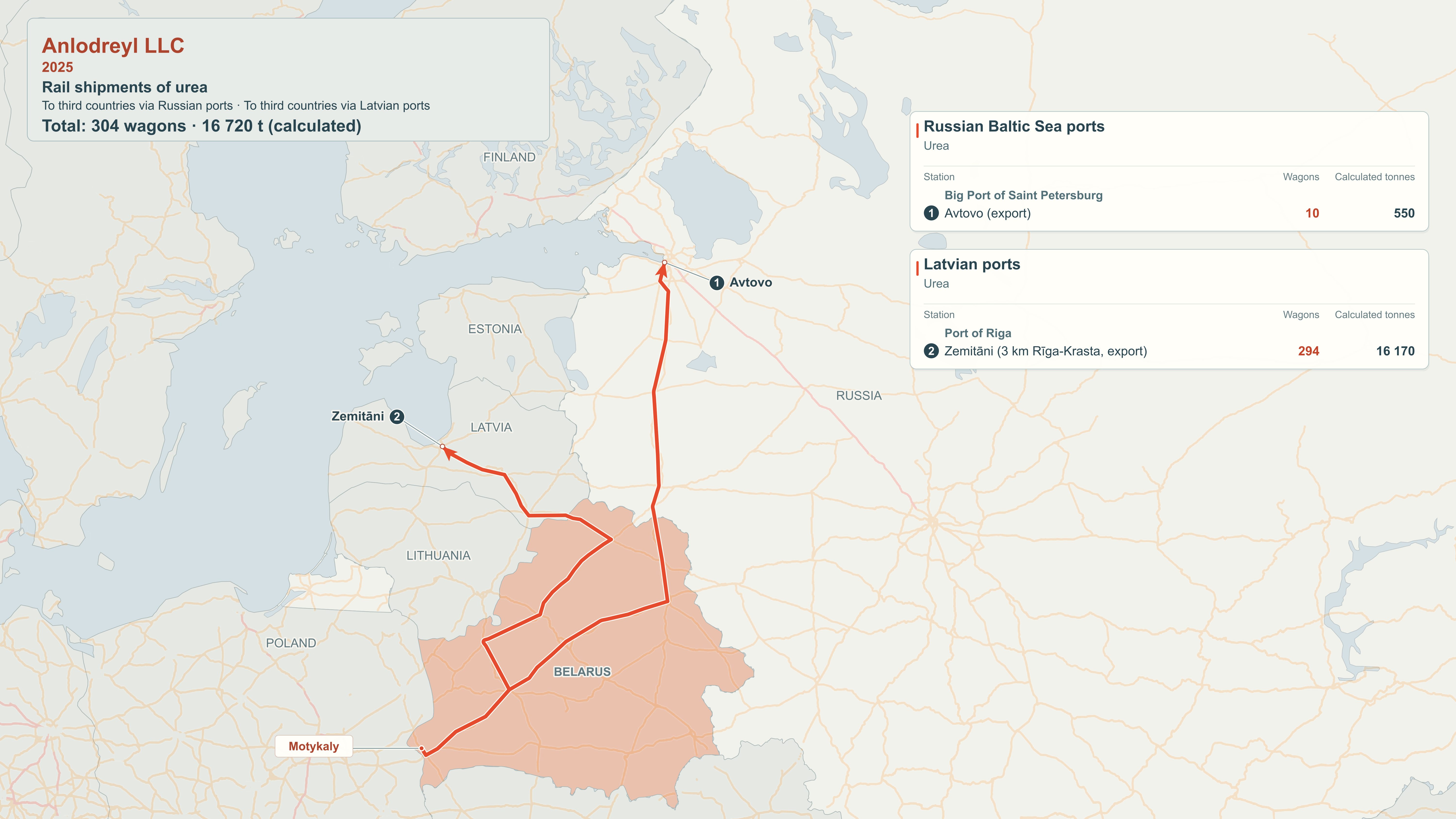
In Riga-Krasta, 160 railcars of Anlodrail's urea arrived for Concord Group, 89 – for Rin Baltic, 45 – for Rin Baltika. One station hub received the company's entire Latvian volume – 16,170 tonnes.
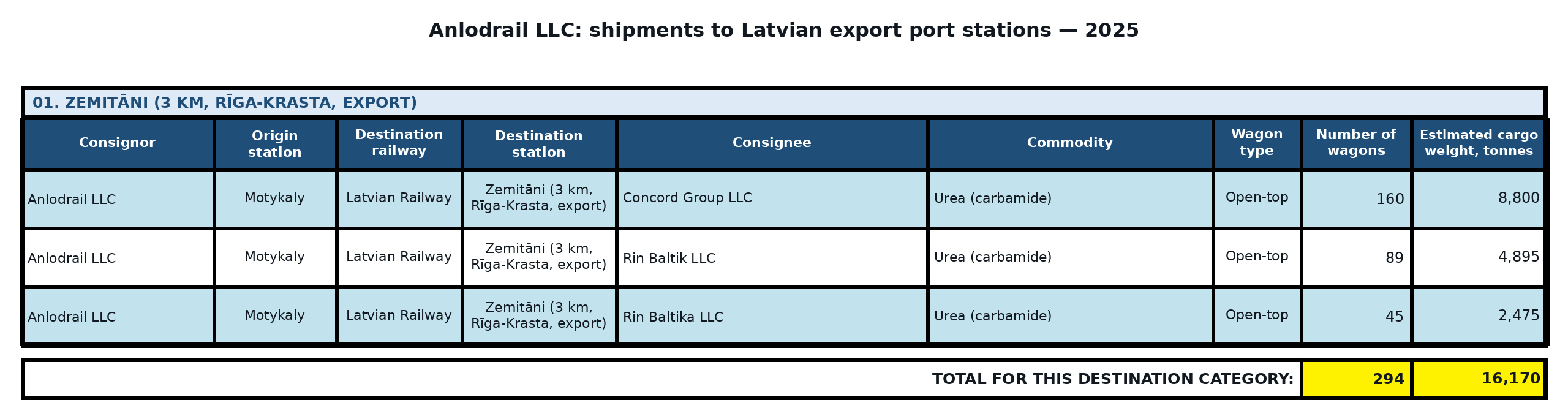
Anlodrail sent the remaining ten railcars from Motykaly to Avtovo for CFS Terminal. Their mass is 550 tonnes. The company's main direction in 2025 remained Latvia: 96.7% of railcars and tonnage.

JLLC Brestvneshtrans dispatched 88 railcars of urea with 5,016 tonnes from Brest-Severny. Two destinations – Liepaja and Zemitani – received 71 and 17 railcars respectively.
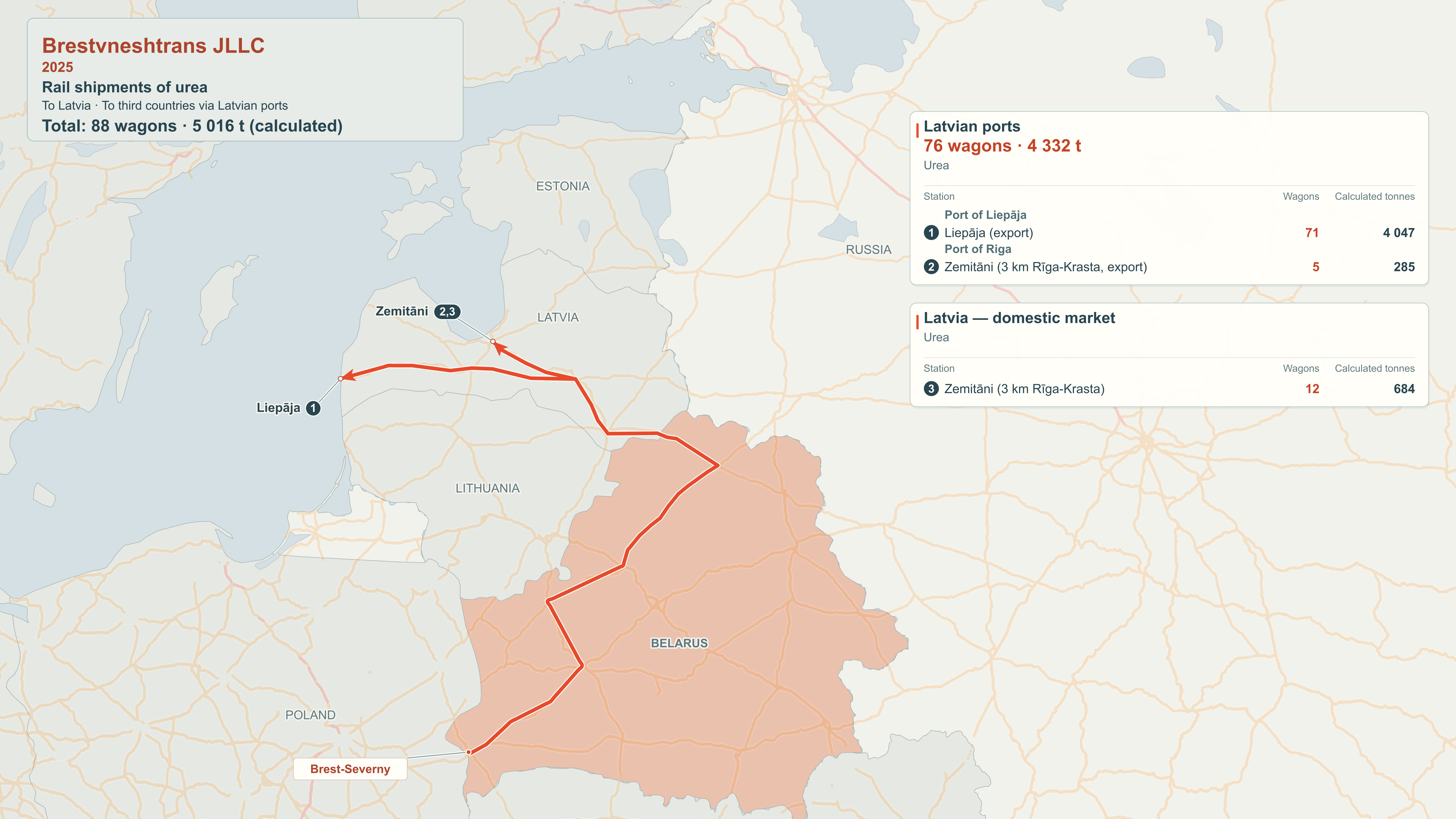
To Liepaja, 51 railcars proceeded for SIA GlobeShift Dynamics, 20 – for AS Cargo Bridge. Their total mass was 4,047 tonnes. Another five railcars, 285 tonnes, were sent to the export destination Zemitani: three for Rin Baltic and two for Concord Group.
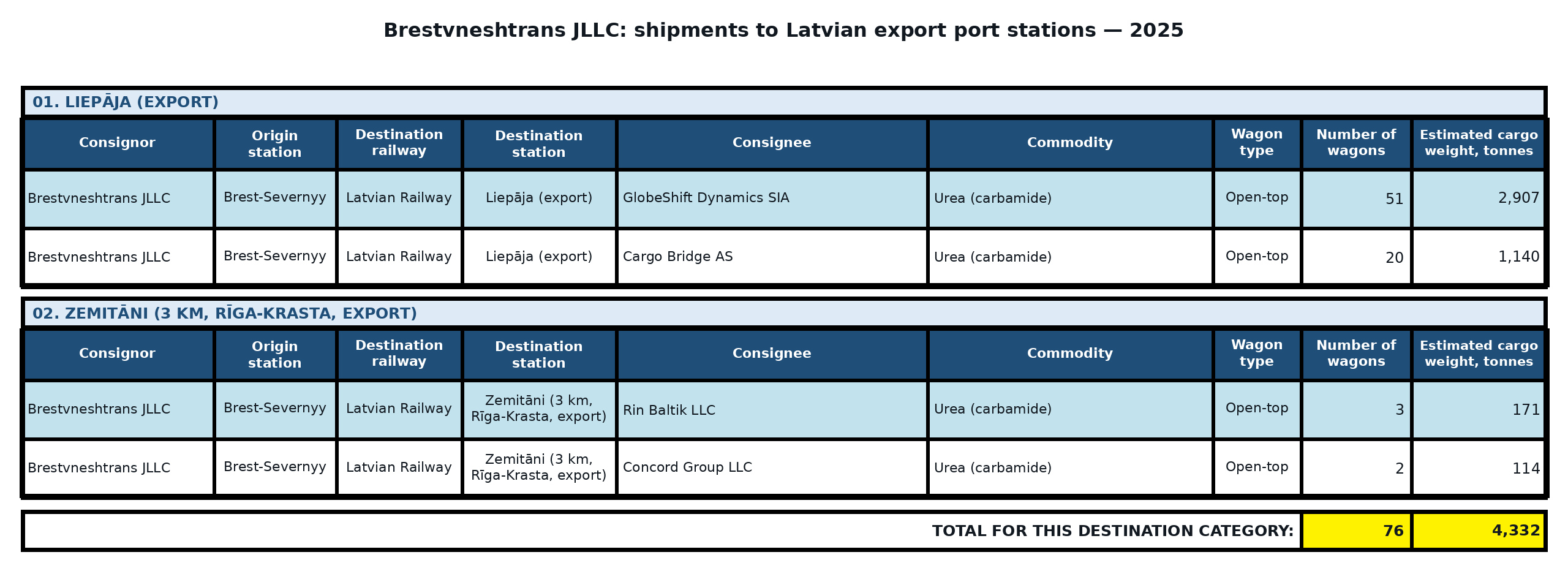
In addition to these five railcars, Brestvneshtrans delivered another 12 railcars of urea with 684 tonnes to Rin Baltic at Zemitani in non-port traffic. As a result, the company's Riga flow amounted to 17 railcars, or 19.3% of its shipments, Liepaja – 80.7%.

Unitary Enterprise Belamix dispatched 62 railcars of urea with 3,534 tonnes from Baranovichi-Tsentralny. The products were distributed among Zemitani, Liepaja, and Olaine.
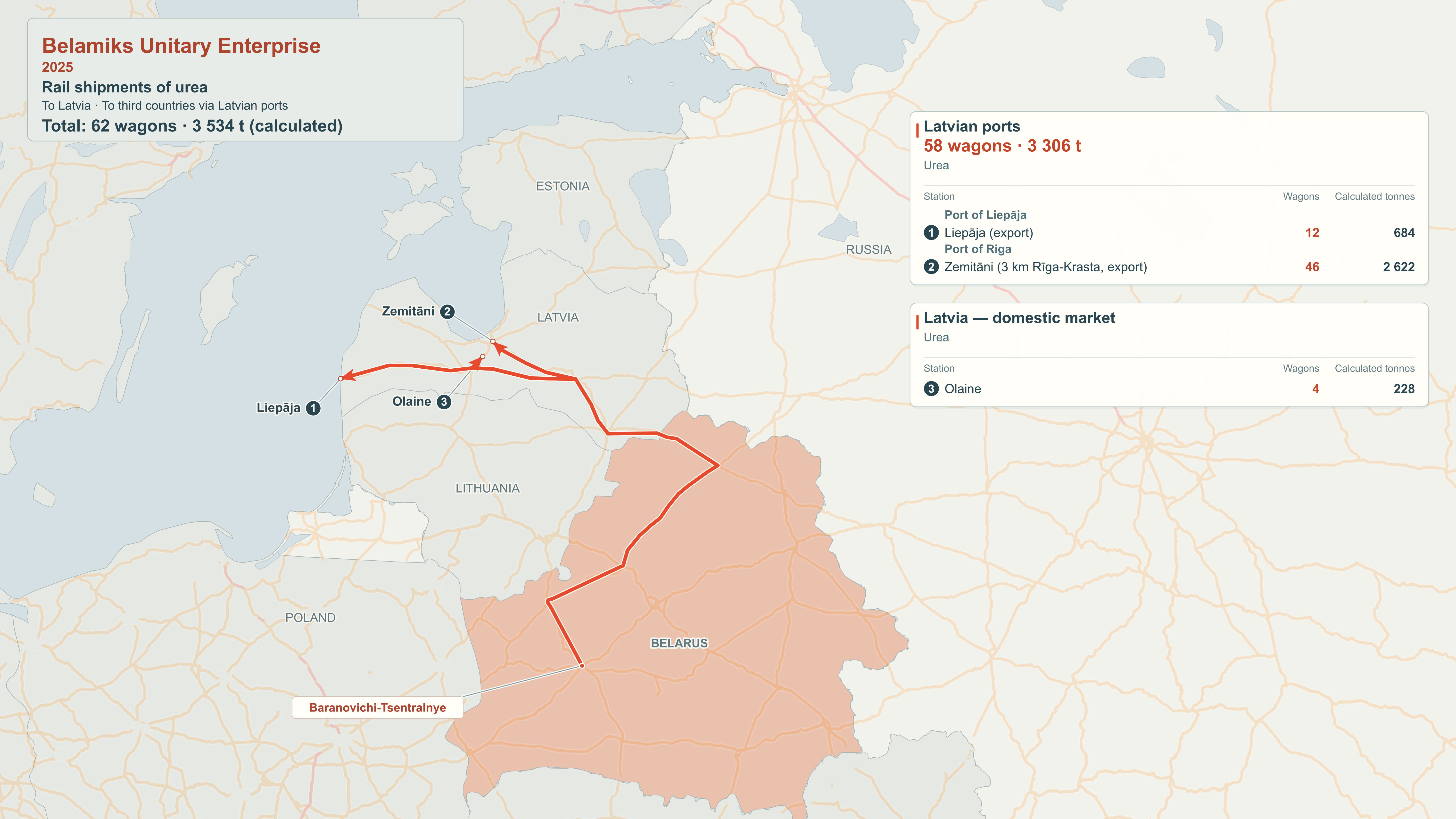
To the export destination Zemitani, 46 railcars arrived: 37 for Concord Group and nine for Rin Baltic. Another 12 railcars were delivered to Liepaja for GlobeShift Dynamics. In total, port destinations received 58 railcars with 3,306 tonnes.
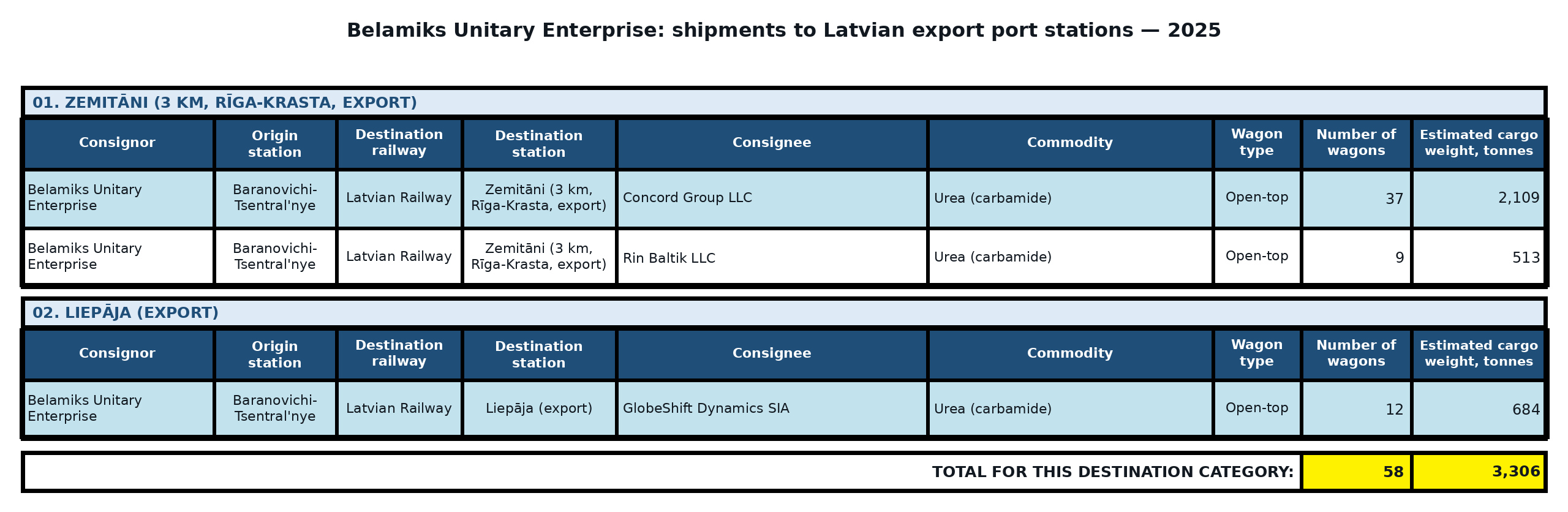
Four railcars of Belamix's urea with 228 tonnes arrived at GlobeShift Dynamics in Olaine. This recipient worked with the company in two directions – via Liepaja and with delivery to Olaine.

LLC TLK Disav dispatched 47 railcars of urea with 2,679 tonnes from Molodechno. As with Anlodrail, the main destination was Zemitani, and Rin Baltic was a recurring recipient.
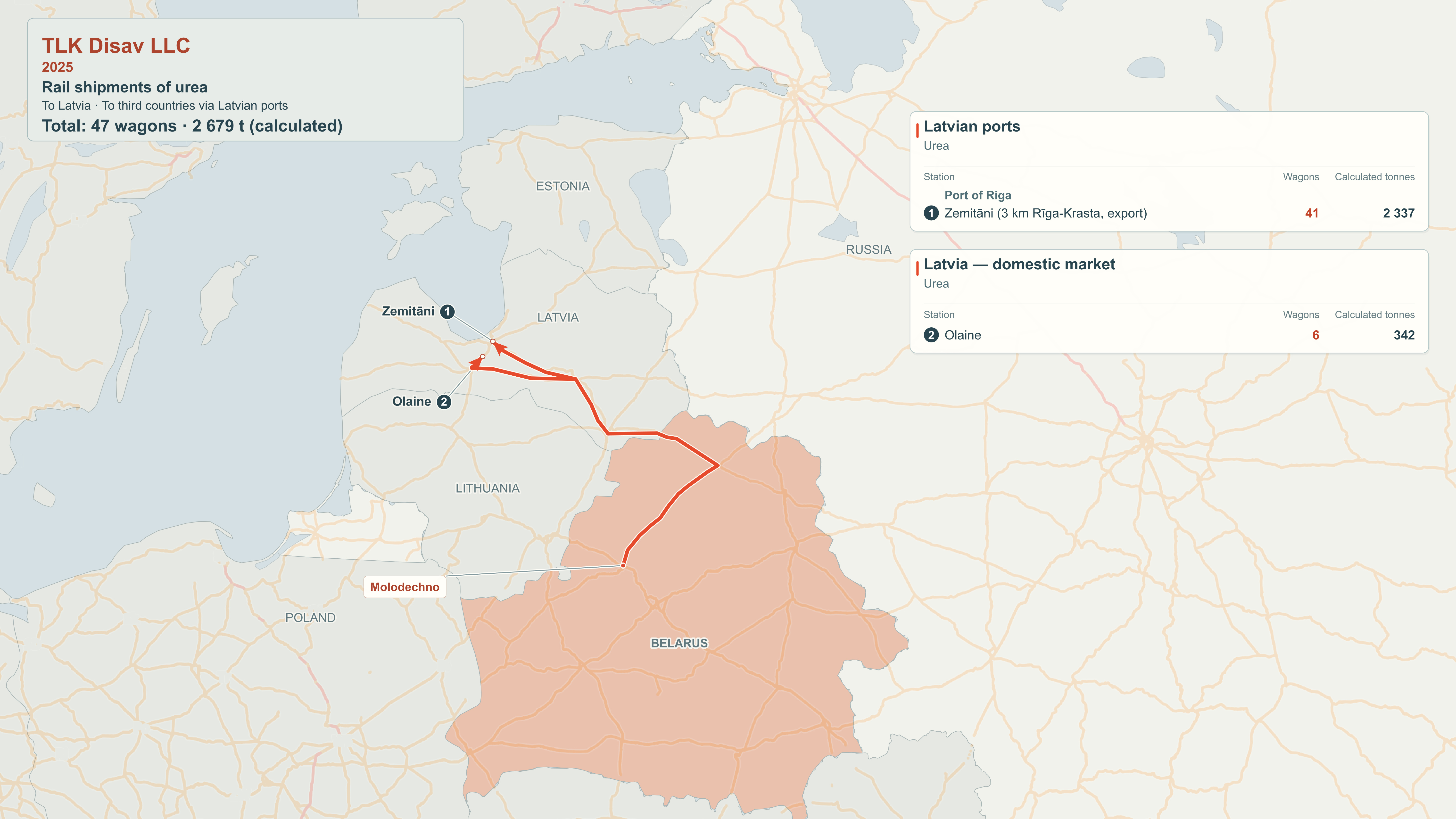
In Riga-Krasta, 41 railcars of TLK Disav with 2,337 tonnes proceeded for Rin Baltic. The Riga hub received products of the same name from Motykaly, Baranovichi-Tsentralny, and Molodechno, combining several independent shipper flows.

TLK Disav sent the remaining six railcars with 342 tonnes to Olaine for GlobeShift Dynamics. Including Belamix's four railcars, this recipient in Olaine received ten railcars of urea from two Belarusian stations.

In urea supplies, not only stations but also recipients are repeated. Concord Group and Rin Baltic receive batches in Riga-Krasta, GlobeShift Dynamics – in Liepaja and Olaine. With such an organization, a change of shipper does not necessarily mean the appearance of a new delivery direction: part of the receiving infrastructure continues to serve the same cargo flow.
LLC Technospetstrading
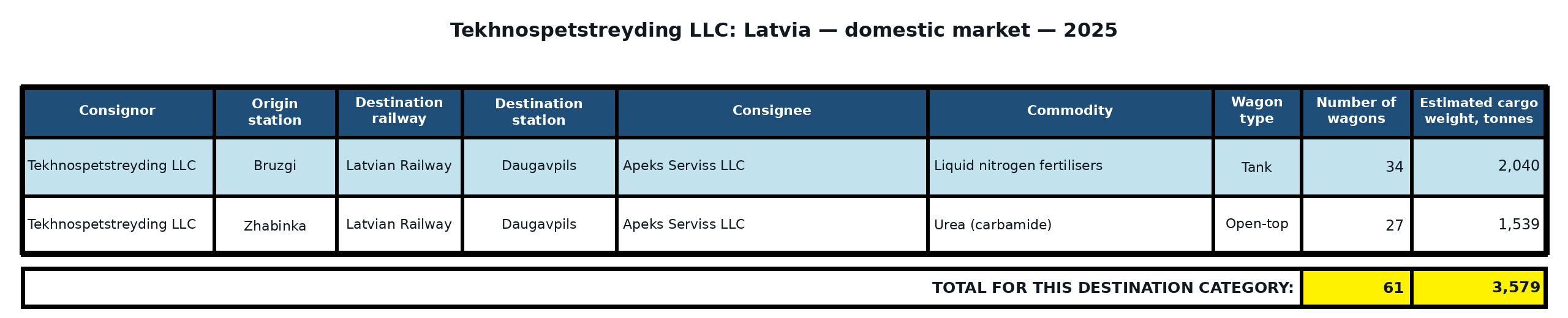
LLC Technospetstrading dispatched 62 railcars of nitrogen fertilizers with 3,636 tonnes. The main destination is Daugavpils, recipient Apex Serviss. Unlike previous companies, two product forms are presented here: liquid nitrogen fertilizers and urea.
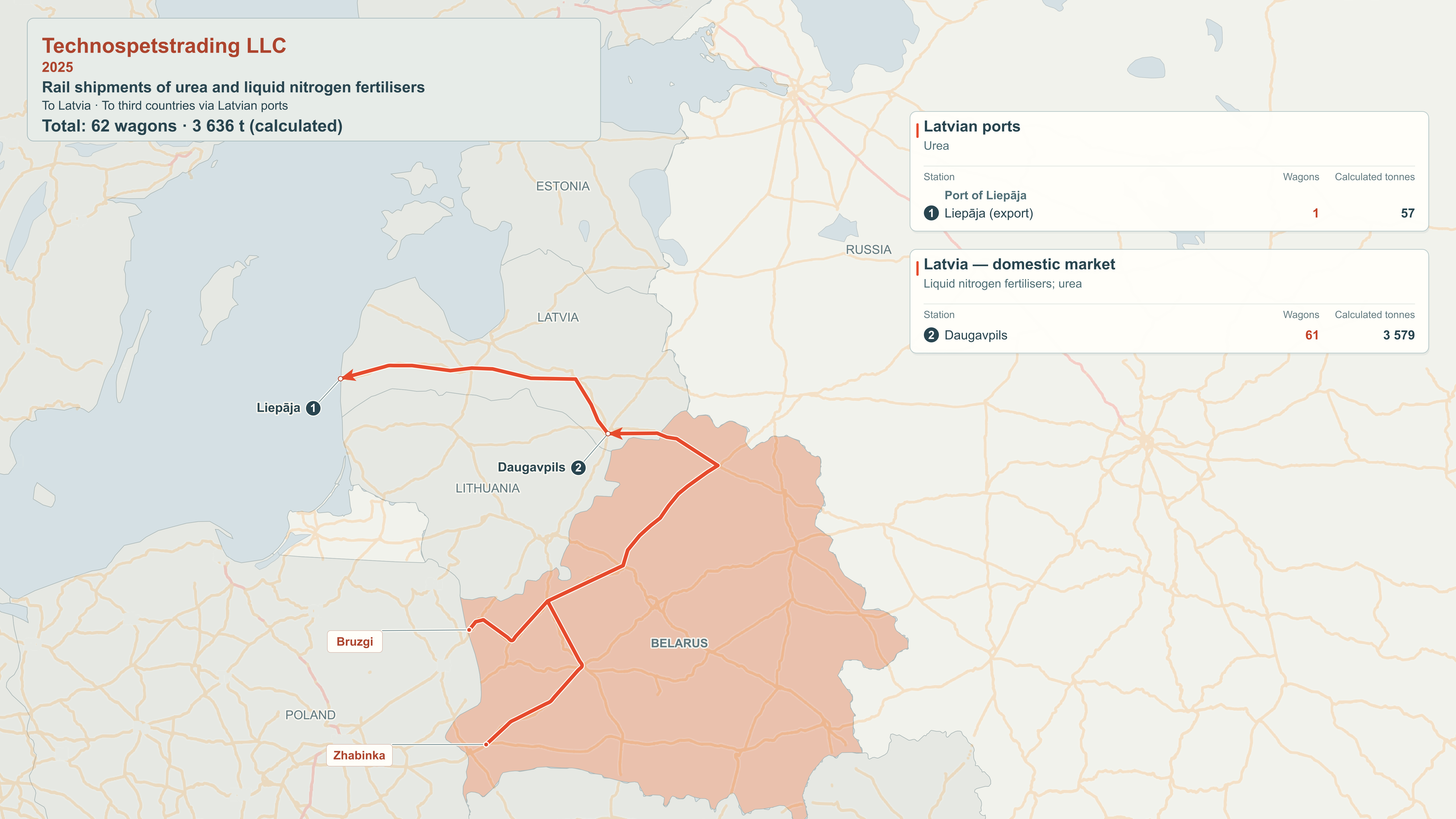
From Bruzgi to Daugavpils, 34 railcars of liquid nitrogen fertilizers were sent, from Zhabinka – 27 railcars of urea. Apex Serviss received both product forms. The Daugavpils direction accounted for 61 out of 62 of the company's railcars.
One railcar of urea from Zhabinka arrived at Liepaja for Astramar Liepaja K A. This batch complements the large Liepaja shipments of Brestvneshtrans and Belamix, but was served by a different recipient.

In the LTV/LSM investigation of June 22, 2025, the origin of urea was checked against documents and factory quality analyses. Astramar explained the supplies with Technospetstrading documents on the Turkmen origin of the products. Concord Group reported that it found no sanctions risks when checking the deal; Cargo Bridge stated compliance with restrictions. The material also described the re-registration of a batch previously rejected in Poland. The companies' statements and investigators' conclusions related to the supplies they examined.
BIC found in Technospetstrading documents a supplier Grodno Azot, which contradicted the explanation about Turkmen products. This is a substantive contradiction in the origin of the goods, not a consequence of the fact of transportation through Latvia itself.
Ammophos transportation
Foreign Unitary Enterprise Gradalogistik dispatched 152 railcars of ammophos with 9,880 tonnes. Unlike urea supplies from several stations, this entire flow was formed at Orsha-Zapadnaya. The company provides transport and forwarding services, including in railway traffic.
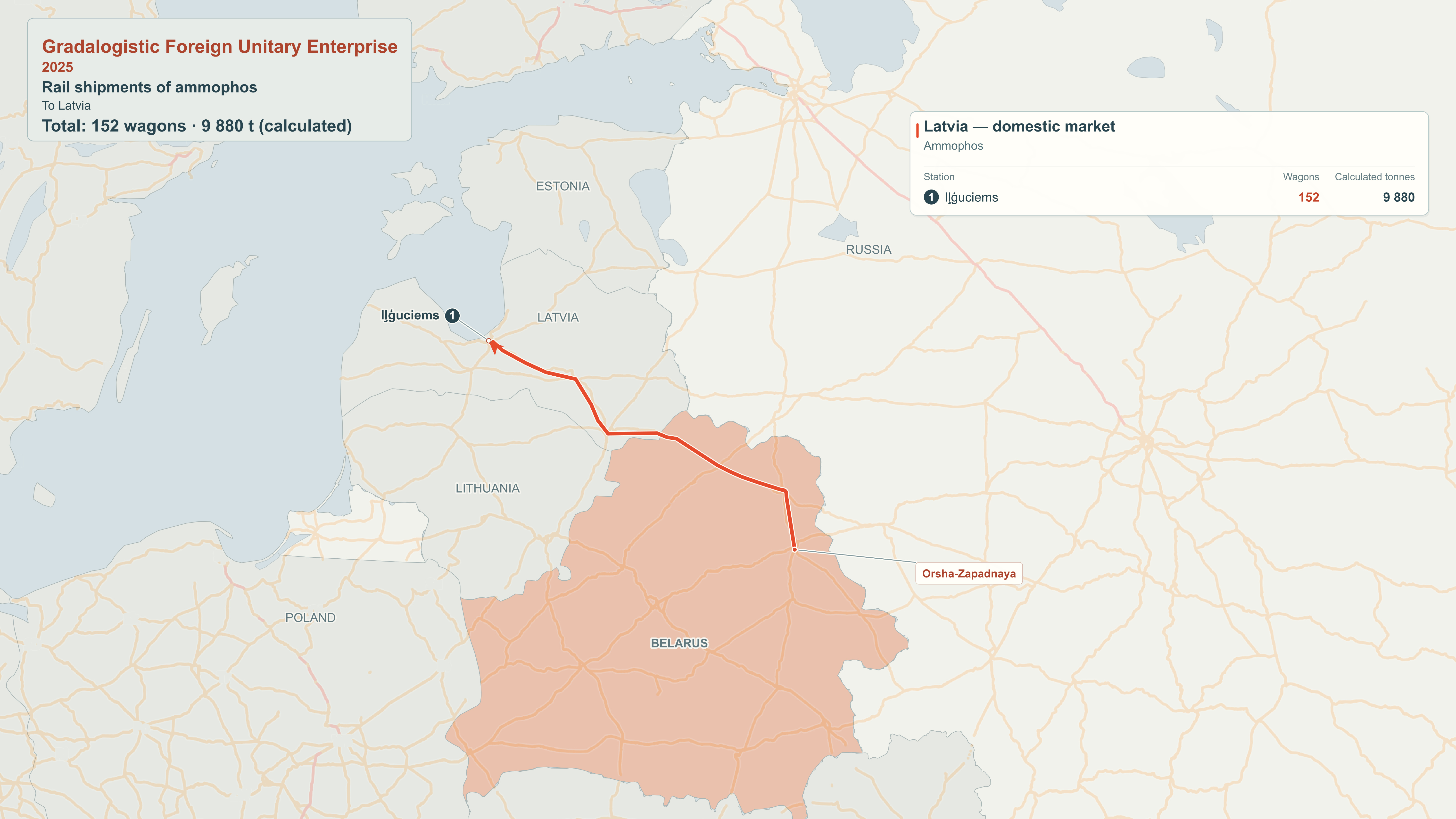
All 152 railcars arrived at Ilguciems for LLC BLC. This is the largest single shipment of ammophos to Latvia in 2025: 77.2% of railcars and mass of this cargo. The remaining volume was provided by another direction – from Vitebsk to Zemitani.

LLC Torbelservis dispatched 45 railcars of ammophos with 2,925 tonnes. Together with Gradalogistik, it ensured the supply of 197 railcars and 12,805 tonnes of this product to Latvian stations.
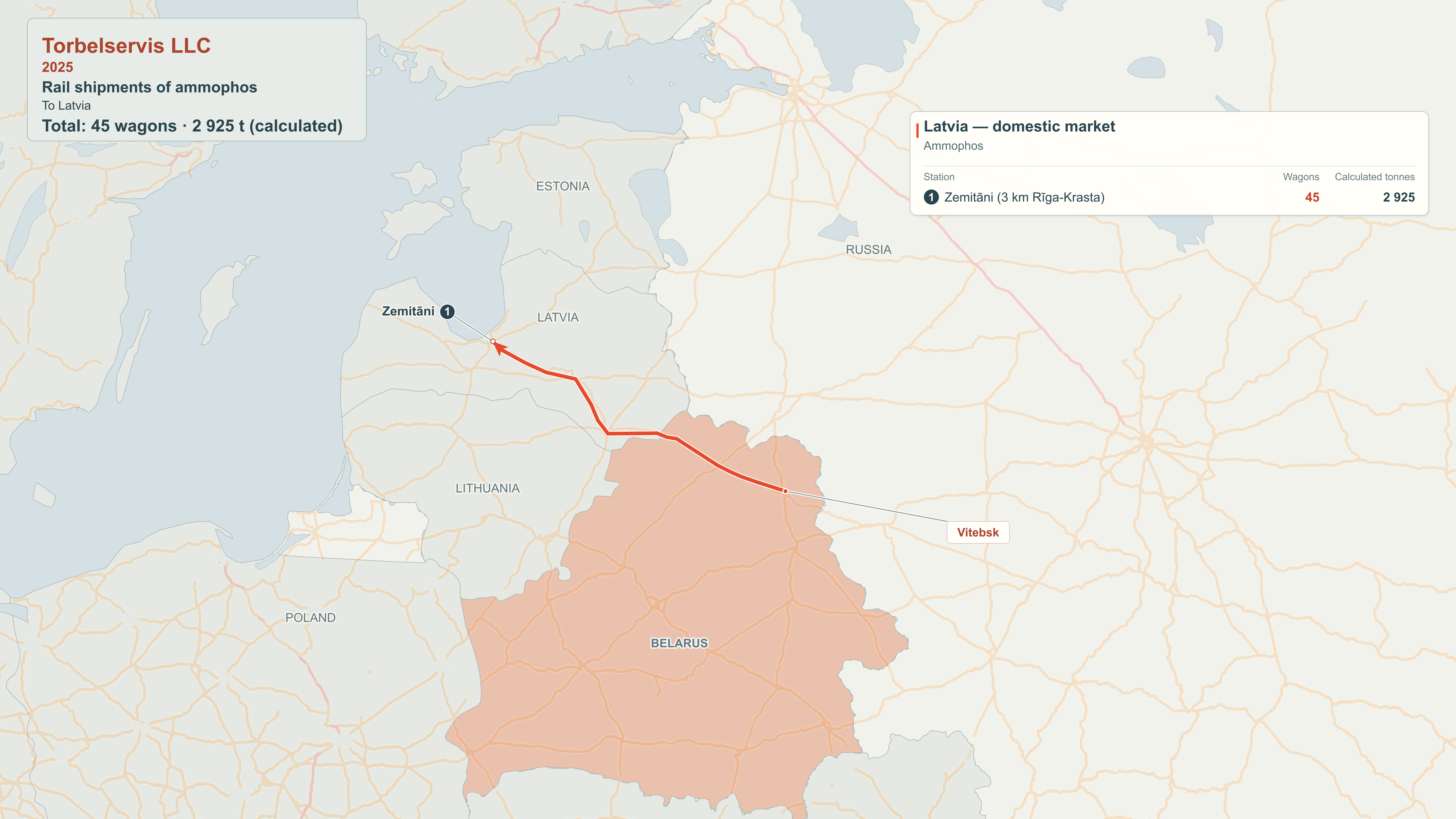
All of Torbelservis's ammophos arrived from Vitebsk to Zemitani for Signals P. Thus, supplies from the two companies converged in the Riga hub, but at different stations – Zemitani and Ilguciems – and to different recipients.

Transportation of liquid nitrogen fertilizers and ammonia
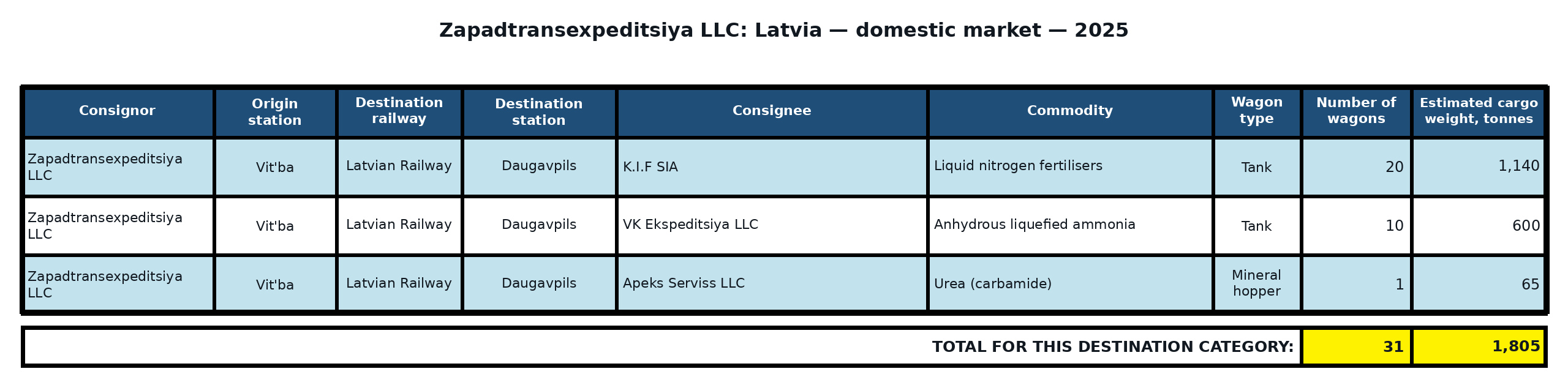
LLC Zapadtransekspeditsiya sent 31 railcars with 1,805 tonnes from Vitba to Daugavpils. Unlike the predominantly urea transportation by other intermediaries, the main mass here consisted of liquid nitrogen fertilizers and ammonia.
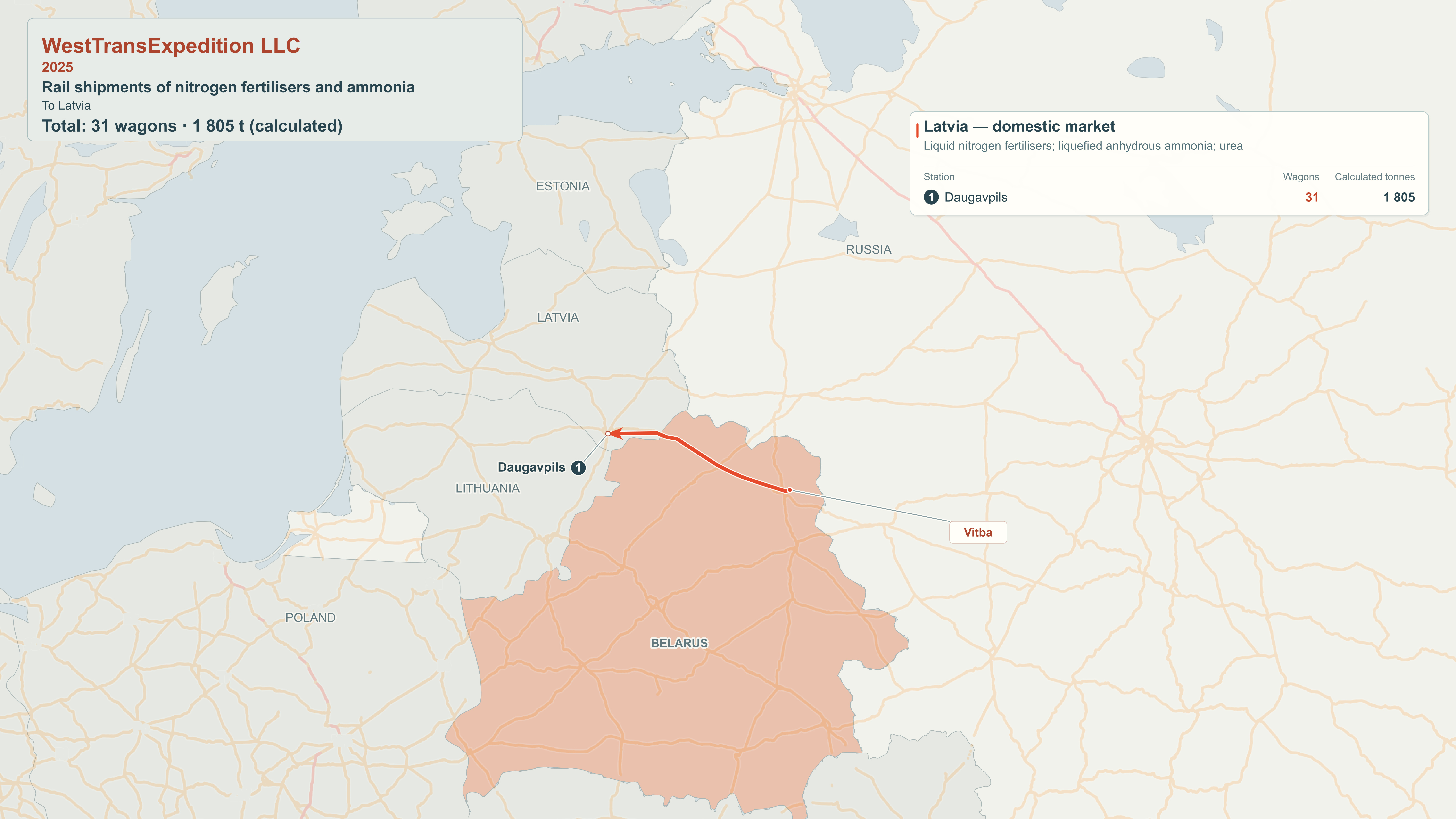
Twenty railcars of liquid nitrogen fertilizers with 1,140 tonnes arrived at SIA K.I.F, ten railcars of anhydrous ammonia with 600 tonnes – at VK Expeditsiya. Another railcar of urea with 65 tonnes was received by Apex Serviss. All batches traveled between the same stations but were distributed among three recipients by product type.
Customs checks in Latvia did not conclude with a unified departmental decision. According to an LSM report from August 24, 2025, customs identified signs of possible sanctions circumvention, and the tax and customs police issued four decisions to refuse initiation of criminal proceedings, finding no elements of a crime. Customs, in cooperation with financial intelligence, appealed the refusals. As of the publication date, the materials were under review by the prosecutor's office.
1.9. Results for 2025 and comparison with 2024
The result for 2025 is 214,869 railcars and 11,118,642 estimated tonnes. Russian port stations accounted for 81.7% of the mass, with Belaruskali forming the basis of this flow. For Grodno Azot, port and non-port supplies differed in product range; for Gomel Chemical Plant, distributed shipments to Russian non-port stations predominated.
Supplies through Latvia developed against the backdrop of the previously established Polish direction. For January–November 2024, the Community of Railway Workers of Belarus noted 1,961 railcars of urea with 108.3 thousand tonnes and 697 railcars of liquid nitrogen fertilizers with 40.2 thousand tonnes there. These volumes show the scale of the western railway exit before subsequent changes in trade and control conditions.
In the review of Latvian and Lithuanian directions for January–September 2024, ammonium nitrate and other mineral fertilizers occupied a significant place. In 2025, the considered Latvian supplies consisted almost two-thirds by mass of urea. Along with the product range, the list of shippers also changed.
The year's outcome is determined by three features. Potash export is concentrated at Russian ports, while separate overland logistics to China through Kazakhstan and eastern exits are maintained. Nitrogen and complex fertilizers differ by destination: from large terminal shipments to distributed supply to regional recipients. In the Latvian direction, several Belarusian stations form batches for a recurring circle of receiving companies.
Section II. Railway Export of Belarusian Fertilizers and Related Products in January–April 2026
2.1. Total Volume, Intensity, and Commodity Structure of Transportation
In January–April 2026, 73,524 railcars with 3,877,132 tonnes were dispatched. Monthly mass varied within narrow limits: 958.7 thousand tonnes in January, 973.9 thousand in February, 965.2 thousand in March, and 979.3 thousand in April. The difference between maximum and minimum was only 2.1%. However, when converted to calendar days, February was the most intensive – 34.8 thousand tonnes per day against 30.9 thousand in January.
Belaruskali accounted for 94.0% of the mass, compared to 90.7% in 2025. Its steady shipments determined the overall result, while the reduction in supplies from other enterprises had a significantly smaller impact on the total tonnage. Without Belaruskali, the average monthly mass decreased by 32.1%.
Compared to the average month of 2025, railcar shipments increased by 2.7%, mass – by 4.6%. For Belaruskali, changes are close: plus 8.3% for railcars and 8.4% for tonnage. For Grodno Azot, both indicators decreased – by 75.9% and 67.0% respectively. For Gomel Chemical Plant, railcar volume increased by only 1.8%, mass – by 15.2%.
The difference between the two indicators is due to the commodity structure and the share of container traffic. This is especially noticeable for chemical enterprises: a change in the number of railcars is accompanied by a change in the average shipment mass per railcar. Therefore, a similar railcar volume does not always mean similar tonnage.
Russian port stations received 3.324 million tonnes — 85.7% of the total volume. Non-port Russian destinations accounted for 487.1 thousand tonnes, Zabaikalsk and Grodekovo in Chinese traffic for 52.3 thousand, and Latvia for 14.1 thousand tonnes. Latvian supplies in the first four months focused on Riga stations and Daugavpils; the previous urea export to Liepaja was absent.
2.2. JSC Belaruskali
Belaruskali shipped 69,957 railcars with 3,643,500 tonnes. The main loading stations remained Kaliy III, Kaliy I, Kaliy IV, and Mulyarovka. Monthly shipments ranged from 17,279 to 17,679 railcars, with a mass of 898.8–919.6 thousand tonnes. The overall intensity changed little, but a noticeable redistribution occurred within the port direction.
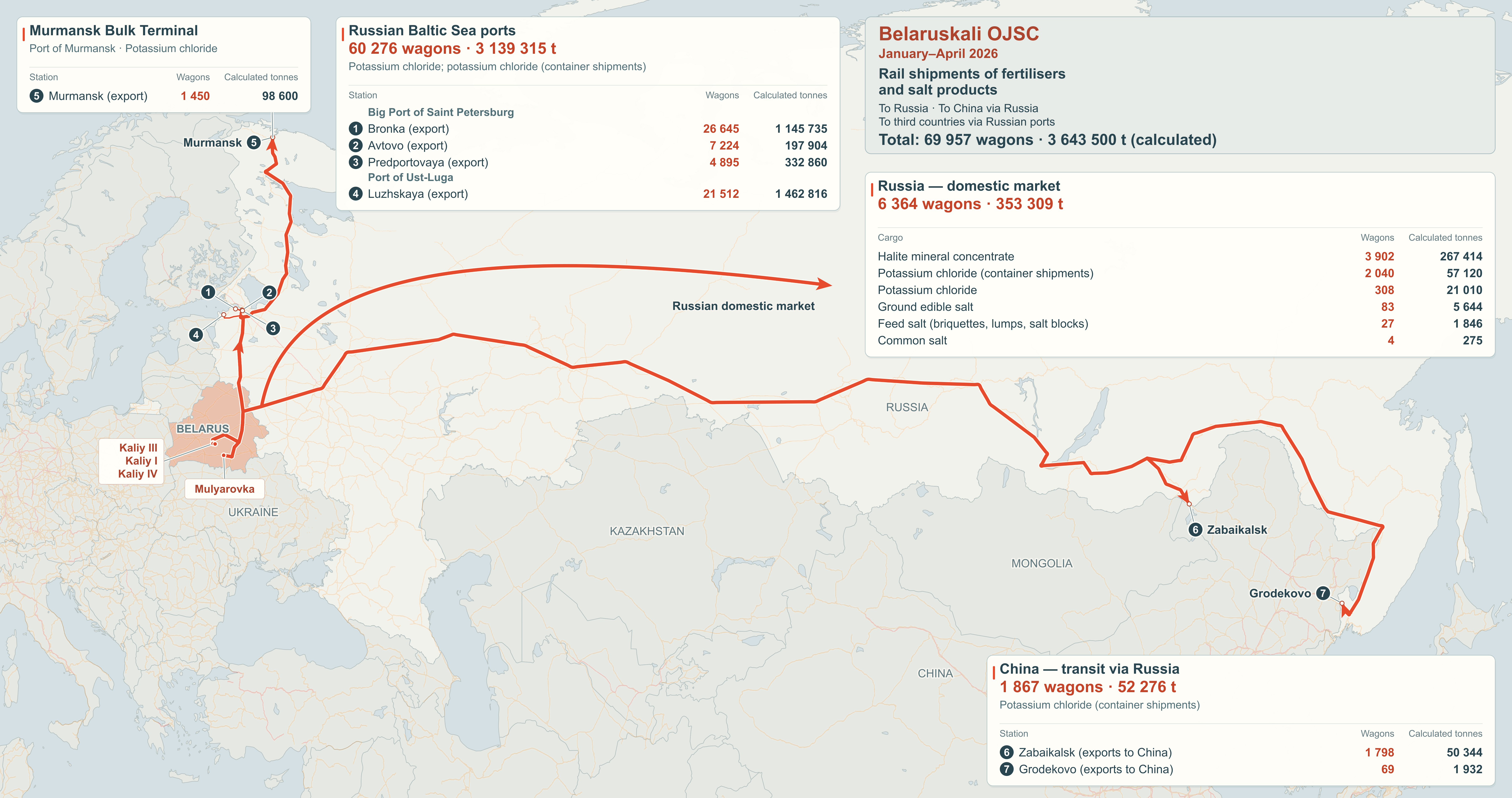
Exports to Third Countries via Russian Ports
61,726 railcars with 3.238 million tonnes were sent to port stations — 88.9% of the enterprise's mass. Bronka retained the first place in terms of the number of railcars — 26,645. In terms of tonnage, Luzhskaya was ahead: 1.463 million versus 1.146 million tonnes at Bronka. The ratio of the two indicators reflects the difference between containerized and non-containerized exports.
| Station | 2025, railcars | 2025, tonnes | Jan.–Apr. 2026, railcars | Jan.–Apr. 2026, tonnes |
|---|---|---|---|---|
| Bronka | 91,992 | 3,955,656 | 26,645 | 1,145,735 |
| Luzhskaya | 42,293 | 2,875,924 | 21,512 | 1,462,816 |
| Predportovaya | 14,423 | 980,764 | 4,895 | 332,860 |
| Avtovo | 18,364 | 843,632 | 7,224 | 197,904 |
| Makhachkala | 351 | 23,868 | — | — |
| Murmansk | — | — | 1,450 | 98,600 |
| Total | 167,423 | 8,679,844 | 61,726 | 3,237,915 |
Luzhskaya's share in the port mass increased from 33.1% in 2025 to 45.2% in January–April 2026. Bronka's share decreased from 45.6% to 35.4%. On average, Luzhskaya received 52.6% more estimated tonnes per month than the average month of 2025, while Bronka received 13.1% less. This is a redistribution within the main Russian port direction, not a departure from it.
In addition to these two stations, Predportovaya received 4,895 railcars with 332.9 thousand tonnes, and Avtovo received 7,224 railcars with 197.9 thousand tonnes. The recipients remained the same: Port Cargo Service and BasisPort. Makhachkala, which was represented in 2025, is absent from the four-month shipments. A new destination for the period under review is Murmansk, with 1,450 railcars carrying 98.6 thousand tonnes for the Murmansk Bulk Terminal.
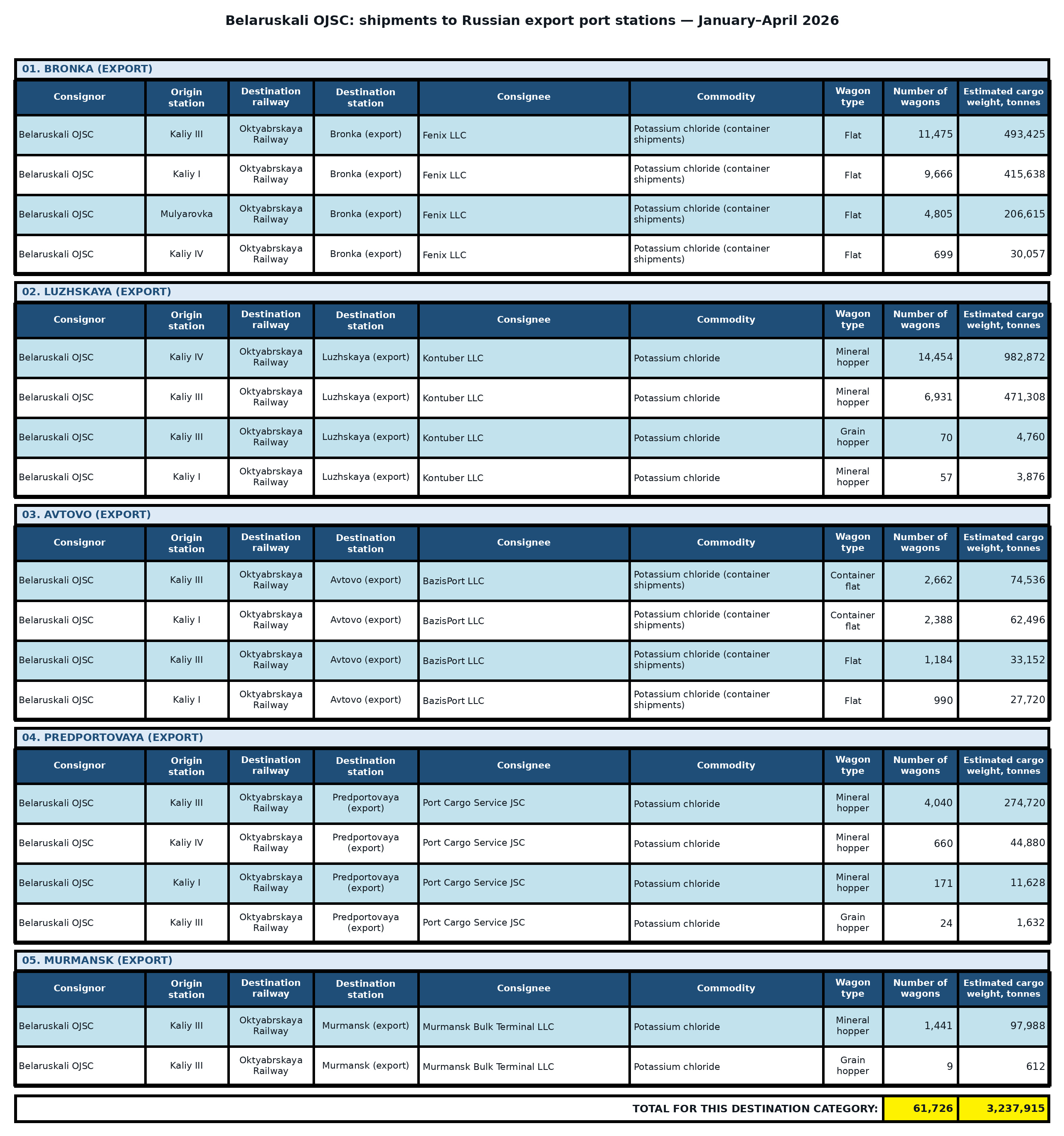
The monthly distribution clarifies how the total was formed. Luzhskaya received 343.9 thousand tonnes in January, 377.3 thousand in February, 336.1 thousand in March, and 405.5 thousand in April. Bronka received 332.9; 250.8; 270.0 and 292.1 thousand tonnes, respectively. Therefore, Luzhskaya's final advantage was not due to a single random month: in terms of estimated mass, it was higher than Bronka in all four months.
Luzhskaya provided the highest monthly mass throughout January–April. Its weight particularly increased in April: 405.5 thousand tonnes compared to 292.1 thousand at Bronka. At the same time, the enterprise continued to operate through both stations — the change in proportions was not accompanied by a rejection of the bulk-container direction.
Shipments via Murmansk
Belaruskali's shipments to Murmansk accounted for 336 railcars with 22,848 tonnes in February and 1,114 railcars with 75,752 tonnes in March. There were no such shipments in January and April. Thus, the entire four-month volume — 98,600 tonnes — was concentrated in two months, predominantly in March.
This concentration coincides in time with published reports from the Murmansk Bulk Terminal. In early March, the terminal reported an urgent request for approximately 100 thousand tonnes of potash fertilizers from an exporter who usually operated via the Baltic, amidst difficult ice conditions. The exporter's name was not disclosed in the report.
The April press release from MBT already provided results: 397.7 thousand tonnes of potash fertilizers for the first quarter, of which 252.7 thousand tonnes were in March, as well as the fulfillment of an urgent request for 102.1 thousand tonnes. The terminal linked the increase in transshipment to the redirection of some cargo from the Baltic and the growth of regular supplies. These are the terminal's figures for all relevant clients, not just the Belarusian sender.
Belaruskali's Murmansk shipment coincided with the expansion of MBT's operations amidst difficulties in the Baltic. However, the exporter of the urgent consignment was not named in the terminal's report, so there is insufficient basis to equate it with Belaruskali's 98.6 thousand tonnes. The very appearance of a large February-March flow indicates the use of another port outlet alongside the St. Petersburg destinations.
A specialized complex operates at MBT: fertilizers are unloaded from hoppers and mechanically fed for ship loading. This technology allows for receiving the corresponding railcar flow without organizing a container scheme, as used at Bronka. In April, there were no Belaruskali shipments to Murmansk, while the four St. Petersburg destinations continued operations.
Export of Potash Products to China
Via Zabaikalsk and Grodekovo, 1,867 railcars with 52,276 tonnes were sent to China: 1,798 railcars via Zabaikalsk and 69 via Grodekovo. All consignments were addressed to Liaoning Migao Chemical Co., Ltd. The route via Naushki, represented in 2025, was absent in January–April. These figures relate only to the two eastern outlets, not to the Kazakh corridor.
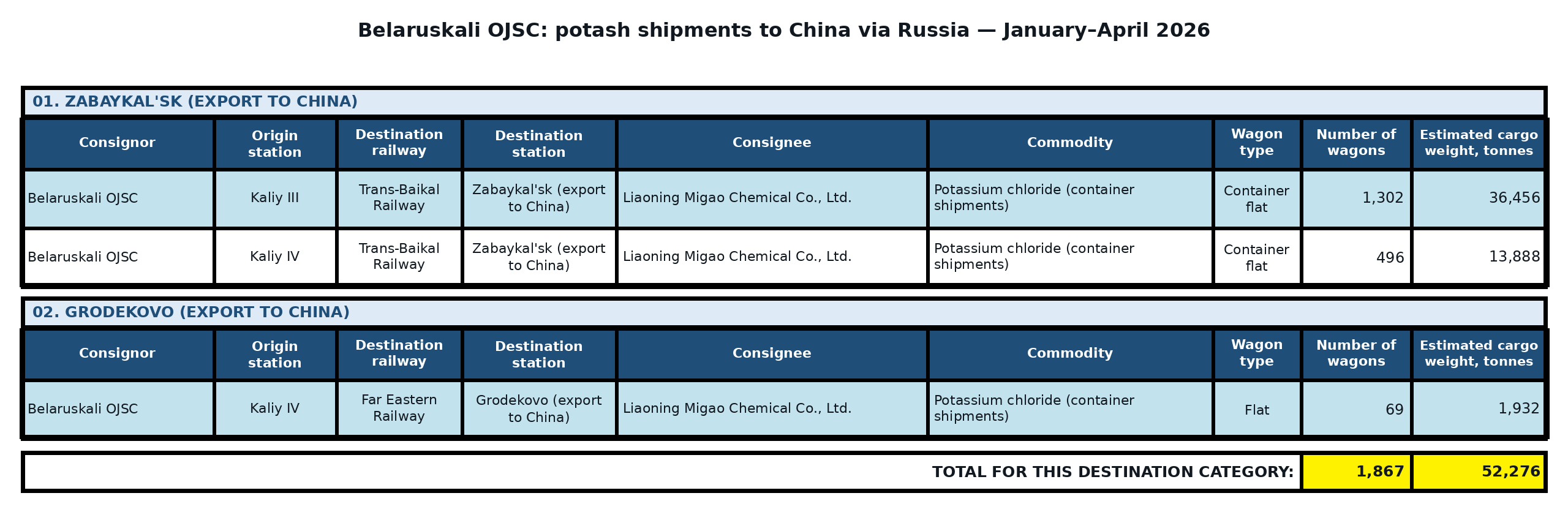
434 railcars went to Zabaikalsk in January, 496 in February, and 434 each in March and April. All 69 railcars via Grodekovo were dispatched in April. The Zabaikalsk outlet accounted for 96.3% of the railcars of the two branches under consideration, while Grodekovo supplemented it only in the last month of the period.
The average monthly mass of Belaruskali's supplies through these eastern outlets increased by 19.7% compared to the average month of 2025. At the same time, the number of active border directions decreased from three to two, and the entire flow concentrated on a single recipient. This is a change in the eastern delivery branch, complementing the main route through Russia and Kazakhstan.
Supplies to the Russian Federation
Non-port Russian destinations received 6,364 railcars with 353,309 tonnes. As in 2025, halite predominated — 267.4 thousand tonnes. Potassium chloride, including containerized consignments, amounted to 78.1 thousand tonnes, and other salts to 7.8 thousand tonnes. NHTK still occupies a significant place in the potash segment: 2,006 railcars to Zeletsino and 24 to Biklyan, totaling 56,840 tonnes.
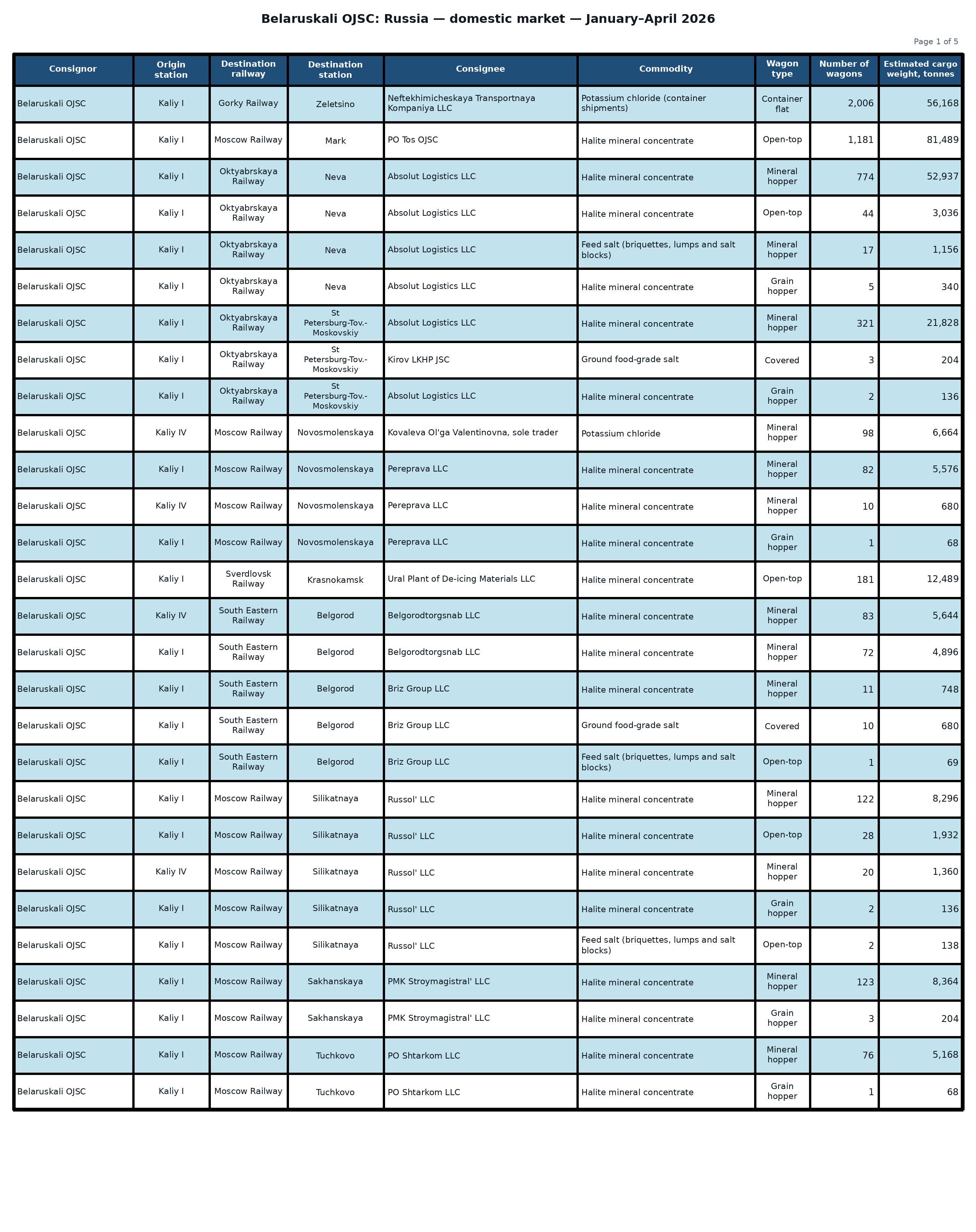
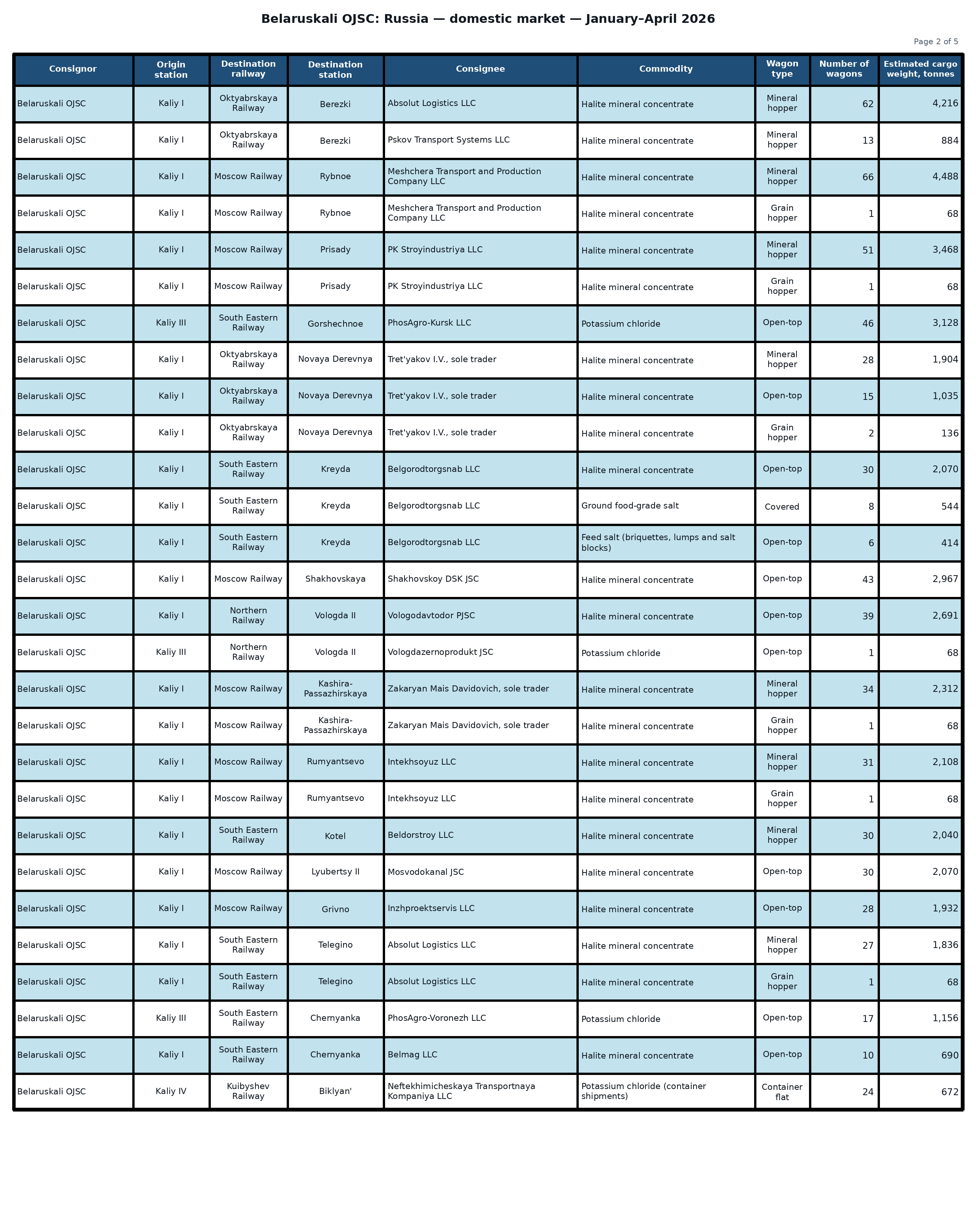
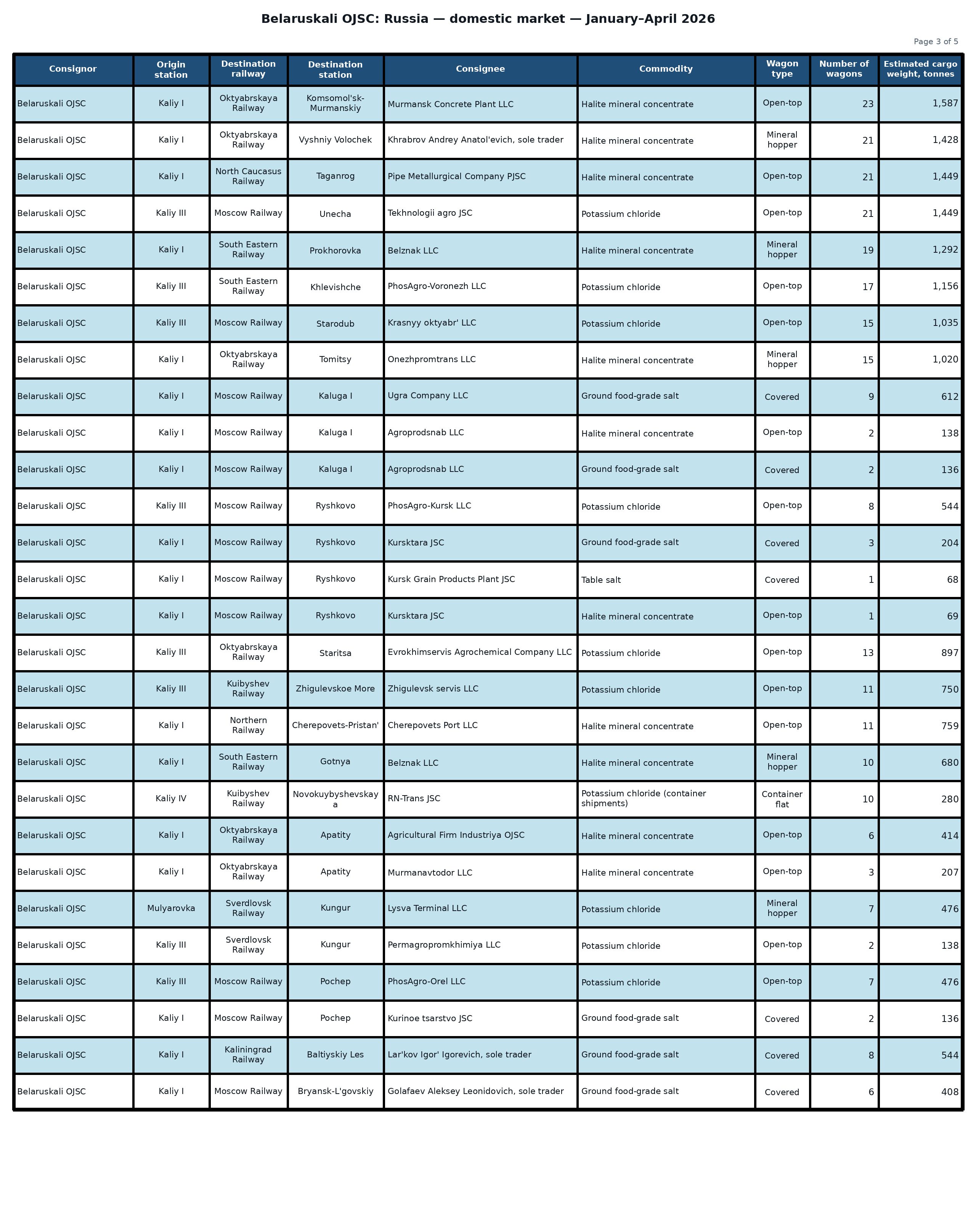
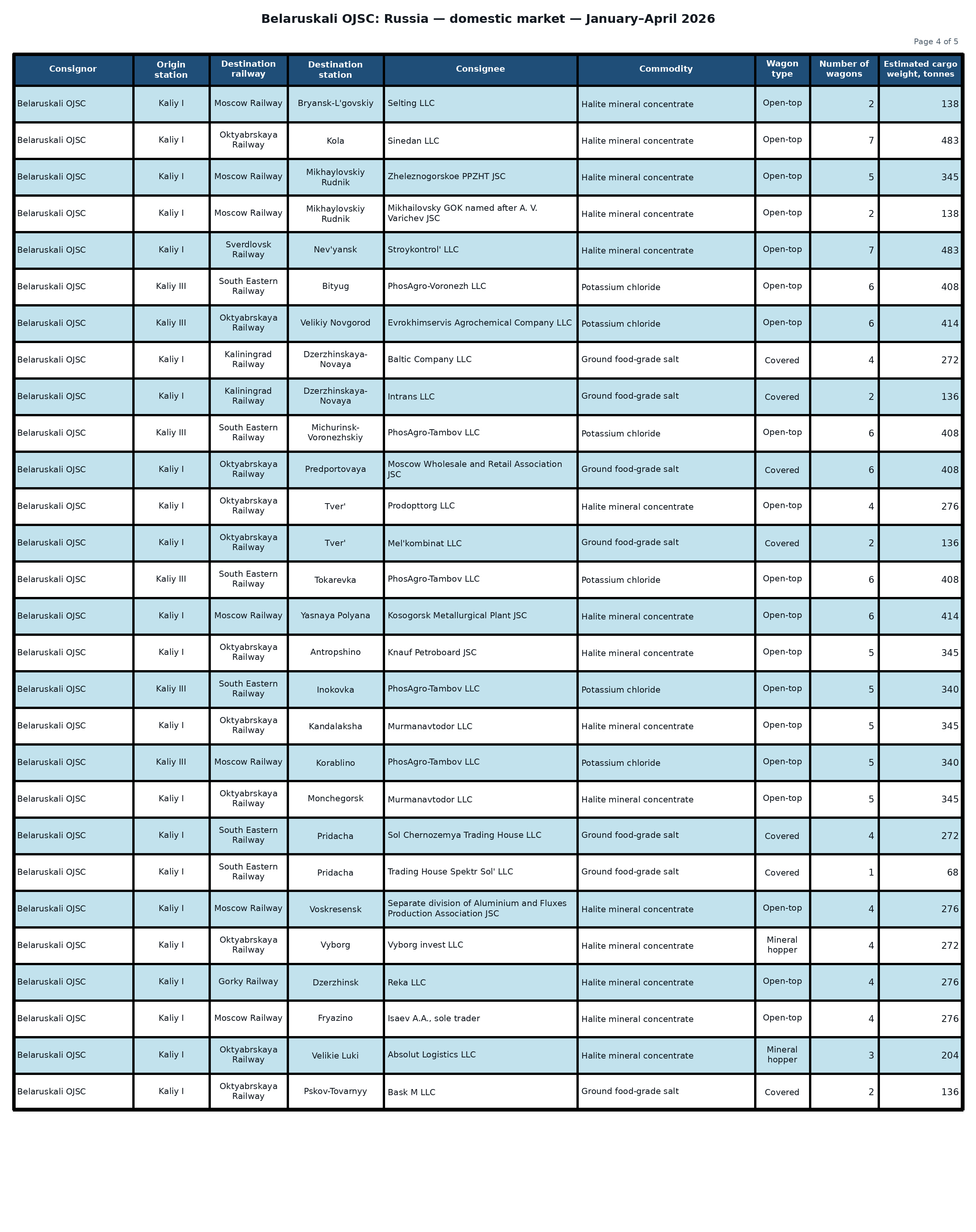
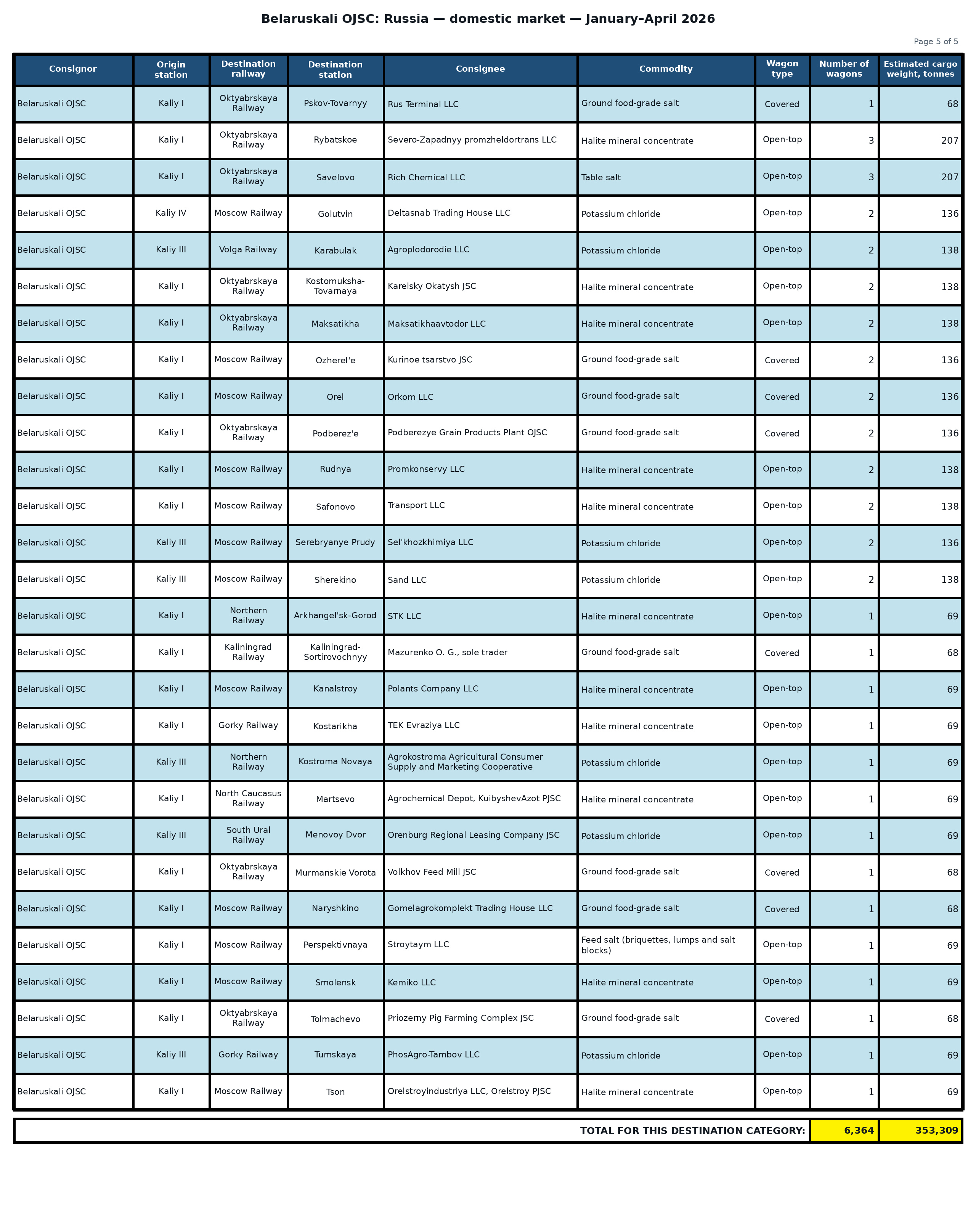
Halite continued to form the bulk of non-port shipments — 75.7%. Potash addressed to NHTK at Zeletsino and Biklyan accounted for 56.8 thousand tonnes out of 78.1 thousand tonnes of potassium chloride in this direction. Thus, both distributed salt shipments and more concentrated potash supplies to a transport recipient were maintained simultaneously.
2.3. JSC Grodno Azot
From January to April, Grodno Azot shipped 1,055 railcars with 62,000 tonnes. Of this mass, 45,468 tonnes were urea, 14,460 tonnes were ammonium sulfate, and 2,072 tonnes were containerized products. Liquid nitrogen fertilizers, anhydrous ammonia, and other related items, which were represented by the main sender in 2025, are absent in the four months under review.
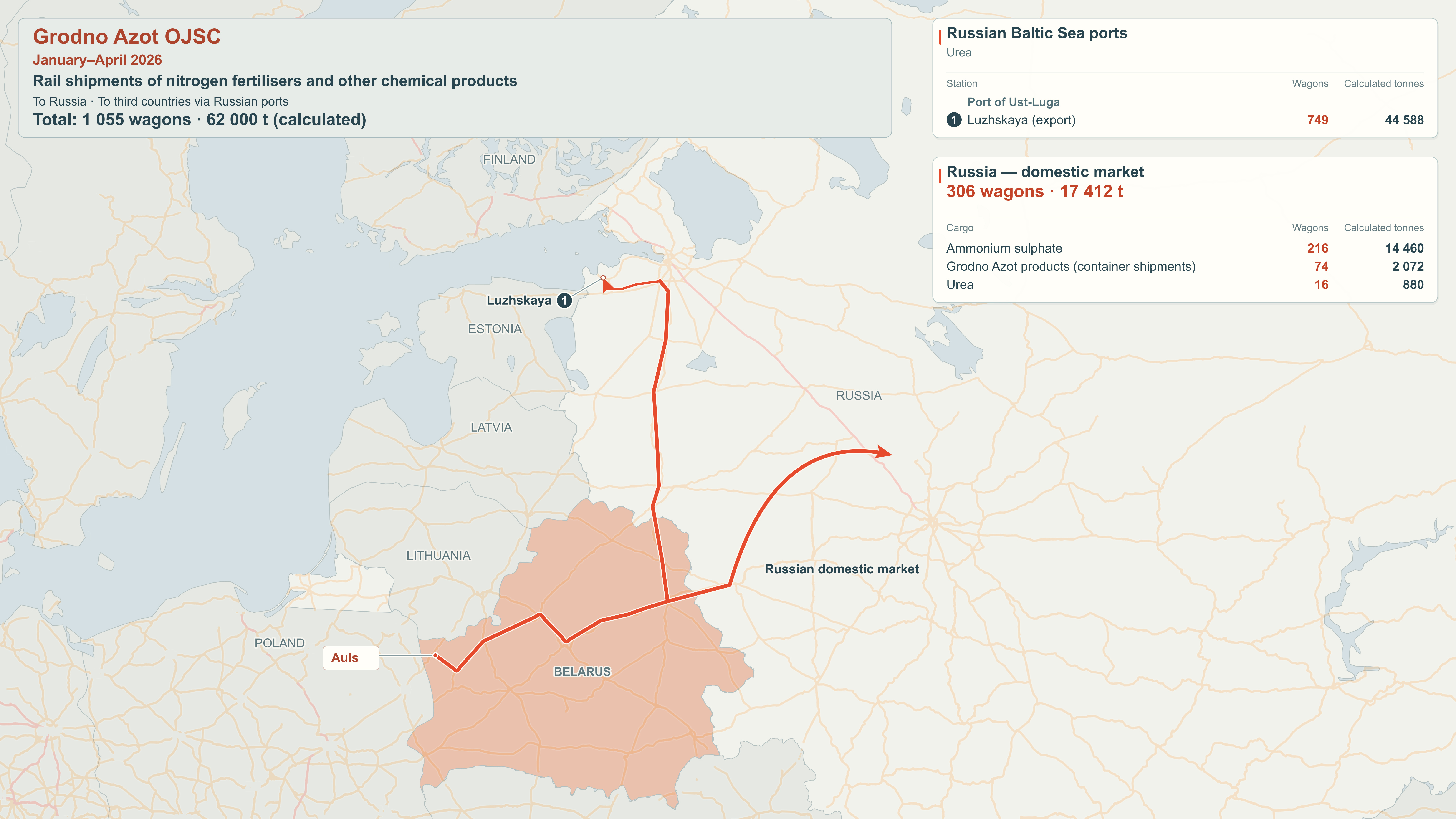
Containerized shipments decreased from 597 railcars per average month in 2025 to 18.5 railcars per month in January–April 2026 — a 96.9% reduction. The change also affected geography: large containerized supplies to Avtovo and Bronka ceased in the four-month period under review. For comparison, the average monthly shipment of urea decreased significantly less — from 196.5 to 191.3 railcars.
Grodno Azot's entire port flow concentrated on Luzhskaya: 749 railcars of urea with 44,588 tonnes for Kontuber. This destination accounted for 71.9% of the enterprise's total mass. The main port export was now provided by a single commodity and a single station outlet.

Grodno Azot's non-port Russian supplies amounted to 306 railcars with 17,412 tonnes. The main part was ammonium sulfate to Koshta for Oberon Trading: 216 railcars with 14,460 tonnes. Small containerized consignments were sent to Chepetskaya and Kaznacheevka; another 16 railcars of urea went to Dyatkovo for CTK.
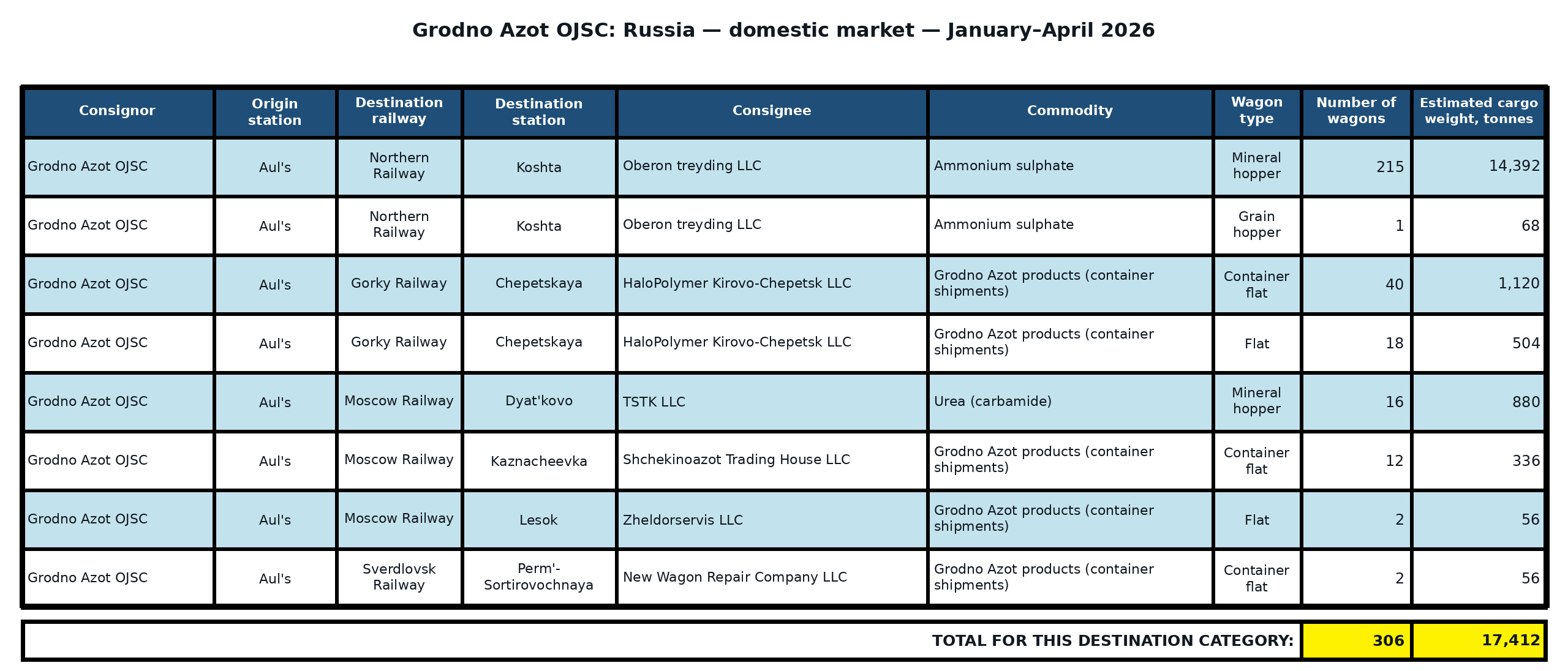
In January, the enterprise shipped 602 railcars with 33,276 tonnes; in February, 261 railcars with 17,748 tonnes; in March, four railcars with 112 tonnes; and in April, 188 railcars with 10,864 tonnes. March shipments were limited to containerized products. This represents the minimum railway supplies in the directions under review, not an indicator of the enterprise's total output.
The average monthly mass decreased to 15.5 thousand tonnes from 47.0 thousand in 2025. The decrease is not explained by March alone: even the January maximum — 33.3 thousand tonnes — is below the previous average monthly level. In April, shipments resumed after the March minimum but remained three times lower than in January.
With a sharp decrease in the container component, urea and ammonium sulfate accounted for 96.7% of the tonnage. The estimated mass per railcar increased from 42.8 to 58.8 tonnes. Therefore, the reduction in the number of railcars was greater than the reduction in mass: 75.9% versus 67.0%.
The range of products shipped became significantly narrower. In 2025, the enterprise sent liquid nitrogen fertilizers and ammonia to the stations under review, operating through several port outlets; in early 2026, the main shipments consisted of urea to Luzhskaya and ammonium sulfate to Koshta. These two destinations accounted for 965 out of 1,055 railcars — 91.5%.
2.4. JSC Gomel Chemical Plant
The Gomel Chemical Plant shipped 2,138 railcars with 146,290 tonnes. The main products were mineral fertilizers, 2,124 railcars with 145,345 tonnes. Another 12 railcars were sulfites, and two were cryolite. Containerized shipments, noticeable in the 2025 structure, were absent in January–April.
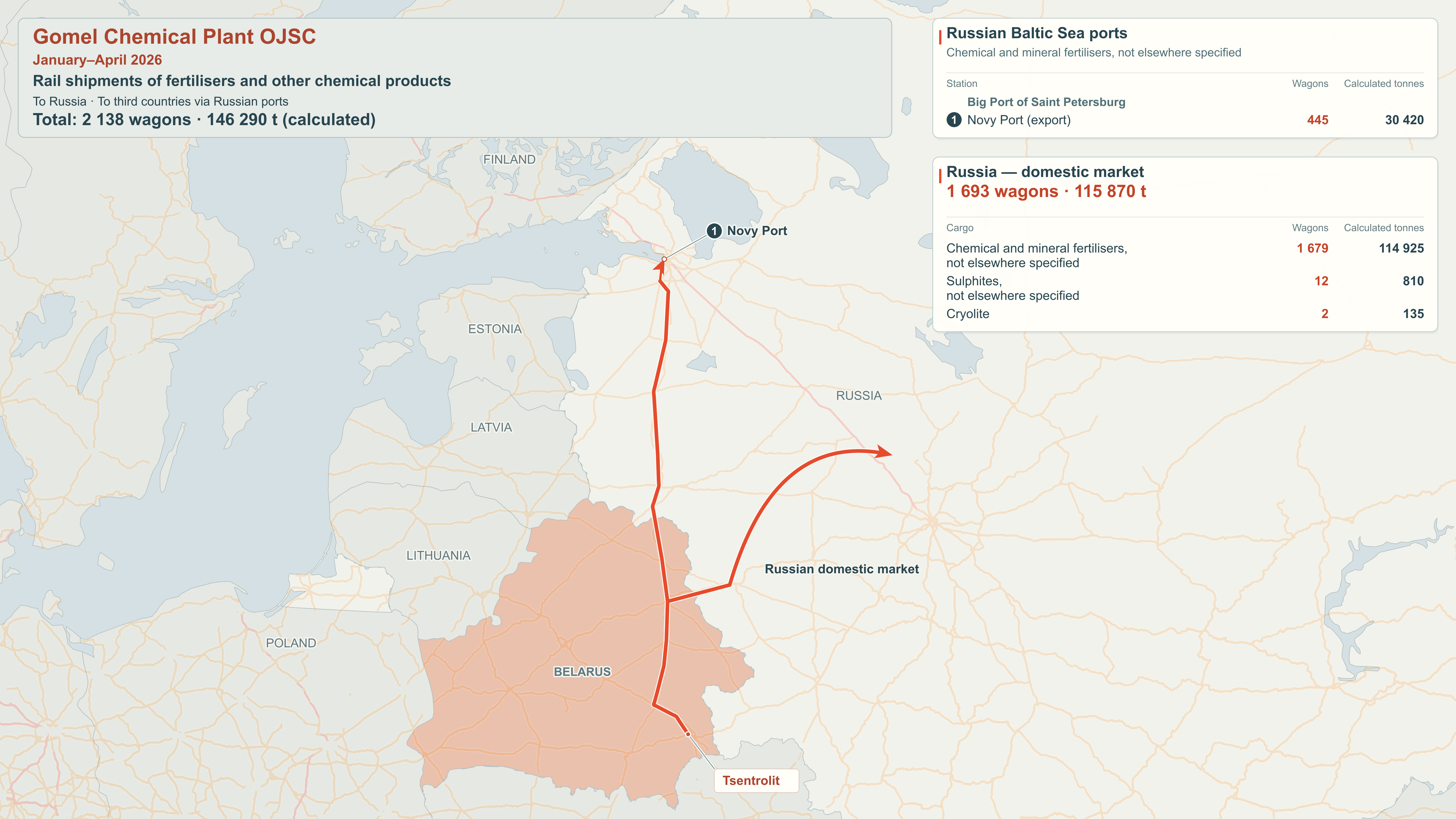
Average monthly shipments increased from 525.3 to 534.5 railcars — by 1.8%. In terms of mass, the increase is more noticeable: from 31.7 to 36.6 thousand tonnes, or by 15.2%. In 2025, almost a fifth of railcars were containerized products; in early 2026, non-containerized mineral fertilizers predominated. The estimated mass per railcar accordingly increased from 60.4 to 68.4 tonnes.
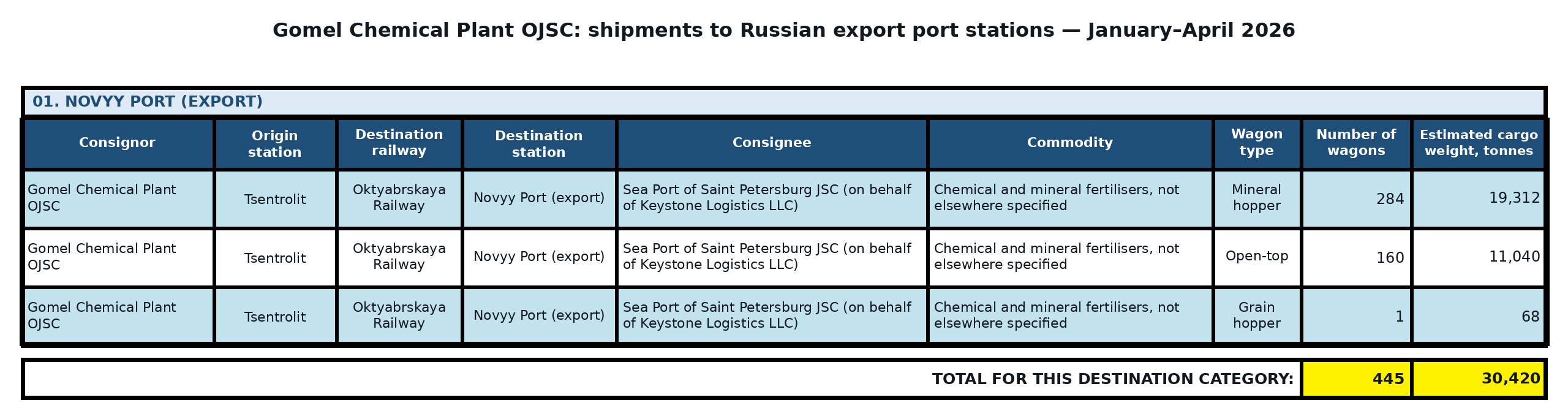
445 railcars with 30,420 tonnes were sent to Novy Port — almost the same mass as to all port stations for the full year 2025. The recipient is Sea Port of St. Petersburg, handling shipments on behalf of Keystone Logistics LLC. Due to this direction, the share of port exports significantly increased.
The share of port destinations rose from 8.1% of mass in 2025 to 20.8% in January–April 2026. Nevertheless, the non-port segment remains primary: 1,693 railcars with 115,870 tonnes. The largest recipients are PhosAgro-Siberia, Bryansk Meat Company, Kochenevsky Agrosnab, Hermesgroup, PhosAgro-Voronezh, and Nazarovoagropromkhimiya.
PhosAgro-Siberia received 166 railcars with 11,332 tonnes, Bryansk Meat Company — 151 railcars with 10,419 tonnes, Kochenevsky Agrosnab — 119 railcars with 8,116 tonnes. These three recipients accounted for 25.8% of the non-port mass. The remaining supplies were distributed among a wide range of addressees: the increase in Novy Port did not eliminate the plant's main regional sales channel.
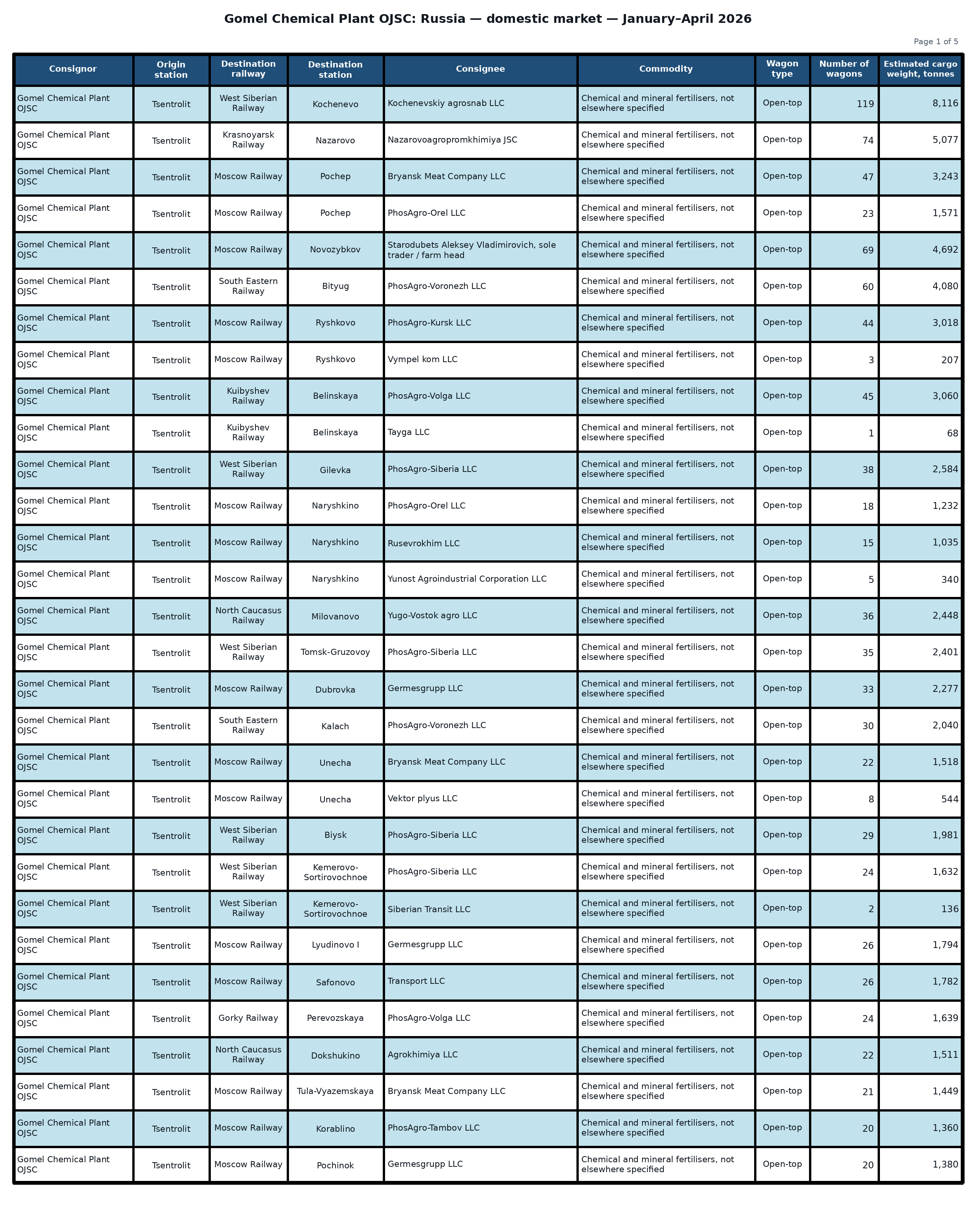
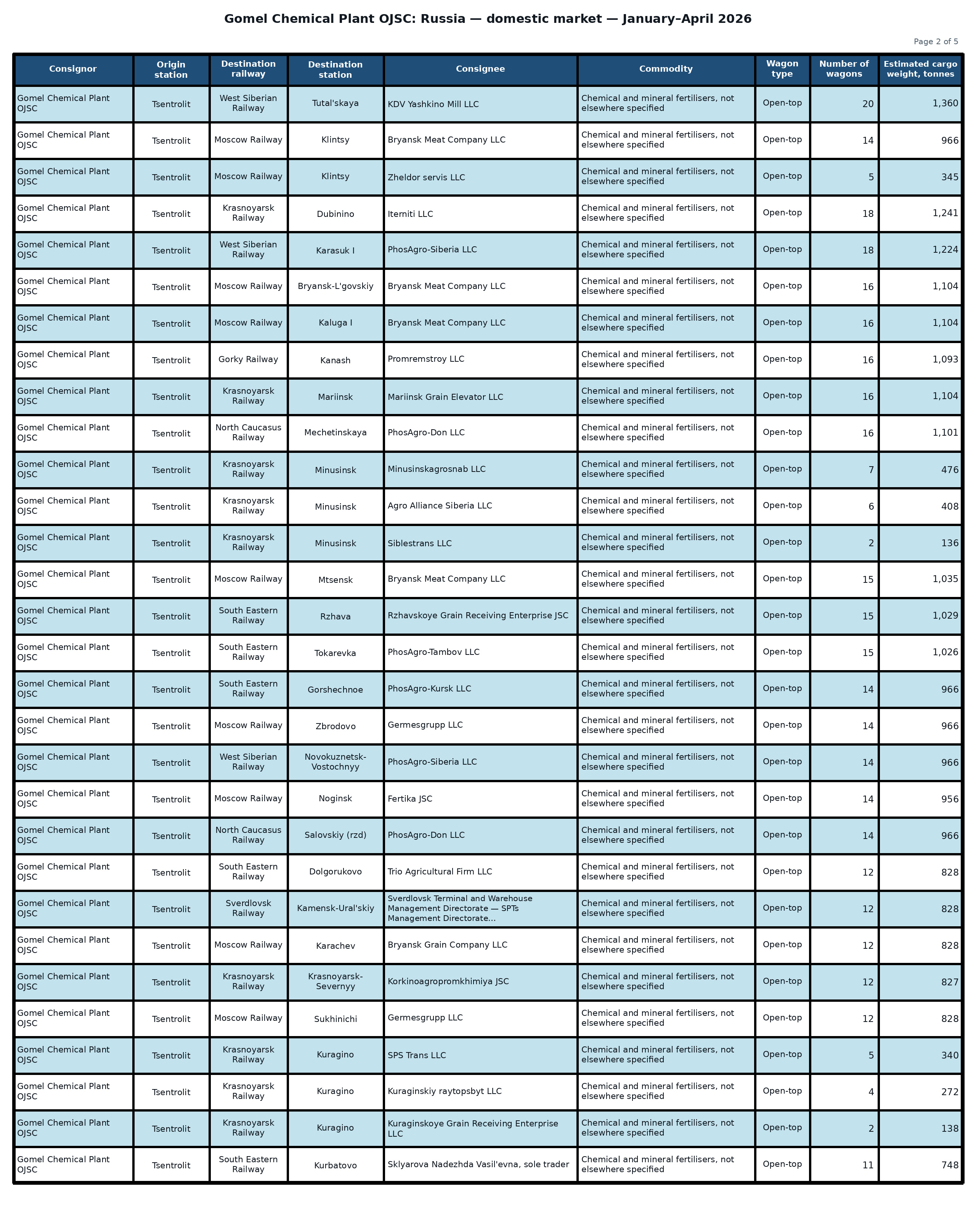
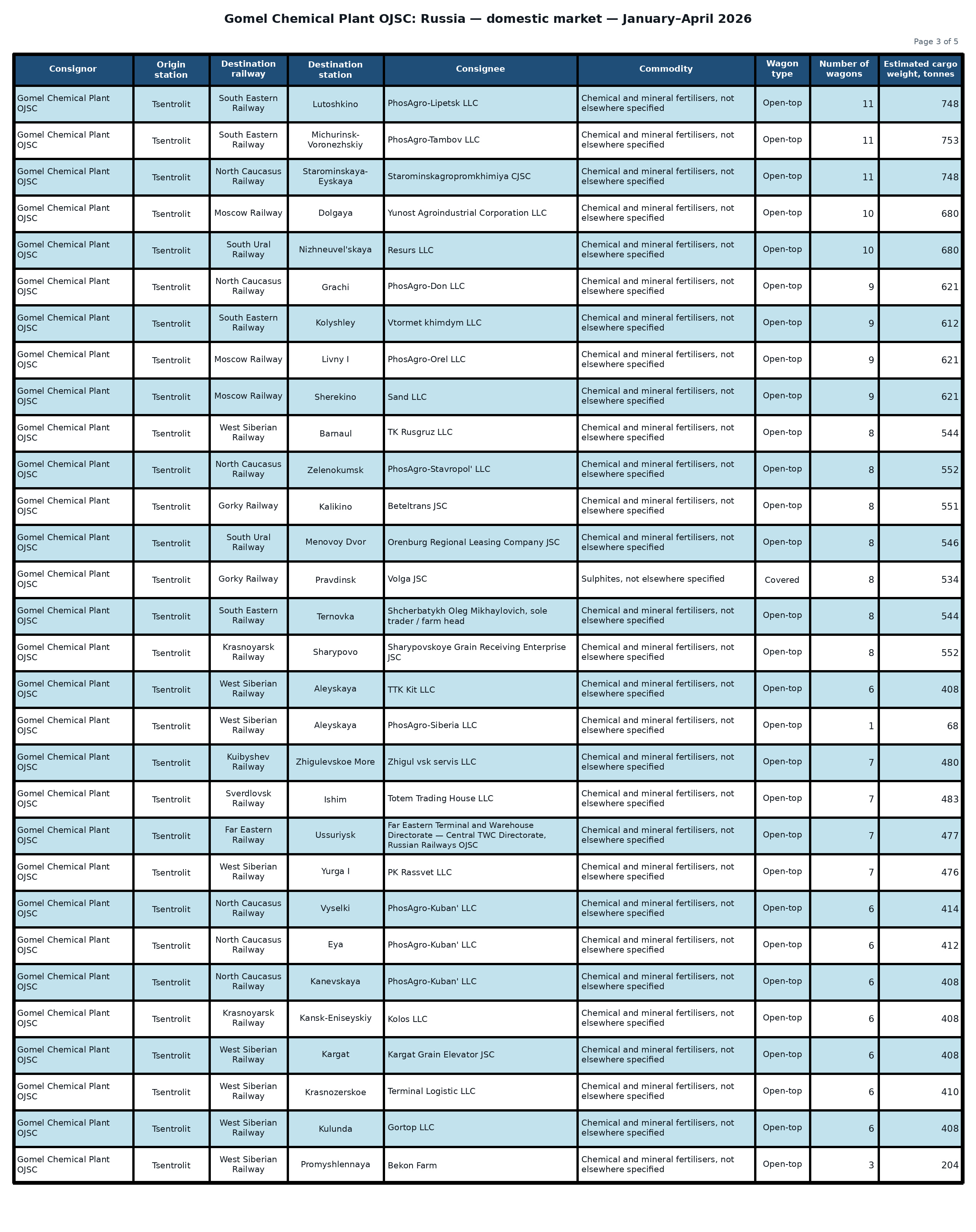
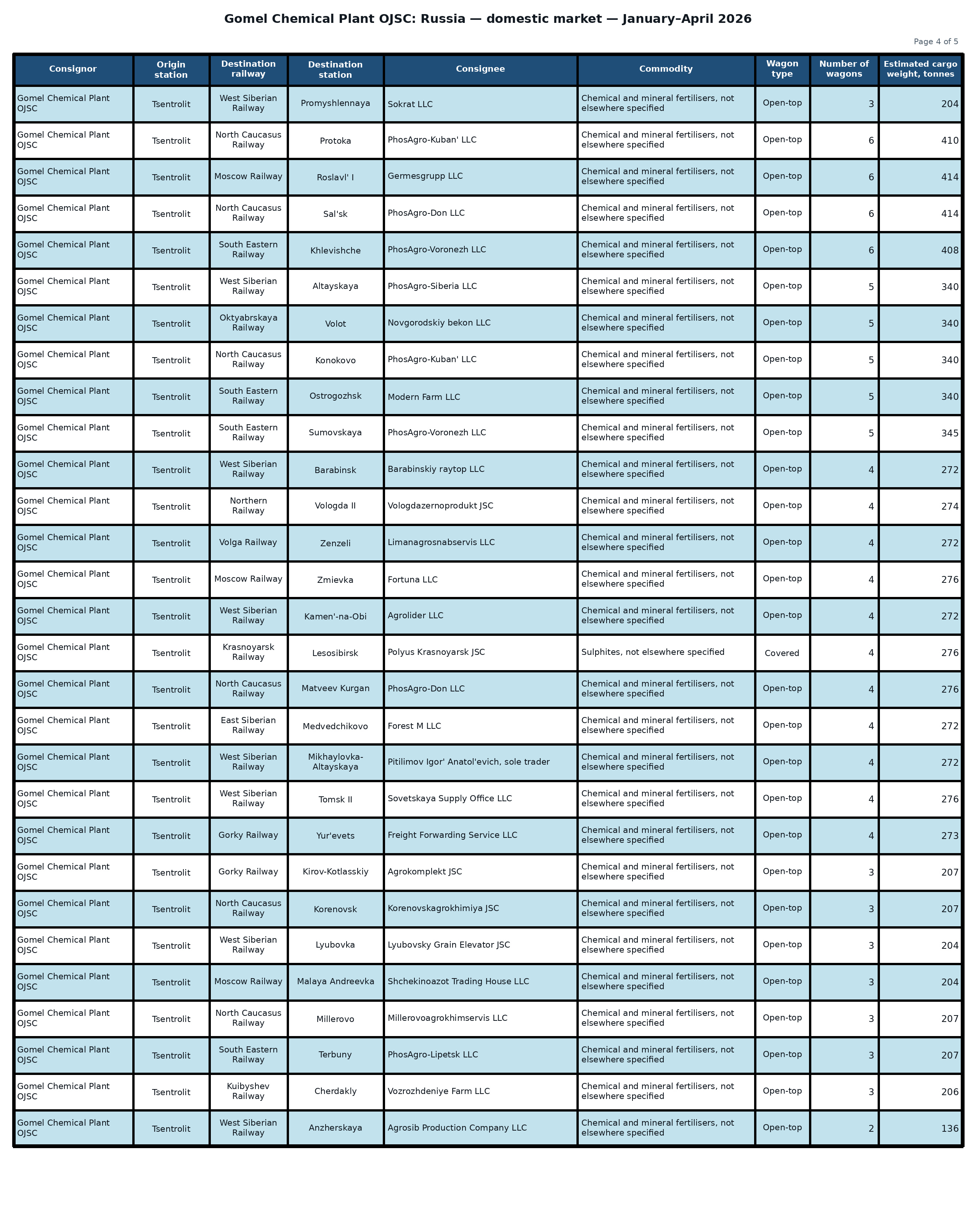
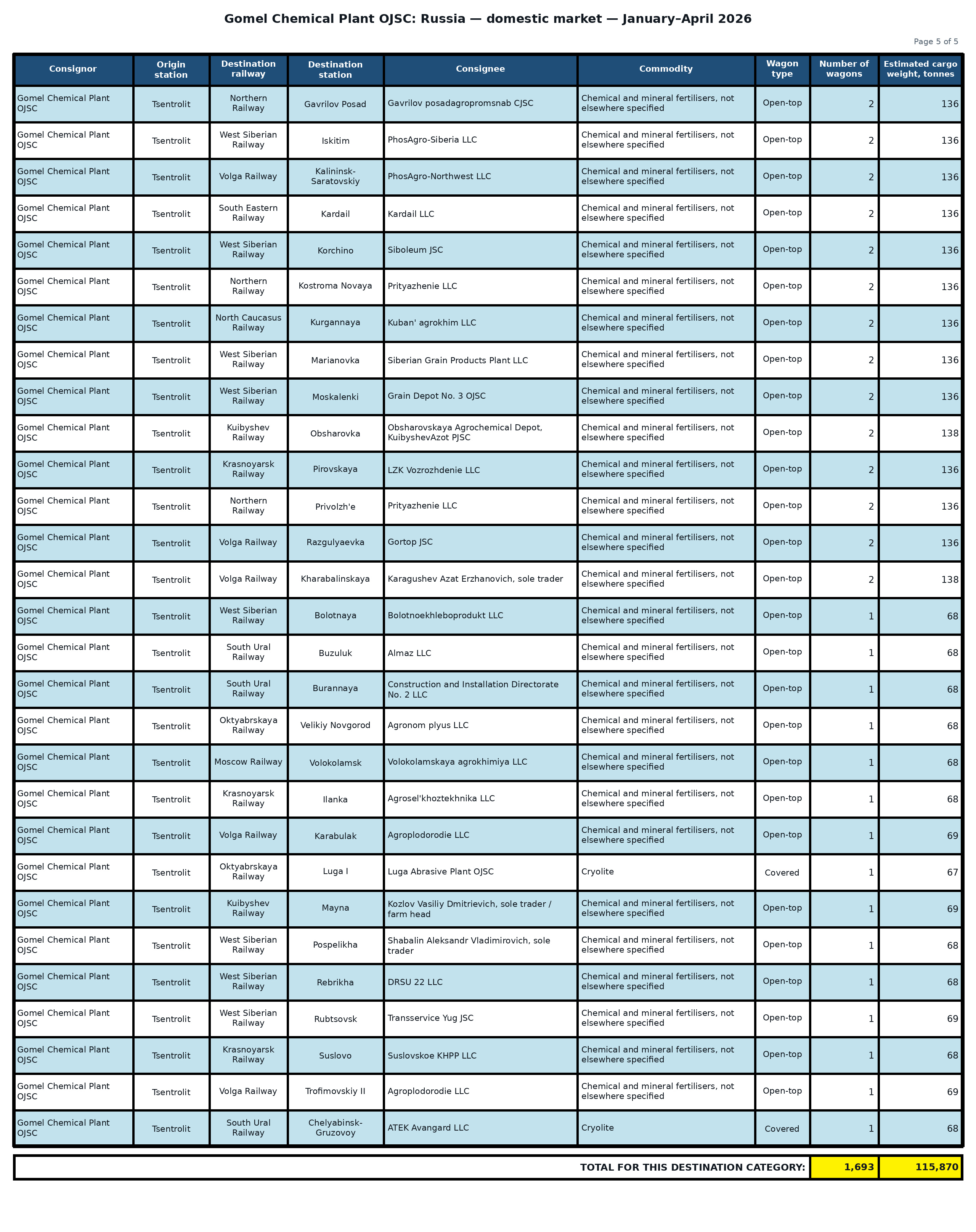
Monthly data shows a low January — 305 railcars with 21,043 tonnes, followed by a significantly higher level: 614 railcars in February, 579 in March, and 640 in April. The mass for the last three months was 42.4; 39.4 and 43.5 thousand tonnes. This is a different pattern than Grodno Azot: after the January minimum, there is no comparable March dip, and April yields the maximum volume.
After January, the plant maintained shipments at a level of 579–640 railcars per month. April proved to be the maximum in both railcars and mass. Simultaneously with the increase in port exports, supplies to agricultural holdings, regional agricultural supply, and industrial companies were maintained.
2.5. Fertilizer Shipments from Other Senders
Direct Supplies to Latvia. Torbelservis LLC
208 railcars with 14,118 tonnes arrived at Latvian stations. Now the main cargo is ammophos: 160 railcars with 10,880 tonnes from Torbelservis, loaded in Vitebsk. Mangali received 88 railcars, Zemitani — 72. The share of ammophos reached 77.1% of the mass, compared to 28.1% in 2025.
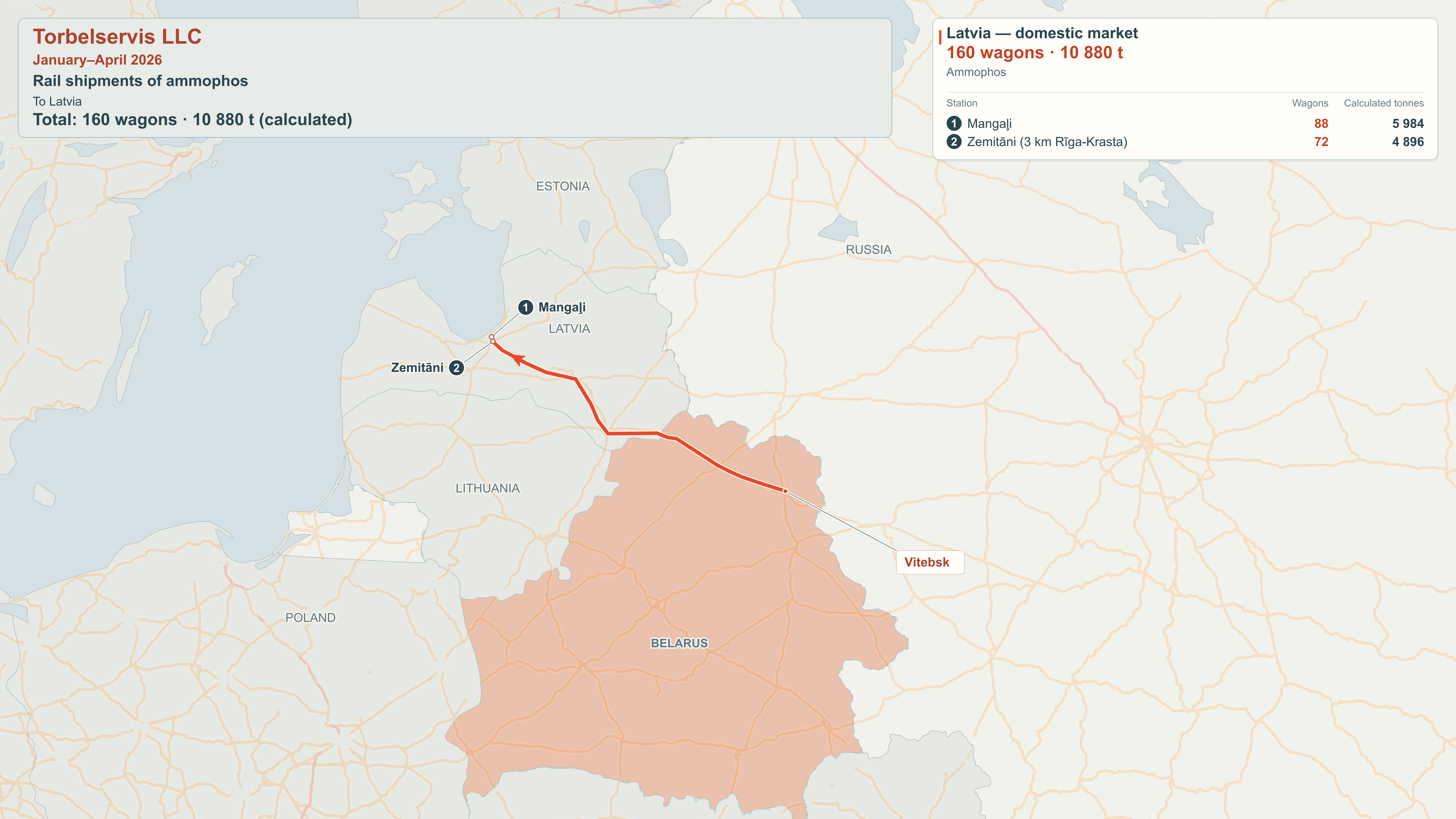
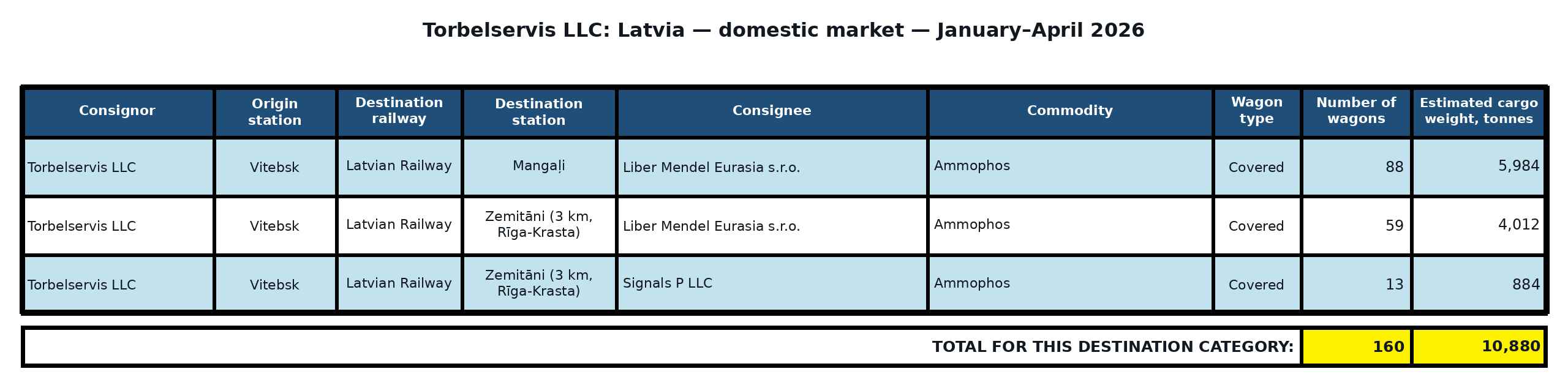
Liber Mendel Eurasia s.r.o. was indicated as the recipient for 147 railcars: 88 to Mangali and 59 to Zemitani. Another 13 railcars were addressed to Signals P. In 2025, Torbelservis had 45 railcars of ammophos for Signals P to Zemitani. Thus, the change is visible not only in quantity: another large recipient and an additional station destination appeared.
Fert Corporation LLC
Fert Corporation LLC shipped 80 railcars of urea with 5,440 tonnes over four months. The majority — 77 railcars — were sent to Russian port stations, with another three railcars going to Latvia.
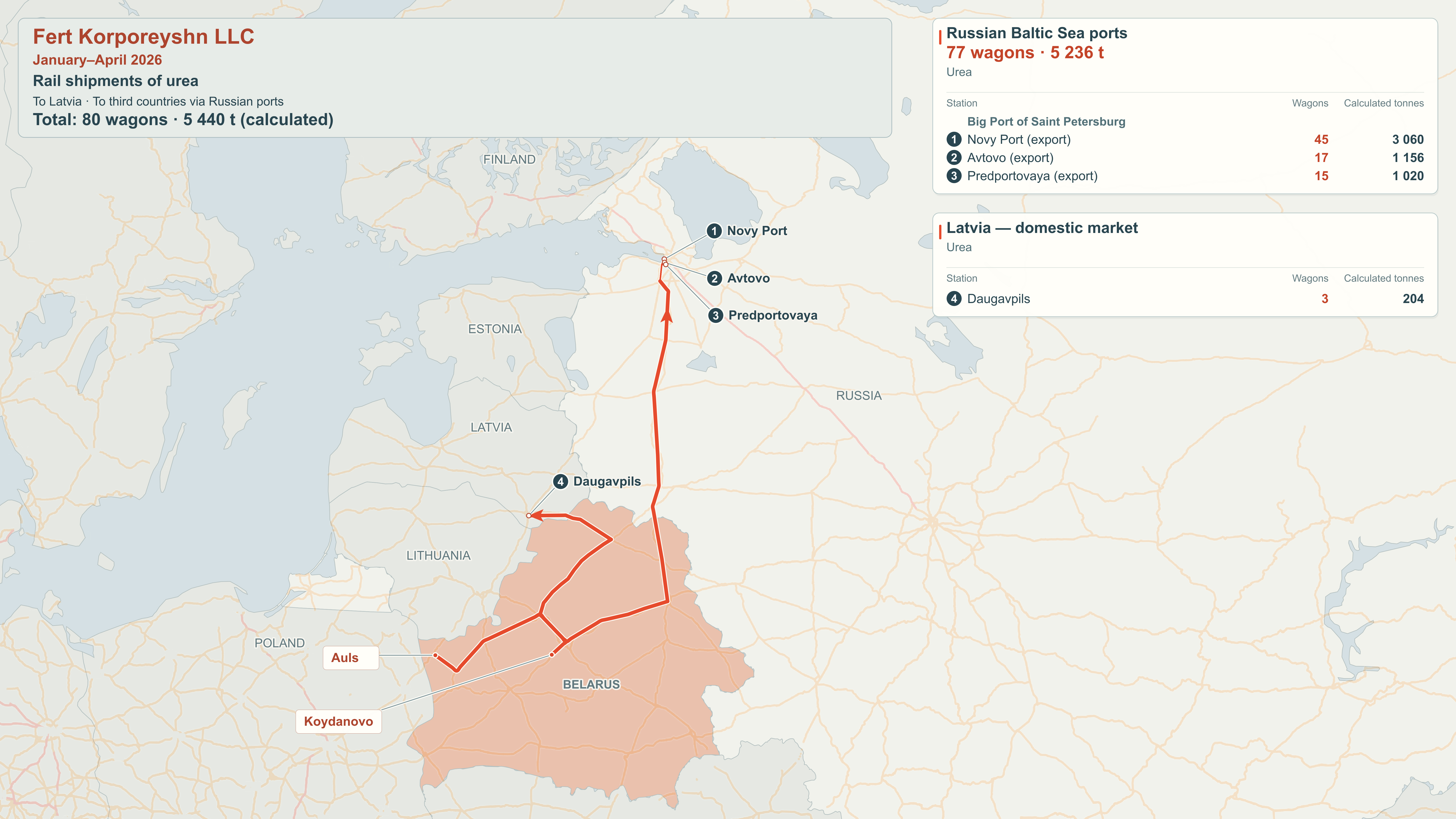
Fert Corporation's Russian port shipments were distributed among three stations: 45 railcars were sent to Novy Port for Latmet, 17 to Avtovo for CFS Terminal, and 15 to Predportovaya for Modul. Compared to the single destination in 2025, the company's list of port connections expanded.
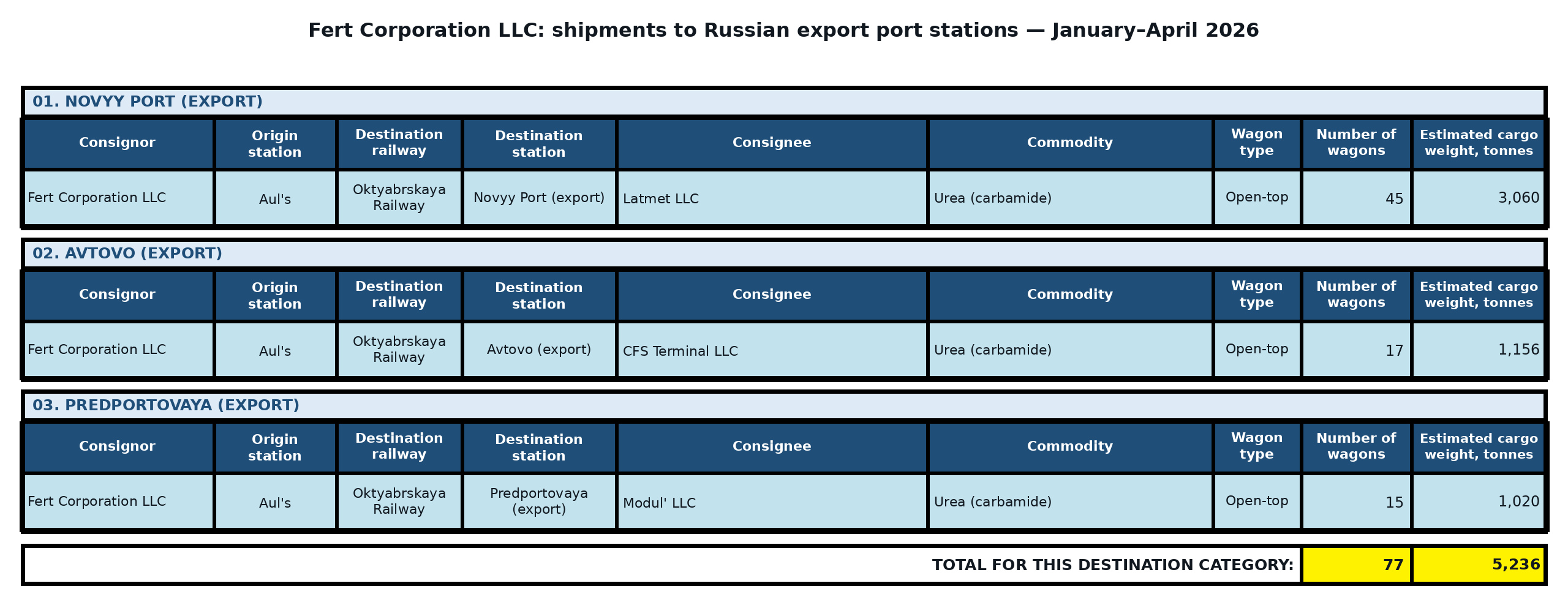
Fert Corporation's Latvian portion is represented by three railcars of urea from Koidanovo to Daugavpils for Apex Serviss. In terms of quantity, it significantly lags behind Russian port supplies but adds another departure station and a separate receiving participant.

Compared to 2025, Fert Corporation expanded not only its volume but also its export network: Novy Port, Predportovaya, and Daugavpils were added to Avtovo. Urea was shipped from Auls to the first three destinations, and to Latvia from Koidanovo. At the same time, the connection with CFS Terminal at Avtovo was maintained.
Zapadtransekspeditsiya LLC
Zapadtransekspeditsiya shipped 46 railcars of urea with 3,128 tonnes: 19 railcars in March and 27 in April. The main volume was sent to Latvia, with a smaller portion to a Russian port station.
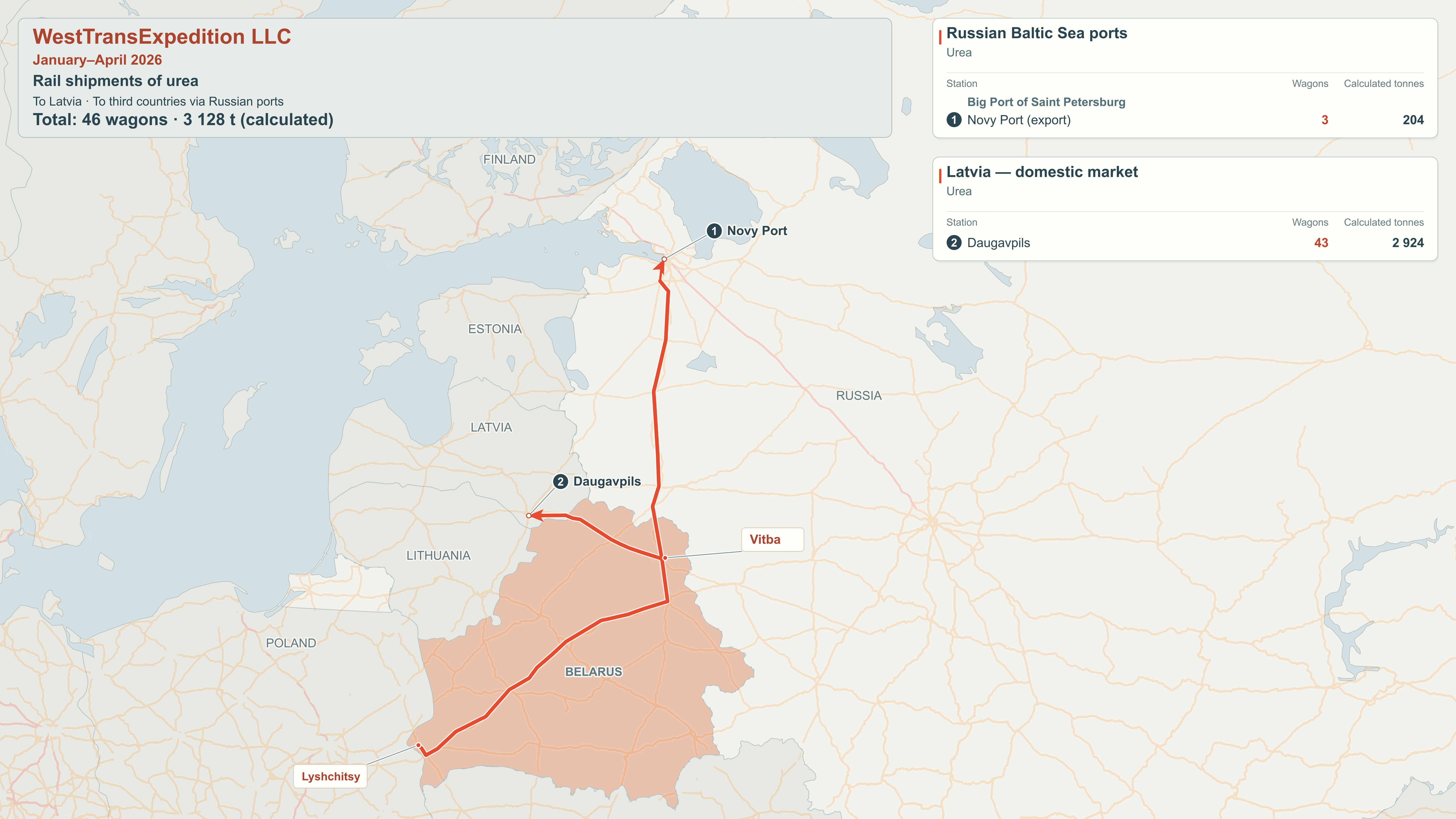
43 railcars from Zapadtransekspeditsiya traveled from Vitba to Daugavpils. The recipient is Apex Serviss, also represented in Fert Corporation's shipments. The product range for both companies in these shipments is the same — urea — but the loading stations are different.

The company sent three railcars of urea with 204 tonnes from Lyshchitsy to Novy Port for Latmet. The recipient is the same as for the 45 railcars from Fert Corporation, which arrived from Auls.

Zapadtransekspeditsiya and Fert Corporation shared two receiving addresses: Apex Serviss in Daugavpils and Latmet in Novy Port. Together, the companies sent 46 railcars of urea to Daugavpils and 48 to Novy Port. Different loading stations provided common delivery channels — Latvian and Russian port.
Sifishgroup LLC
Sifishgroup LLC is represented only in April: two railcars of liquid nitrogen fertilizers, 110 tonnes. The consignment traveled from Bruzgi to Daugavpils, addressed to Apex Serviss.
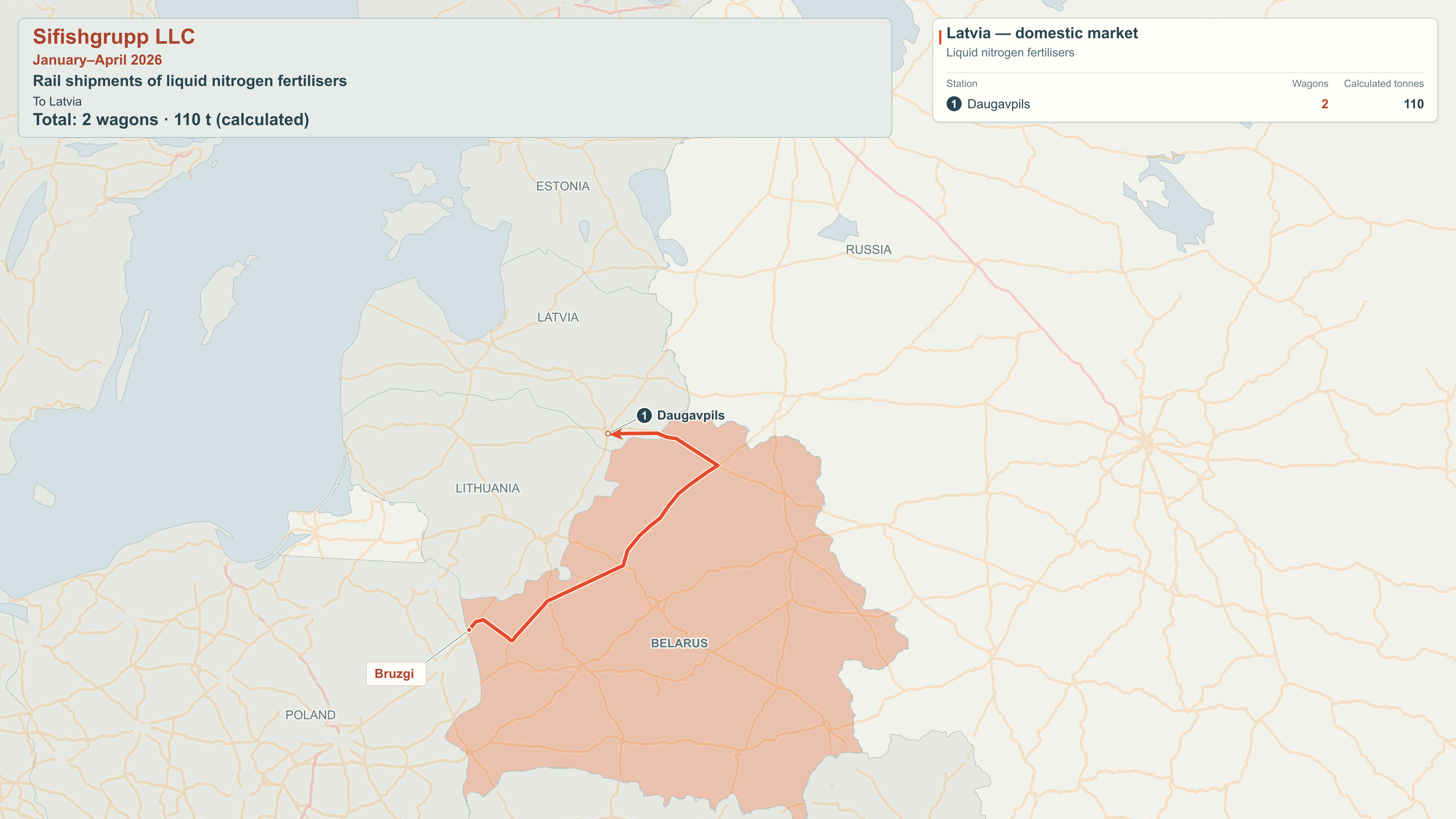
In 2025, Technospetstrading used the same connection — Bruzgi, Daugavpils, Apex Serviss — for 34 railcars of liquid nitrogen fertilizers. In April 2026, another consignor appeared on this route while the product range remained the same. Together with urea from Zapadtransekspeditsiya and Fert Corporation, Sifishgroup's supplies formed the entire Daugavpils flow for January–April — 48 railcars.

Company BKM LLC
Company BKM maintained its specialization in potassium nitrate: 86 railcars with 5,784 tonnes. 32 railcars were shipped in January, 28 in February, and 26 in March. There were no shipments in April.
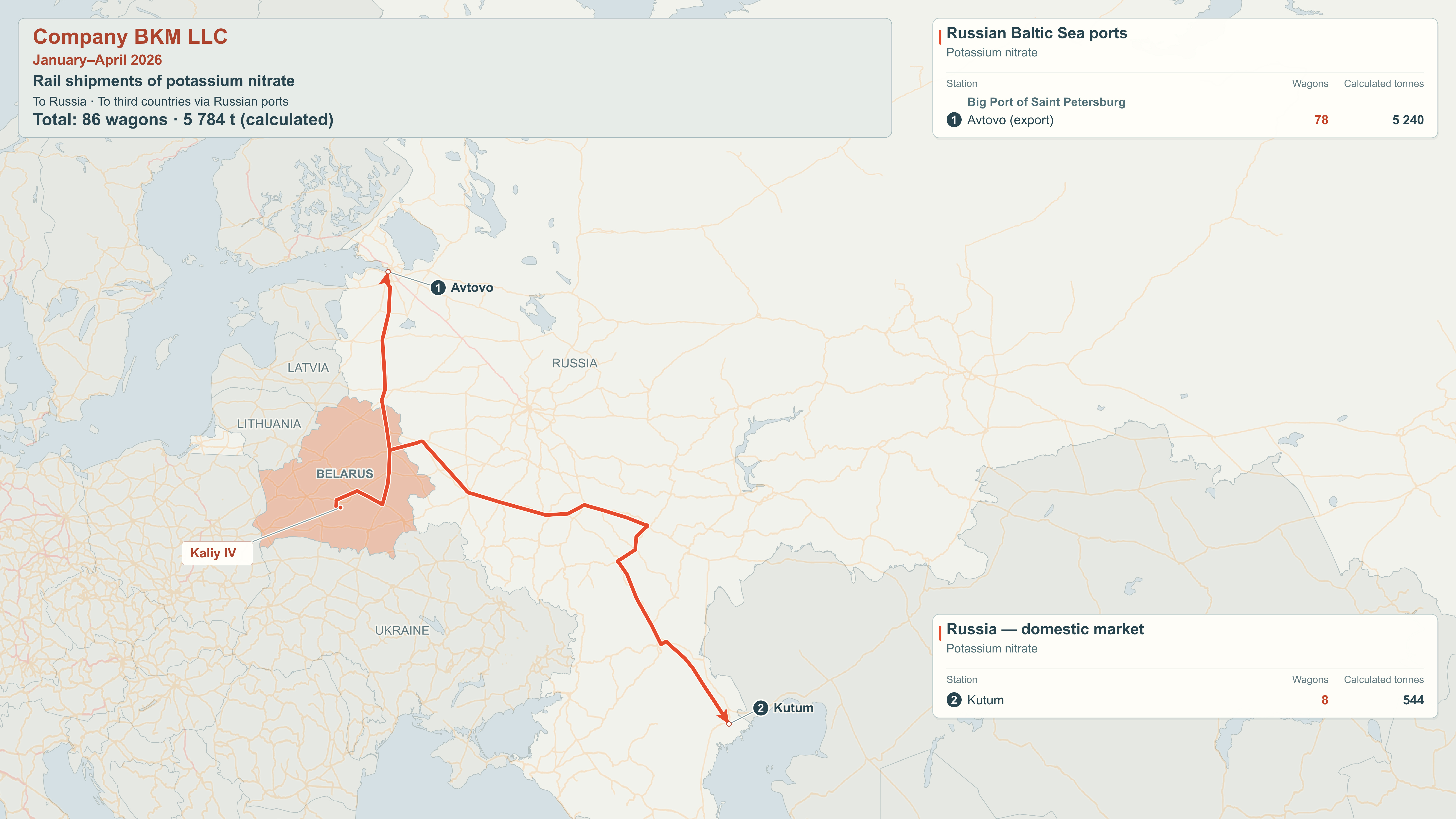
78 railcars of potassium nitrate with 5,240 tonnes arrived at Avtovo for Neva Metall. This recipient also received the main part of BKM's port flow in 2025. Now its share has reached 90.7% of railcars and 90.6% of the company's total mass.

Eight railcars of potassium nitrate with 544 tonnes arrived at Kutum for Astrakhanplodoovoshch. Thus, BKM retained two destinations: a large port destination — Avtovo — and a significantly smaller targeted supply to Kutum.

The Latvian direction changed more significantly than its overall volume. The average monthly mass decreased by 7.2%, but the share of urea fell from 63.7% to 22.2%, while ammophos took first place. Instead of large urea consignments to Riga-Krasta and Liepaja, the main flow was formed by ammophos supplies to Mangali and Zemitani. In Daugavpils, the nitrogen profile was maintained, with a change in the composition of senders.
2.6. Results for January–April 2026
In the first four months of 2026, 73,524 railcars with 3,877,132 estimated tonnes were shipped. The average month accounted for 969.3 thousand tonnes, compared to 926.6 thousand tonnes in 2025. The share of Russian port destinations increased to 85.7%, and Belaruskali's share in the total mass increased to 94.0%.
The overall result is composed of multidirectional changes. Belaruskali saw an increase in average monthly mass and a redistribution of port destinations. Grodno Azot experienced a reduction in volume, product range, and container component. The Gomel Chemical Plant maintained a wide network of Russian recipients and increased the role of Novy Port. In the Latvian segment, ammophos took first place, while the urea flow decreased.
Changes in Trade Conditions
Changes in transportation occurred against a backdrop of a heterogeneous trade regime: restrictions on producers and individual intermediaries were in effect alongside commodity bans and import duties. The sequence of decisions differed for the potash and nitrogen segments.
On June 12, 2025, the EU Council approved additional duties on Russian and Belarusian agricultural goods and certain nitrogen fertilizers. The regime began to apply on July 1, with a phased increase in rates for fertilizers. This changed the import conditions for relevant goods regardless of targeted restrictions on individual companies.
The American regime for potash companies was eased in two stages. On December 15, 2025, OFAC issued General License No. 13. Then, on March 26, 2026, the agency removed Belaruskali, Belarusian Potash Company, and Agrorozkvit from the SDN list. The General License was moved to the archive.
European restrictions remained separate: on February 26, 2026, the EU Council extended sanctions against Belarus until February 28, 2027. The change in the American regime did not mean the lifting of EU restrictions.
In terms of timing, transport changes began earlier than OFAC's March decision. Already in January, Luzhskaya surpassed Bronka in mass, and the Murmansk flow appeared in February. Consequently, the beginning of the redistribution cannot be explained solely by the lifting of American restrictions: it also coincided with changes in port operations during winter.
What changed after April 2026
On October 4, 2026, the Financial Times reported on a consignment of 30 thousand tonnes of granular potassium chloride, loaded by Belarusian Potash Company at Bronka on September 15 for shipment to the USA. According to Kpler data cited by the publication, unloading in New Orleans was expected on October 14. As of October 6, this refers to a dispatched consignment and expected arrival, not a completed delivery.
The report characterizes a change in the sea direction while maintaining the Russian port outlet. Loading for the American buyer uses the same Bronka, which already in 2025 received almost 4 million tonnes of potash by rail. The change in the sales market in this case did not require a return to the previous Baltic route through Lithuania: the rail-port leg was maintained.
Conclusions
In 2025, the main volume of the reviewed shipments was provided by potash exports to Russian ports. Bronka and Luzhskaya received almost four-fifths of Belaruskali's port mass. Predportovaya and Avtovo supplemented them with different handling technologies — from transshipment with subsequent delivery to the sea terminal to a combination of containerized and non-containerized flow.
In January–April 2026, average monthly shipments increased, but the concentration on Belaruskali intensified. Luzhskaya surpassed Bronka in mass with a smaller number of railcars. Murmansk received a separate February-March flow and did not replace the St. Petersburg destinations. In overland delivery to China, it is necessary to distinguish between the main Kazakh corridor and the eastern branches: for the reviewed shipments via Zabaikalsk and Grodekovo, intensity increased and concentration on Zabaikalsk strengthened in early 2026.
Grodno Azot experienced reductions in shipment volume, product range, and the number of port outlets. Containerized shipments almost disappeared, with urea to Luzhskaya and ammonium sulfate to Koshta forming the main flow. The Gomel Chemical Plant, conversely, increased port exports through Novy Port, while maintaining a large network of regional recipients in Russia.
In the Latvian direction in 2025, urea from several trading and forwarding companies predominated. In early 2026, ammophos became the main cargo, and nitrogen supplies concentrated on Daugavpils. Senders changed faster than some receiving connections. Published investigations established documentary links between individual participants and Grodno Azot products; shipments show through which stations and recipients the relevant directions passed.
The total volume of the reviewed directions amounted to 214,869 railcars with 11,118,642 estimated tonnes for 2025 and 73,524 railcars with 3,877,132 tonnes for January–April 2026. The stability of total shipments was ensured by the potash segment. In nitrogen products and complex fertilizers, more profound changes occurred — from a reduction in individual plant flows to a redistribution of ports, delivery stations, and the circle of recipients.